Vicky Lovejoy | Productive Parking Lot Chatter, Fun Searches, and Inclusivity in Scent Work
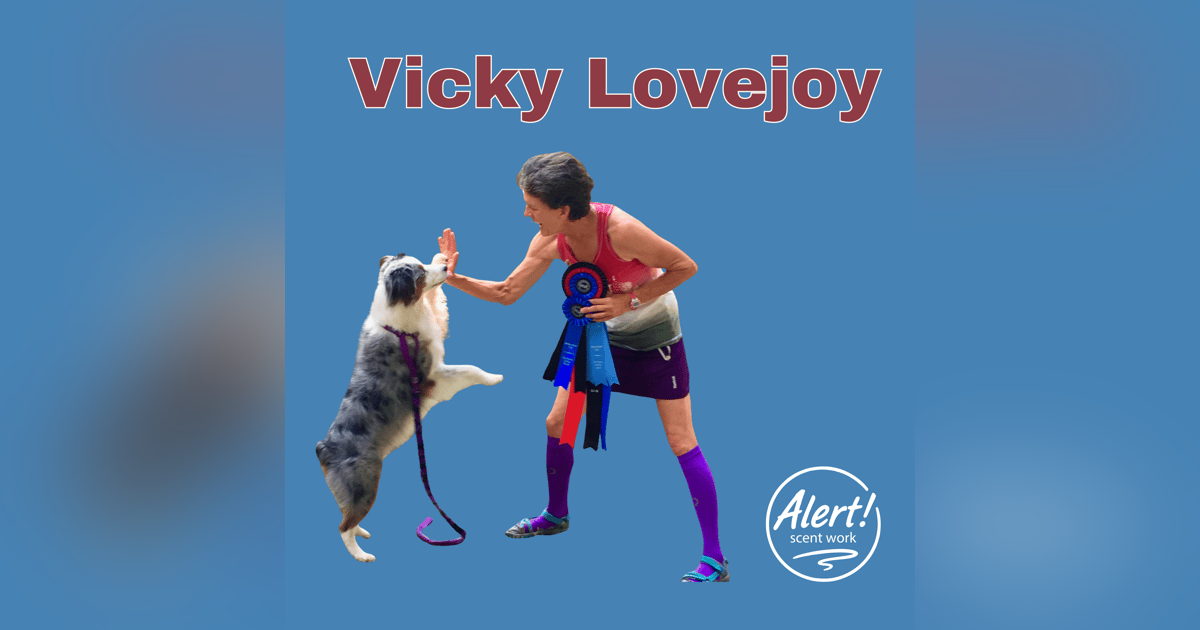


Vicky Lovejoy was there at the very beginning — before formal trials existed, before organizations formed, when a group of enthusiasts in the Los Angeles area were just figuring out what this sport could be alongside founders Ron Gaunt, Amy Herot, and Jill Marie O'Brien.
She has been competing and judging across AKC, NACSW, UKC, NASDA, and more ever since. In this episode, Vicky brings a perspective on scent work that very few people can offer — she has seen it from just about every angle, as a competitor, a judge, a trainer, and someone who was there when the sport was invented. Her dogs, by the way, all have an aviation theme. Beryl Markham, the pilot. Amelia Earhart's Lockheed Vega. Bessie the Fire Horse. Gaston — said with a French accent. And Phoenix, the outlier.
What we talk about:
- Vicky's origin story — from a shepherd with elbow dysplasia to being one of the first people to compete in what would become organized scent work
- What hooked her — and why she describes the sport as the dog teaching us rather than the other way around
- How breed and individual tendencies shape how dogs search — including why her shepherds would catalog hides and check the perimeter before committing, and why herding dogs often go to the back of the search area first
- How judging has influenced how she competes — and a story about forcing a false alert at the end of a long trial day that she still thinks about
- What makes a search fun — not just technically challenging, but genuinely enjoyable for dog and handler together
- How she thinks about setting hides and what she hopes competitors take away from her searches
- The parking lot conversation after a low Q rate — and how to turn post-search analysis into something productive instead of just venting
- Cherish the engagement — what she means by that and why the bond you build through scent work is unlike anything else
- Seven questions with Vicky — her dog's favorite rewards, including touch games and a boing, her signature distractor, advice for her beginner self, and what she wishes more competitors understood about judges
Find Vicky:
Scent Work University: https://www.scentworku.com/collections/meet-vicky-lovejoy
AKC Judges Directory — search Victoria Lovejoy to bring her to your trial Based in Eastern Washington — travels nationally
Alert! Scent Work is a podcast for competitors — the parking lot conversations you'd never get to have at a trial, with the judges and community members you wish you had more time with.
Listen to the podcast and find everything here:
https://www.AlertScentWork.com
Follow along: Facebook: https://www.facebook.com/AlertScentWork
Subscribe to the newsletter: https://www.alertscentwork.com/newsletter/
When you agreed to be on the podcast, I had no idea how much history you had in the sport. After I did a little research on you, I was like, I'm surprised she even said yes. You've been doing this for a long time. You've got chops. What do you have to say to that?
Vicki:I'm not one to ever blow my own horn, but I've been lucky to be in it from the beginning. I've had some great dogs. I've gone to invitationals. I've done Summit so many times and had Summit titles.
Scot:It's so funny how little we sometimes know about the people who are judging us. The amount of scent work stuff you do is almost overwhelming — between the judging and competing, there are letters flying around: AKC, NACSW, UKC, NASDA, ASCA. How do you even keep up?
Vicki:I don't, usually. A lot of people write all their dogs' title abbreviations, and I don't. I try to remember the last one so I know the next level, but I don't have a list of all my dogs' titles after their names. I don't even know half the abbreviations.
Scot:All right. Well, I should say this is Alert Scent Work. I'm Scot, Murphy and Keeva's dad. And today it's Vicki Lovejoy, mom to many dogs. I was overwhelmed by the number of dogs you have — so introduce us to who you are the mom of right now.
Vicki:Currently I do have six. I remember an old Paula Poundstone podcast where she was talking about how she ended up with 14 cats. She said, well, I had 13, and then I got one more. Then I had five and I got one more.
Scot:Right. What are their names? Help me put a name to this crew of yours.
Vicki:I've got Beryl — Beryl Markham. I named her after Beryl Markham, the aviator pilot. Cool story. I thought a flying creature was a good representative of Beryl because I do a lot of agility too.
Vicki:And then I have JJ — Jumping Jack Flash is his registered name. They are the foundation sire and dam of my breeding. I do some Coolie breeding, so they were the start of it.
Vicki:And so I have their daughter Vega — Lockheed Vega, after Amelia Earhart's Lockheed Vega, because they're all flight things.
Scot:We're learning a little something about you here. I think you're fascinated by the history of flight.
Vicki:Exactly. And then I imported a male from Australia last year. His name is Gaston — you have to say it with a French accent. I call him Gas.
Vicki:Vega had a litter last year, and I still have one of her babies who's pretty fabulous. And here's another little bit of trivia — Bessie the Fire Horse, because Amelia Earhart named one of her Lockheed Vegas "old Bessie, the fire horse."
Scot:Got it. Your pilot, your planes — you have a tight theme going on. I appreciate that.
Vicki:And then I have the outlier, which is the Vizsla, and that's Phoenix.
Scot:How did this journey — or some might say obsession — start for you? At one point you were just living life, Vicki. You didn't have six scent work dogs. You weren't judging scent work. How did it all start? Where did the obsession begin?
Vicki:I was lucky enough to be in the classes at the ground floor — sort of the beginning of scent work. Fun nose work is what they called it when Jill Marie and Amy and Ron first came up with this idea. Jill Marie was the training director at the Long Beach Humane Society, where I took some agility classes. I had a shepherd that ended up having some elbow dysplasia, so I couldn't do agility with her anymore. They had just started offering these fun nose work classes — no competitions or anything. But a bunch of us wanted a little bit more. So we started to have some fun events based on detection trials. And then pretty soon we wanted real trials. The school where I was teaching was able to be used several times to host trials, and other area schools in the Los Angeles area were sort of our first dipping a toe into the waters of competition. We had a few trials before they formed NACSW. And I used to say it's an addiction — you get started and you can't stop.
Scot:No, I think we all can relate to that. So you weren't able to do agility, that's why you signed up for scent work. But what hooked you? What made it the addiction for you?
Vicki:For me, it's the fascination of how the dog is teaching us. They're the ones doing the work and figuring out the problem, and we have to be smart enough to figure out what they're telling us. People used to think of it as the lazy option — oh, when I'm old and tired, I'll just do nose work. It's like, well, it's a lot of work, because we are so focused on learning from our dogs and listening rather than telling them what to do. I've always been an animal lover, and I have a great respect for the ability of animals to try to communicate with us and incorporate us into their world rather than the other way around.
Scot:A lot of people end up in scent work because they were in agility. That was their number one for a while, and then something happens. I hear this story a lot — people are just amazed by how the dog does what the dog does. Instead of telling the dog to jump over this or go through this tunnel, you're letting the dog lead the search. That's really appealing.
Vicki:There are so many dogs of different breeds and backgrounds and people. As a judge, I can remember a few years ago an older woman who had an assistant, trialing a dog. She was probably in her 90s, in a walker. She was slow, but she was still out there doing it and having fun. It was what brought her joy. I thought, yeah, anybody who wants to learn about it can do it.
Scot:One of the things I love is how many different dogs there are. I love it when a dog you wouldn't expect to be there just goes out and has a great time. I'm really glad you brought up how anybody can play the game, because I too have seen people in wheelchairs. One time I was at a trial where a woman who was blind had her assistant sketch out on her back what the search area looked like. Then she would go in and search with her dog. When her dog alerted, she could tell through the leash, and she'd walk down the leash and touch the dog. It was just so inspiring to watch that.
Scot:You've run all sorts of dogs. A lot of times you'll run into people who just run one type of dog, and I wanted to dig into that. You've run Aussies, Coolies, Vizslas. That's a wide spectrum. I've heard people say your breed kind of dictates your approach, and I thought that was silly until I got around people who knew what that meant. How do you adjust your scent work based on the breed?
Vicki:I had German Shepherds for a long time. They've been bred to be guard dogs or herding dogs — either way, very aware of their environment and checking everything out. A Shepherd will go into a search area and may catalog all the hides and just move on, then check the perimeter, and then maybe get back to work. I had a Shepherd who would do just that. I got to the point where I would notice where she went first, because 90% of the time that was where a hide was. But she wouldn't stop at it — she had to check out the room first, and then maybe come back and work it later. I think where we get in trouble is when we try to interrupt things that have been so genetically instilled. You can leverage them, but if we try to override them, we can sometimes get in trouble. Some of my other herding dogs typically blow the threshold and go to the back, and work from the back forward.
Scot:Is that because that's how they would herd sheep? They would go behind the back of the flock?
Vicki:Absolutely, absolutely.
Scot:That's great. So if you have one of those breeds, you just have to accept — we're going to the back of the room first.
Vicki:Yeah, absolutely. I remember at an Elite trial recently — it was a long, narrow hallway with rooms off it, all in play. I thought, I'm going to take control. I usually let my Coolie run off leash, but I said no, I'm going to take control, it'll be more efficient. I really wish I had just let her run off leash, because by taking control I kept interrupting her desire to chase the odor the way she wants to chase it.
Scot:That's a really valuable lesson. I want to talk about how being a competitor and a judge has crossed in your life. How has judging influenced how you compete?
Vicki:I learned a lot from judging — both things I like that handlers do, and things I notice that don't work as well. Handlers not going into that corner, or the different ways we talk dogs into hides because they're confused. I try to remember those things when I compete, and I still make mistakes. So.
Scot:How many rounds have you watched? But I bet you still talk your dog into things.
Vicki:Absolutely. My favorite was a couple years ago — and I'm positive I'll do it again sometime. It was an end of the day container search, three elements. I went in and I was like, how come she's not searching the boxes? In the back of my mind I'm thinking, they wouldn't put a blank search at the end of the day. So yes, I finally forced her to alert on something and it was a no. I just thought, oh my God, I'm such an idiot.
Vicki:I go back to how I felt in my early days. I mean, I'm a little more resilient now when it doesn't go well. But early on I used to come back and tell Ron or Amy, I'm sorry I messed that up, and I would just feel like the bottom of the barrel. As a judge now, I try to support people when things don't work out and still make it positive.
Scot:So if I came in as a novice and I just completely blew it, what would you say to me? And I want the tone you would use.
Vicki:Perhaps you should think of a different sport. No, I'm kidding.
Scot:What a strange coincidence — I've heard that so often. Maybe nose work isn't for you guys. I know you're kinder than that.
Scot:That's good that you can bring that compassion. Is there a time where that compassion made a difference, or something a judge said made a difference — especially in those early days when you were a little hard on yourself?
Vicki:I was so lucky to trial under Ron and work with Ron. He was so — you knew in NW3s when you found all the hides because of the way he would say yes when you called finish. Just his enthusiasm and excitement for all people to succeed.
Scot:Is that something you try to do? Try to celebrate each victory?
Vicki:I do, yeah.
Scot:It makes a difference as a competitor when the judge is engaged versus when they're just saying, yep, correct. When they're excited, you don't have to go over the top, but just being genuinely enthused. So if I ever got a detective Q under you, would hugging be allowed?
Vicki:Well, someone I know? No, I'm not.
Scot:No fair. Do you kind of share those experiences?
Vicki:Yeah, absolutely.
Scot:Cool. When you're judging, what are you trying to accomplish when you set challenges for competitors? What kind of an environment do you try to set up for them? What are you trying to accomplish when they walk into your search area?
Vicki:I want fair hides. That doesn't mean easy, but I want them to be fair. When I'm looking at an area, I want to find locations that are going to offer interesting hide placements as well as an interesting search environment — because those may not always be the same thing. When I'm setting hides for novice, it has to be sourceable in any venue. I want it to be somewhere the dog could get to it from multiple sides or directions. In novice, the question should be: can your dog go into a new environment and find a hide? It shouldn't be a complicated calculus problem.
Scot:Right. That comes later.
Vicki:Exactly. And in detective, they don't have to be individually challenging hides, because in detective it's the unknown — it's covering the ground, multiple types of areas. You don't have to put a hide on the ceiling or deep in a ditch. You can have relatively straightforward hides that would be doable by an intermediate team if it were a single-hide search. But the complexity comes from either having several that are somewhat proximal to each other, or from the navigation through the environment. There are so many factors — understanding odor movement, then adding in the human component, not just the dog component.
Scot:So beyond the technical stuff, what kind of experience do you hope they have? When somebody's done with one of your searches, what would you want them to say?
Vicki:I want them to come out and say, hey, that was a fun search. At detective, I sometimes miss one. If I'm not going to get a Q, it's usually because I've left one behind somewhere. I don't call false alerts — well, recently I have not called any false alerts. But I want to come out and go, hey, that was a fun search. Too bad I missed that one. I kind of understand why — I can go back and think about it.
Scot:I'm going to jump in on that word — fun. What is a fun search? That could mean a lot of things to a lot of different people.
Vicki:Was my dog engaged and having a good time? You can tell if your dog's having a good time — are they in there, are they actively hunting, were they confident? Did I feel like I used whatever experience I had to cover the area to the best of my ability? Were the hides I found interesting? Not necessarily super challenging — that's not a problem — but just, was it sometimes maybe three chair hides that, because of how they were configured, were super fun and interesting to work? Or maybe there's a hide in the molding that makes you go, wow, really? For me, fun is a combination of how much I enjoyed watching my dog work and how much engagement they had.
Scot:I love what you just said about enjoying watching your dog work. That makes me think about how I define fun. Based on what you said, it's that communication factor — a fun search is when you can actually figure out what your dog is trying to communicate in a difficult situation. Or can you use what you know about how odor moves, and ask yourself what this odor picture looks like through your dog's nose? And how can you be a good teammate and step in when time is a factor?
Vicki:Yeah.
Scot:All right Vicki, I'm curious — this can be hard for judges to do, but I'm going to ask you to tell me about a time as a judge that a search kind of went sideways on you. Whether it was weather, wildlife, distractions. I find these little stories fascinating about the art of judging. Judges think long and hard about making searches fun and level-appropriate, but sometimes something happens you just didn't expect. Do you have a story like that?
Vicki:I'm going to have to think about that one.
Scot:Maybe this has never happened to you. That's good.
Vicki:I've had searches that didn't go the way I wanted because maybe the hide didn't work the way I intended. I can't think of anything wild and crazy that happened during a search I set, which is probably good.
Scot:If you think of anything, jump in. How about one of the things we talk about in the parking lot — searches where the Q rates are kind of low. The parking lot chatter is like, what went on? When that happens, are there themes you see, and is there something competitors can take away from that?
Vicki:There's always a faction that wants to find blame — on the hide, the judge, something else. I try to step back and go, okay, that was a tough hide. Maybe nobody else got it either, which you usually feel better about. Misery loves company. But still, the judge who set it had a reason, hopefully. What made it difficult? I try to find ways to figure out — even if it was a hide that nobody got or only one person got — what can I learn from that? How could I make my training better so if I'm faced with something like that again, I might get it? Also, sometimes I'll go talk to a judge afterward if there's a low Q rate. You find out it wasn't any one thing — it could be one team did this, another team did that. I remember one search where I got into a second room, but nobody Q'd — including me. I thought it was the second room hide, only to find out that everybody actually missed the blank room. So the reason I thought it failed wasn't it at all. It was something else completely.
Scot:So in those parking lot conversations, we sort of have to take it with a grain of salt. I try not to let it influence my thoughts until I have more information.
Scot:That's probably good. And now, like, when you're the judge who's also competing, you have a whole different perspective to bring. The search is never going to be the same for every dog — environmental conditions change all the time, even in an interior search. During the day, the odor's been sitting there, doors have been opening, ventilation has changed, wind has changed, temperature has changed, barometric pressure has changed. It's not going to be the same search for everybody.
Vicki:Right. And it may be that the time you went in, everybody else who went before you got that hide. The time you went in, the odor wasn't available at that corner or wherever. And the other thing we need to think about is every team is different, every dog is different.
Scot:Yeah. That's a good perspective for us out in the parking lot — maybe be a little more reflective on what the actual lesson is, as opposed to assigning blame. One of the things I was really dying to talk to you about: you had said "cherish the engagement with your dog in this amazing sport" — I believe on an NACSW page. I want to know what that looks like for you, because a lot of people talk about that engagement. You've even said scent work builds relationships between dogs and handlers that are different from any other sport. What does that mean to you?
Vicki:I think we get something through scent work, maybe more than some other sports — not to lessen them. In agility, I sometimes feel like the engagement is all the training that goes into all those behaviors, and then when you get on the course it's having enough practice and confidence to put it all together in those 45 or 90 seconds. Nose work is similar in that you're training and observing your dog, but then going into a completely different environment — because it could be anything. Sometimes you're in fairgrounds. Some of the fun searches I've missed are the ones on old boats that they do sometimes in California. I want to do that. But they're completely different environments for you and your dog. Just seeing how you as a team go in — how am I supporting my dog without interfering? To me it's magical, the work they do for us. They go, hey, there's a hide here, is this what you're looking for? I love the fact that they're focused on their job — I'm getting this done, I'm going to find that thing. It's just a partnership you've made with an animal not of our species.
Scot:When I read that quote, what resonated with me was thinking about my current dog that I've been working with for three years — all the hours we've put in together, training and travel time and hotel time and time in the search ring. You know this animal better than you've known any other animal. You start to understand their personality and their quirks because you're putting them in situations where those start to come out. That relationship is so much stronger because of it.
Vicki:You're taking a journey with your dog. It's a long, continuous growth journey. I put my 14-year-old down last year, and I was like, could I have let her go? Should I have waited a few more days? It was hard because we had done so many things together.
Scot:Was this your blue Merle Aussie?
Vicki:Yes. Yeah.
Scot:When I was doing research, I saw that blue Merle and — I have a blue Merle too — I started looking at all the pictures and the puppy pictures you had. Was that your first scent work dog?
Vicki:No, but she's the one I took the furthest. I did Summit with her, and agility championships, and I just kind of did everything with her. She was my everything dog.
Scot:Yeah. Special animal, special relationship.
Scot:I'd like to start to wrap this up. It's been fun talking, but we're running out of time. Maybe if you had that much fun, we can have you back sometime. Before we go, I want to do a segment called Seven Questions. I'm going to give you seven questions and I just want what comes to your mind first — short answers, one or two sentences. If I want a little more, I'll ask. Are you ready for this?
Vicki:Okay.
Vicki:I don't know.
Scot:Yes, you are. That's the answer.
Scot:All right. Seven questions. When you're judging — beyond seeing competitors succeed — you love it when...
Vicki:I love seeing when a competitor is so surprised — the dog works it out and the competitor calls alert almost as a question, like, right? And of course they're succeeding, but still. Yeah, I love that.
Scot:What's one thing you wish more competitors knew about being a judge?
Vicki:The value of our own experience in helping us understand odor theory and odor movement — so that we do try to place fair hides. I think sometimes competitors think we're trying to trick them. I can't speak for everybody, but sometimes hides can be tricky because of environmental factors, or because of how the hide was positioned. So go in and let your dogs do their job.
Scot:You've got to pick one here out of your six, or a couple. What's your dog's favorite reward after a great search? And I want you to get real specific.
Vicki:JJ is definitely toy. He's got to have a frisbee or a tug or something. The others are happy with toy rewards too, but I do a lot of touch games as well. So it's not just food. The leaping up and touching my hand, or the Vizsla has a boing where he gets to leap straight up in the air. Those activities are reinforcing for them as well as getting the reward.
Scot:That's a really unique answer I haven't heard yet. Part of my post-search ritual with my dog is the same thing — we'll go for a quick little run and I'll put my hand out and have him do touches. Thanks for bringing that up. Rewards don't always have to be food or toy.
Scot:What's one piece of advice you'd give to your beginner self in scent work? It's going to require you to go back a ways, I'm sorry.
Vicki:In teaching beginner classes, I want people to be patient — paying attention and noticing and responding to the hide for a long, long time. Because we want to build that reflexive understanding in the dog that odor pays, rather than immediately asking, where's the alert behavior? I can't see when they're not telling me. Getting too focused on the alert behavior versus taking the time to develop the value of the hide — and then the alert comes as we learn to read our dogs.
Scot:Do you have a signature distractor — one that just kind of always ends up with you at trials and people might see in the search area a lot?
Vicki:Well, I use a lot of string cheese for treats for my dog, so often I'll just take the wrapper and stick it in as a distractor.
Scot:Okay. So be sure to proof your dogs against string cheese if you're ever showing under Vicki. Wow, this was such a fun conversation. Thank you so much. Before we wrap up, I want to make sure people know how to connect with you and learn more about what you're doing. Where should people go?
Vicki:I mostly — I don't have a website, I'm horrible about that. I keep talking about it, but I don't. So I have my Facebook, and word of mouth. My Facebook page is Ascent K9 — facebook.com/ascentk9 — or just my name, Vicki Lovejoy. I'm in the eastern Washington, Tri Cities area, but I travel all over.
Scot:You also teach at Scent Work University. You have some courses there, don't you?
Vicki:I've got one — the transition from agility to nose work.
Scot:Oh, that's cool. A lot of people have done that transition, so that could be really interesting — how can you apply what you did in agility to be even more successful in nose work?
Vicki:That, and also the challenges that people have because they're used to telling the dog everything to do.
Scot:All right. And of course, you can also find Vicki in the AKC Judges Directory online if you'd like to bring her to your club. Vicki, thank you so much. It turns out I should not have been intimidated by you. I'm glad you said yes — this was like landing a superstar on the podcast. I know you don't like to toot your own horn, but you've been doing this for a long time. You've been there since the beginning. You worked with the founders of scent work, which is just incredible. Thank you for sharing your experience and your knowledge.
Vicki:Thank you for having me. I've enjoyed it.