Tracy Hill | Setbacks, Sick Dogs, and Showing Up Anyway
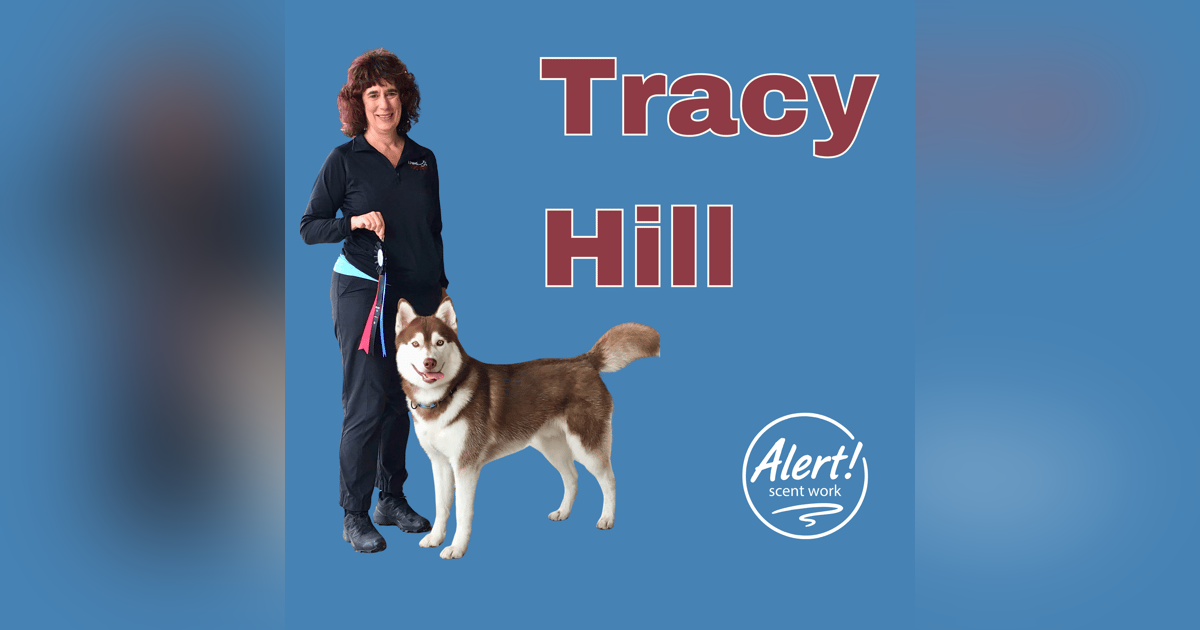


Scent work isn’t just about ribbons. It’s about setbacks, resilience, and the bond that makes every trip to the start line a gift.
In this episode, Tracy Hill offers practical takeaways for competitors while also opening up about the challenges that rarely make it to social media. From learning to process “no” to navigating the realities of a sick dog, she reflects on how those difficult moments shaped her approach to training and competing.
It’s an honest, encouraging conversation about perspective, perseverance, and the joy of working with our dogs, even when things don’t go as planned.
The first time I ever volunteered with you, you walked me through how you were setting hides and it was just a ton of fun. It was so educational. But the thing that really stuck with me even more was how obvious it was that you love the sport. It is infectious. You love doing it and talking about it and sharing it, and that really stayed with me.
Tracy:Aw, thank you. That is very kind of you and it is very nice to hear. I appreciate that.
Scot:Tell me more about that passion. What is that passion all about?
Tracy:You have to understand, I competed in other dog sports before, and growing up I was a competitive figure skater. So competition and competing have been with me my entire life.
But with rally and obedience and agility, even though I love those sports, there was a lot of pressure. In nose work, scent work, whichever you call it, the dog leads the parade. The thing that really turned it on for me was watching dogs use their natural ability to do something for us that comes naturally to them and brings them joy.
And also, if you do it right, and I do not mean getting a Q every time, but if you do it right and you watch your dog doing what they love, it is an amazing feeling all the way around. So that is what really got me hooked.
Scot:Yeah, I can agree with that. I sometimes get mesmerized watching my dog. I forget what I am doing. I am just thinking, this is amazing, what this animal is doing right now. They see this invisible world that we do not, and they are finding an object we could never find in that room.
Tracy:Well, unless it is cypress, and sometimes cypress takes over a whole room. Then we cannot pinpoint the source.
Scot:Clove, for whatever reason, is what really sticks out to my nose.
Tracy:Oh, that is interesting.
Scot:Yeah. Well, I have to say, your energy is awesome, and I just know when the Husky Hauler pulls up, whether you are competing or you are judging, you are going to be bringing a whole bunch of energy and I cannot wait to talk to you today.
This is Alert! Scent Work. My name is Scot, Murphy and Kiva’s dad, and today my guest is Jinx’s mom, Tracy Hill. How are you, Tracy?
Tracy:I am awesome, Scot. Thanks for having me.
Scot:Take me back to the very beginning of that scent work journey. What is your origin story? How did you end up in this sport?
Tracy:I was thinking about that as I was walking said Husky this morning.
For those of you who do not know me, I have 4 Paws DogWorks in Richland, Washington. It is a training center that my husband and I built from the ground up. In 2015, I had a woman by the name of Karen Shivers, who some of you probably know. She started the UKC sport of nose work along with others.
We happened to have a mutual friend who hooked us up, and she came out to my place and did a workshop weekend for us. At that time I had my half Husky Jake, and my little Lab who is still with us, Molly. That got me hooked. A few months later I started teaching introductory classes, and then I started getting other people hooked.
Then a bunch of people said, “Hey, we should have competitions, trials here at 4 Paws DogWorks.” And I am like, okay, I wonder how we do that. With the help of a lot of other judges and other people who had been involved with the sport much longer than I had, we did get started.
Back in the day with UKC, you had to have what were called pretrials, which is kind of like NACSW ORTs. The dogs had to pass all five odors in order to be able to get their PT title at that time. So we started small with our club, and that is how we got started. My half Husky and I, and then Molly, my little Lab back here, just kept going and going and going.
Scot:Take me through what was going through your mind when you first heard about this class with Karen Shivers, that you could bring this to your dog training facility. Were you like, “Hey, this is interesting,” or, “I have never heard of this, let us try it”? What was that emotional moment?
Tracy:I met Karen, like I said, through a mutual friend, and she is also very infectious. In a good way.
We started doing just the basics, hunting for food and doing all the things, and just watching all of these teams and all of these people getting into something that was completely foreign to all of us. We were all learning together and coming up together. That bonded a bunch of us from the beginning at my facility, and they said, “You are going to continue with classes, right?”
I am like, sure. I mean, not that I had no idea, but I had very little idea. I knew all about dog training and teaching and those kinds of things, but how do we do this? So I had other practitioners come in and do workshops and seminars, and that is really how it started.
Scot:What does scent work, and judging scent work or participating in scent work, give you personally that makes you keep showing up, traveling, and pouring so much energy and money into this sport?
Tracy:There are a lot of reasons. One is the love of watching teams work, and watching dogs work. It is fascinating to me. The science behind it and the behavior behind it are fascinating.
I tell my students all the time, when you enter a competition most people are super nervous. I get it. Some people did not grow up like I did in a competitive sport or never even played a team sport.
That is another thing I think is so cool about this. There are people who have never competed in anything a day in their lives, but they have now entered nose work for whatever reason. It is their first competition and they are nervous.
You make a lot of mistakes in your first few competitions and with your first few dogs, but you learn from them. I tell people, nervousness and excitement feel exactly the same way in your gut. It is your response that makes the difference, whether it is nerves or excitement.
Scot:Yeah, I can tell you were a figure skater. You had to get that mental game down, right? All athletes have to manage that nervousness. I have heard it framed that way a lot, that it is just excitement and you need to interpret it as such, or interpret the nervousness as a good thing because it means you want to do a good job.
Tracy:That is a great point. When I was a figure skater, I was a singles skater. I was not involved in pairs or dance. The difference for me now is that I have a partner, but we do not even speak the same language.
They are much more sensitive to things going on inside us than we realize or than we respect. I say respect because whatever we feel goes down that leash and into the collar or harness. If we are nervous, they are going to be like, “What? This is not the same person that is normally on the other end of the leash. What is happening?”
And honestly, when I first started competing, before I started judging, I was that nervous person. I should have known better, but over time you learn. Now when I step up to the line, I think, this is amazing. I want to see what our team can do.
Scot:I love that. I look forward to getting to that stage myself.
Tracy:Well, I am going to go on a little bit of a tangent, and it may be stealing some of what you wanted to ask me later. When you have a really, really sick dog and you cannot do the things because they are sick, it makes you appreciate so much more being able to go to the line with that dog again.
Scot:Right. Every time you step to that line is a gift.
Tracy:It is. You have seen the tattoo that I have on my inside wrist, right? It is a heart around a dog paw. I look at that every time I step to the line, and I remember that is what it is about. It is the love of the dog, the dog’s love for you, and the love of doing something so cool together.
They would not do this on their own. They would not say, “All right, let us get my harness on.”
Scot:“Let me find some birch. I just really have to find some birch.”
Tracy:“Yeah, I am feeling the birchy today.”
Scot:So if I am hearing this right, in scent work you like the competition aspect because it has been ingrained in you, and you love going up there with this animal you love and watching them do these amazing things.
Tracy:Yes.
Scot:Are there other things? Did I miss anything that you love about the sport?
Tracy:I love all the things about the sport. I really like sharing knowledge with people, and being able to set up tests for them and their dogs that are level appropriate, and helping them learn something they did not know about their team.
I have another mentor, Michael McManus, who came out to do a workshop weekend with us the day I brought Jinx home when he was 10 weeks old.
Michael told me something that has stuck with me all of these years, and Jinx is now six. He said, “You are not a real nose work person until you have heard a thousand ‘no’ responses.”
I do learn a lot more from my nos than I ever do from my yeses. The yeses are easy. You think, this was great, everything was clicking, we were in sync, it was lovely.
You get a no, and I used to drive home four hours from a trial thinking, what happened?
Scot:Sounds familiar.
Tracy:And I am sure a lot of people listening can relate to that. Now when that happens, I give myself an hour to wallow, and after that I make a training plan. Okay, what was the gap in our training that we missed?
Scot:Yeah.
Tracy:The nos, frankly, keep me coming back to compete.
Scot:Let me add one more thing, and I am sure you do this. It took me a while on those four hour drives home, after beating myself up and finally designing a training plan, to also celebrate what went well. What did we do well? What were we excited about? Even if you have to pick the smallest things.
Tracy:Oh, absolutely. I know we follow each other on social media, and you will see me post a lot about weekends that did not go well. No Qs, but here is what did happen. We solidified this. We were able to clear that room. We made it to room two, or whatever that looks like.
Those things should not be taken for granted. If you have been chasing something for a while and you finally get it, breaking it down into smaller milestones matters. If I can just get into room two, that is going to be a success. Then if I can get into room three, holy cow.
Scot:What you just said also made me think about this idea that when we step to the start line, it is not just a single thing of “dog finds hide, you call alert, you get it right.” There are so many steps and so many things that have to happen, especially when you move up in levels.
There are so many pieces to that puzzle to finding that final odor. Being able to break it down and say, “Hey, the dog really recognized it and tried to bracket. They did not source it, but they bracketed it really nicely.”
I think we can oversimplify what success is and forget all those complicated steps. Sometimes that is where you find your successes. There were things in that search that went well, even if you did not find a hide or did not get the Q.
Tracy:Right. One of the things I know makes a lot of people nervous is when they get that 30 second notification. “Thirty seconds.”
It used to be that my body’s response was to clench. Now my response to “30 seconds” is, where have we not been? If the dog is not working, if the dog is not giving me any changes of behavior in the area where I am, when I hear “30 seconds” I think, where did he last show a change of behavior, or she for that matter. Where did they show that change of behavior that I do not feel like we covered properly?
I will take them back, and if I see changes of behavior in that area, that validates for me that if I had another 30 seconds on top of that 30 seconds, we might have been able to solve it. That is okay. I will go work on some speed drills at home and see if we can tighten that up a bit.
Scot:Right. And even just celebrate recognizing, when 30 seconds came, that you thought, “Okay, where have we not been?” The fact that is even part of your thought process, because at some point it was not. That has to develop.
Sometimes I would celebrate just that. Thirty seconds, alright, what do I do now, what do I do now, what do I do now, oh, that is right, I wanted to go where we have not been. That is a win if you have never even had that thought before.
Tracy:Absolutely. I do not think we give the human end of the leash as much credit. We tend to denigrate ourselves and assume it is all our fault.
Ninety percent of the time, it probably is. But some of the time, like when Jinx was really sick, he just could not. I needed to give some grace to both of us on those days where one or both of us were off.
Scot:I want to talk about judging a little bit. You said one of the things you love is setting tests for competitors. You mentioned that you like to create searches that are fair but still challenging to the level, which all judges try to do.
But there is also the aspect of “was it fun, was it unique.” I personally like searches where there is a hide that works in a place I never would have thought of, but my dog finds it.
So there are those two components, fair and challenging, and also the experience for the teams. Talk me through your mindset when you are setting a search. Let us start with that experience for the team. What do you want the team to experience when they step into the space you have designed?
Tracy:The main thing I want them to experience is fun. That is probably most obvious at the end when they leave. I think, okay, if it was fun to me, I am hopeful it was fun to the competitor.
Of course containers and buried are completely different, because we have prescriptive ways we need to set those up for the most part. But interiors, exteriors, and Detective are places where we can really be creative.
Way back when, when people were learning the sport, I think sometimes the tests people set up were inadvertently much more difficult than they thought they would be.
So when I look at a space I think, what is going to happen if the environmental factors change in this room? Like if the air conditioning comes on and changes the airflow. Or outside, you start with a sunny day when you set the hides, and by the time competitor 24 runs it is pouring rain and there are 40 mile an hour winds.
Scot:I would say most of our listeners understand that these environmental things change how odor behaves, but I want to drop that in for anyone new listening. Sun, shade, humidity, dry air, all change how odor behaves and how the dog senses it. These are things that we as competitors and judges have to think about all the time.
So for the newbies, there is a whole bunch of other stuff to terrify you.
Tracy:Well, and the other thing to consider is, for example, I live in Eastern Washington. It is pretty dry here for the most part. Those are the conditions my dogs train under. We go to the west side, or wherever we go that is more humid, and it is a completely different odor picture.
Scot:Right. And those are odor pictures your dogs have not necessarily seen as much, so it takes them a little while to sort them out.
Tracy:So back to your original question, what do I look at? I look at the space that I have. Competitors also need to understand that sometimes when we get to a space we are assigned, it is not optimal. That is not anyone’s fault, it just is.
Then you need to think, in this space, what is the best possible challenge I can set. Best not meaning hardest. Best meaning the best I can set for this space that makes it challenging but doable for dogs that have trained for those sorts of things, and fun.
We have to remember it should not be impossible. I am not going to say I have never set something that turned out harder than I intended. You are not going to say you have never been there either. It is disappointing when you do not get it.
But at the end of the day, you spent time with this creature who adores you, and you got to see a lot of people you maybe have not seen in a while. You made some new friends. I want it to be an experience.
Scot:Right. It is entertainment, just like any other entertainment.
Tracy:Correct.
Scot:I like that mindset.
When you talk about creating searches that are fair but still challenging, for people who do not know, there are judges’ guidelines. You have the rules, and then you have the judges’ guidelines. You should read the judges’ guidelines if you are a competitor, because they really do spell out what is expected in Novice, Advanced, Excellent, Master, and even Detective.
When you judge, a lot of times in the morning briefing, judges get a quick moment to talk. Often in that moment, judges will give a little advice, like “do not crowd the start line,” or whatever.
Now let us pretend you are at the morning briefing and they say, “Alright, you have five minutes to give these people some tips at different stages.” What would you tell Novice and Advanced teams?
Then second, what would you say differently to more experienced Excellent, Master, and Detective teams? Based on all the things you have seen as a judge, what is the advice that could really help an advancing or novice team?
Tracy:Breathe.
Scot:That is a good one. Yeah, I have heard that before.
Tracy:Seriously. You can see the looks on people’s faces sometimes, especially if they are new to any kind of dog sport and competing at all. They are literally holding their breath.
So breathing is one. Enjoying the journey is another. You have been in enough briefings with me, Scot, to know that a lot of times I will hold up my arm with my tattoo and say, look, this is what it is all about in the end. Enjoy the time with your dog, because they are not here nearly as long as they should be.
Scot:You are one of those judges that usually gets the competitors crying first thing.
Tracy:I have heard that.
Scot:There are a couple of other judges I have heard similar stories from. The conclusion is always that maybe we sometimes take this too seriously. We should try to have more fun with it and treat it as the blessing that it is.
Tracy:Yeah, absolutely. At the end of the day, you go home with the best boy or the best girl.
Scot:Before you move on from Novice and Advanced, what would be a couple of little training tips? You are a trainer and a judge and a competitor. What are a couple of training tips you would give people?
Tracy:First off, I would suggest if you are not training with an actual trainer somehow, whether online or in person, try to do that, because it is harder to do this on your own.
That being said, I highly recommend videoing every practice search you do, and going back and actually watching those videos. Watch for your dog’s changes of behavior, because that is going to be your precursor to their final alert.
Scot:Yeah, that is great advice. When I first started, I did not even realize that was a thing. It was not until I found myself in Excellent and Master and people were saying “read your dog” that I thought, what is that? I just tell my dog to go find it and he goes and finds it. What do you mean, read my dog?
The earlier you can start observing and noticing the little changes they have when they catch a whiff of odor, or how they narrow down exactly where it is, that is invaluable. If you start doing that earlier, your life will be so much easier when you move up.
Tracy:And when you move up, do not forget about going back to fundamentals and doing fundamental exercises. Sometimes doing one and dones keeps the excitement for the dog.
You want that “wait, I want to do more.” “Nope, all it is today is a one and done.” I would rather have the “but I, but I” than “ugh, not this again.”
Scot:Yeah. “I have to find six hides with three converging and one higher than I have ever tried before.” That is exhausting to a dog’s brain. That is stuff you should absolutely train, maybe not all at once, quite frankly.
Tracy:Right. If I am being honest.
Scot:I love that. Leave them wanting more instead of having long sessions. I think I am starting to finally incorporate that better with my dogs.
Tracy:Good for you. Look at you. You can be taught.
Scot:I can be taught. I am an old dog and I am learning new tricks.
Tracy:You and me both, my friend.
Scot:You alluded to this before with your dog Jinx. When you have a sick dog, every dog has their thing. For you, working through this illness has been your dog’s thing. Talk us through what it is like to try to adjust when your dog has a thing and you are trying to do scent work. What has helped you get through this time?
Tracy:It depends on the thing.
Scot:Do you mind saying what your dog’s thing is?
Tracy:He has what is called EPI, which is exocrine pancreatic insufficiency. That means his pancreas does not produce enough enzymes to properly digest his food. It results in horrible diarrhea and general malaise. He lost seven pounds. He could not keep anything in him. It was awful.
Imagine if you had the flu and you were asked to go search, and you tried and tried and tried.
Before I realized he was sick, he was starting to slow down in his searching. All of us thought, well, he is finally maturing, he is getting a little more methodical, the usual things. When you see the dog every day, you do not see the slow progression into a serious illness, until they throw up blood on Christmas morning.
Scot:That is pretty loud and clear at that point.
Tracy:At that point you know something is clearly not right.
What that taught me, working through it over the next few months, is patience. You and I have not known each other that long, but I am not particularly good at patience.
That is not to say I was not patient with him, because obviously I was. But it is hard when you see your teammate suffering and still trying to do his best.
I still wanted to take him to work with me, because I felt like being cloistered in the house all the time was not right either. There is no mental stimulation at that point. But he could not really muster enough to do any real good work.
That did give me the opportunity to go back and do a lot of one and dones. I would ask him to go find a box with odor. There would be two boxes out there. “Just go find the one, buddy.” Reward, reward, reward.
I was able to take pretty close to a year to go back to fundamentals. I could not compete him in exteriors at all, because at one point during the misdiagnosis he was on so much prednisone that he was peeing all the time. It was not his fault. I would potty him before a search.
I watched him in one search. He was chasing the last odor, and suddenly he did a complete turnaround and went outside the search area to pee. We were still done, because you cannot pee during a search.
Scot:Yeah.
Tracy:It made me realize I needed to give him the space and the grace to come back to me when he could.
Scot:You do not have to apologize for that at all. So here we are now.
Tracy:EPI is a condition that is completely manageable. We did have a little setback a couple of Fridays ago. I have no idea what happened, but he is back.
Now I have learned how to manage that wave of stuff. It has been interesting. I have also learned not to panic at every little blip. I think that is important for people to remember too, even if your dog is not sick.
If you go through a year of not getting that last element you need for your full whatever title, it is part of your journey. Once you get that elusive title, you are going to look back and think, wow, I really did learn a lot.
Time is the great perspective. You can look back and think, we came through that and our team is stronger for it.
Scot:I saw you post recently on Facebook that Jinx finally earned that elusive Master Exterior Q, and that it was a year of chasing it.
Tracy:It was a year of chasing it. It was 89 degrees with what felt like 8000 percent humidity.
As you know, in AKC Masters it is an unknown number of hides. You have to be right on your end of the leash too. Is my dog actually done working?
He found the hide, and I think I heard “30 seconds,” I am not sure. I said “finish,” and Donna said “yes.” I said, “What? I am not sure I heard you correctly.”
Scot:I am not used to that word “yes,” especially in this context.
Tracy:Exactly. So that was a lot of fun.
Scot:How many NQs led to that Q?
Tracy:More than two hands’ worth.
Scot:Wow.
Tracy:Yeah.
Scot:You and Jinx overcame something there. What were you feeling inside when it finally happened, other than shock at first? When the shock wore off, what were you thinking?
Tracy:I will tell you exactly what I said to Donna on my way out. “Wow, we really can do this.”
You start doubting yourself. I am a judge, and I think people need to hear that. Sometimes instructors or judges are not willing to admit to their students that they hear “no” a lot too.
I will come back and tell my students I heard “no” this weekend, I was only two for five or whatever it was, because I think that humanizes us.
Scot:I would think it could be very difficult as a judge and a competitor. If people decide they want to watch, I asked Judge Laurie Schlossnagle one time if I could watch her, and she laughed out loud.
I think the reason she laughed is because of that tension of, “I do not know what you expect to see when you come in here.” Just because you judge does not mean you are this perfect competitor all the time. You have challenges like any competitor does.
Tracy:My first response to that is, are we not all humans? Are our dogs not all dogs?
Do we all have good and bad days? Absolutely. Do we as humans make bonehead decisions at the end of our leash? You bet.
You have asked me before if you can watch my Detective runs with Jinx. I say yes, because you may see something that I do not. You can come up to me afterwards and say, “Hey, what happened in that interior? Why did you make the decision you made?” I will be happy to tell you, and I am going to ask you right back, what did you see?
Scot:That is a healthy relationship with it. Probably hard to get to that point. You have been a dog trainer for a long time, you were in competitive figure skating, you were getting feedback all the time, so maybe not as difficult for you as for other people.
Tracy:That is true on one hand. On the other hand, we all have egos, fragile or not, or overinflated, whether or not deserved.
If you are riding a high, it is great. If you are riding a low, the last thing you want to hear is something negative. Not even necessarily negative, but the last thing you want is more feedback, like you said.
If you can get out of your own way long enough to listen, you are going to learn a lot you never thought you needed to know.
Scot:Alright, we are going to wrap this up with a thing I call Seven Questions. It is quick fire.
Tracy:Oh boy.
Scot:I am going to ask seven questions and I want you to come up with the first thing that comes to your mind. I am looking for a sentence or two for each. If I want you to expand, I will ask.
Tracy:That is fair.
Scot:What is your dog’s favorite reward after a great search?
Tracy:Lots and lots and lots of food.
Scot:Anything in particular?
Tracy:For Jinx, he is on a specific diet, so whatever I have for him is what he gets. For my Lab, it does not matter. The more the merrier.
Scot:What is one piece of advice you would give your beginner scent work self?
Tracy:Do not take it so seriously.
Scot:What would your dog say about you as a handler? We are looking for the good. You can say something negative, but we are also looking for some good.
Tracy:Sometimes you are a freaking idiot.
Scot:What good would your dog say about you as a handler?
Tracy:I love being with you and doing the thing.
Scot:I think your dog would also say, “I love your passion for this. I love it too.”
Tracy:Aw, thank you. That is sweet.
Scot:What is your favorite search to run your dog in?
Tracy:I know a lot of people are going to think I am weird. I actually like buried.
Scot:Why? Tell us why.
Tracy:I will tell you exactly why. I chased Advanced Buried for probably eight or nine trials. We just could not get it. Once we finally got it, he was like, “Okay, now I get it,” and then we just flew through and I got his Master Buried title in three trials.
Scot:What is one compliment from a fellow competitor or a judge that really stuck with you? As a judge, did a competitor give you a compliment, or as a competitor did a judge give you a compliment, that you think about a lot?
Tracy:As a judge, from competitors, I have had a lot of people say, “That was the most fun I have ever had in a search.” That is overwhelming to me. I think that is amazing.
A corollary to that is, “I will be seeking you out. I will be stalking you to where you are judging.”
Scot:You have had people say that to you. That is awesome.
Tracy:Yeah.
As a competitor, one of the things I have had judges say, when we are on, not during that terrible period, is, “I really can see the teamwork and the love between you two.”
Scot:What has your dog done in a search that made you laugh?
Tracy:So many things. I say two things about him. One is, if you want to use him as a demo dog, he will show you every potential pitfall in your search. He is “if he fits, he sits,” so he will push through and bull through things. The easiest way to find it is not the Jinx way to find it.
Scot:Got it.
Do you have a signature distractor that you use in your searches, something you bring with you to a lot of trials?
Tracy:Yes. Her name is Ducky.
Scot:Tell us about Ducky.
Tracy:Ducky is literally a decoy duck that hunters use.
Scot:Why Ducky? Why is that your signature? Why do you love Ducky so much?
Tracy:I can only use her at the upper levels, because she is a mimic.
There are usually two reactions that dogs have to her. In Masters or Detective I have put her at the start line staring at the dog.
They will either go up and sniff her and look at their handler like, “What is this doing here? It is not real. Why is it here?” Or I have had a couple of dogs stalk up to it very slowly, wondering if it is real. When they realize it is not, they are like, “Oh, what was I worried about?” and off they go.
Scot:So if people have hunting dogs, they need to watch out for Tracy Hill and Ducky. You better train it, because that is going to show up.
Tracy, Jinx is sitting there, ears up, waiting for a search. What is the one thing you would want him, or any dog, to know about why we humans love this game so much?
Tracy:Because it deepens our bond.
Scot:I love it. It does. Absolutely does.
Tracy:If you are doing it right, it does.
Scot:I love that. What a great answer. What a great way to end.
You can find Tracy in the east central part of the state of Washington.
Tracy:Eastern Washington.
Scot:Eastern Washington. I see that you judge a lot in Oregon and Washington, and you get to Idaho once in a while. You get to Utah once in a while.
Tracy:Yep. And I am willing to go anywhere.
Scot:If you are looking for a judge and you are digging Tracy’s vibe, you can find her information in the AKC judges directory. I will also put your email in the show notes.
She will pack up the Husky Hauler, which is her camper, and head out to your trial and get it done for you.
You can find all of our episodes of Alert! Scent Work at alertscentwork.com. You can also follow along on Facebook, facebook.com/alertscentwork. I would love to hear from you. Send me an email at hello@alertscentwork.com if you have judges you would like to hear on the show, want to share your own scent work stories, or want to let me know what you are enjoying about the show.
Tracy, thanks again for joining me today and for everything you do to make this sport such a great experience. I meant it when I said you bring the enthusiasm, so thank you so much for making it happen.
Tracy:Scot, it has been a pleasure