Penny Scott-Fox | Pressure in Scent Work — How It's Affecting Everyone and What We Can Do
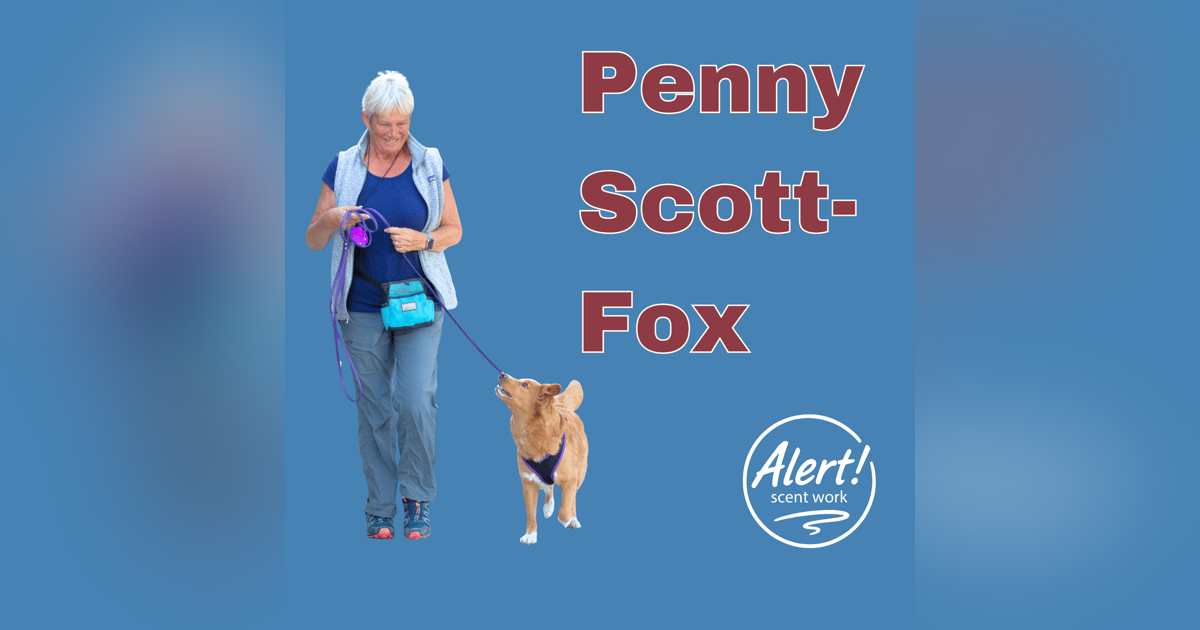


In scent work, we talk a lot about odor theory, training, and handling technique. But there's something else affecting your performance, your dog's performance, and your experience of the sport that doesn't get nearly enough attention — pressure. Penny Scott-Fox has been watching what it does to competitors, dogs, clubs, and judges, and she wanted to talk about it.
Before we get to the main topic, we start with her recent 2 minute and 14 second detective run. I had to ask how that was even possible. What followed was a conversation about how to better train for detective, how to build a dog that drives to odor, and two very different handling philosophies based on the dogs we each have. I think a lot of people will see themselves in this conversation.
Then we get into the main topic, pressure in scent work. Through the conversation, we uncovered ideas that will help competitors, trial committees, and judges alike succeed and enjoy the sport more fully.
What we talk about:
- The 2:14 detective run — what made it possible, and what it reveals about foundation training and building a dog that drives to odor
- Why dogs that have sailed through the lower levels sometimes hit a wall in detective — and what to do about it in training
- Two different handling philosophies for detective — Penny's and mine — and why the dog you have shapes everything
- Penny's 40th detective Q — and the bronze, silver, and gold detective titles her club awards that AKC doesn't recognize
- Pressure on the dog and how it impacts your partner in scent work
- Pressure on the handler and what both of us do to take the edge off, including Penny's ritual to reduce pressure in obedience (works for scent work too)
- Why pressure on the handler almost pushed me out of the sport, and the two rules that made it fun again
- Pressure on clubs. What the growth of scent work is doing to trial quality, and how clubs can best serve competitors
- Pressure on judges, why the push to be the judge that sets sexy hides isn't always good for dogs or competitors, and a conversation about what really makes the sport fun for competitors
Find Penny at scott-foxdogtraining.com
Alert! Scent Work is a podcast for competitors — the parking lot conversations you'd never get to have at a trial, with the judges and community members you wish you had more time with.
Listen to the podcast and find everything here: https://www.AlertScentWork.com
Follow along: Facebook: https://www.facebook.com/AlertScentWork Subscribe to the newsletter: https://www.alertscentwork.com/newsletter/
There's something you want to talk about, and I'm interested in talking about that because I think it's important. But there is something I want to ask about first. A 2 minute and 14 second detective run. Seriously? Is that possible? How did you do that? I could see our team — Murphy and myself — doing a 2 minute and 14 second master exterior if all four hides were out and I knew I didn't have to clear the rest of the area. But for a detective where it's unknown, five to ten — talk me through that.
Penny:Zest just drives to odor. She has judges she really likes because their odor and their hide placement makes sense to her. There were only — I think there were six hides, might have been five. And I just don't go back. If she hits a hide, I move on and I don't waste my time. If she clears an area quickly and moves on, I just keep going with her. In this search in particular, there was a bunch of tables with food underneath them. I was just like, I'm not even going to fight this for you. We're just not going to go there. So I missed an entire section and just got lucky. She was going for the food and I was like, no — if there was odor, she'd be going for odor. So I'm going to miss out these six tables where a lot of people went around them and I just chose not to. It was a gamble. It's not that I don't care, but I'm enjoying pushing the envelope.
Scot:It's a different philosophy. All right, so this is Alert Scent Work. I'm Scot, Murphy and Keeva's dad. And today I'm talking again with Penny Scott-Fox, Zest and Tabor's mom. I do want to circle back around this because I think there's an interesting conversation here in the philosophy of how to do detective. You have a dog that has really trained drive to odor. I have a dog that will drive to odor, but not to the same extent. If he's not in odor and we haven't covered an area, I have to kind of take him there because he loses motivation. It doesn't sound like that's a thing you have at all. And I think my situation is probably more the case for a lot of people. What are your thoughts on that?
Penny:I think it depends on your foundation — that's what it all comes down to. I teach dogs very young to drive to odor, and my philosophy is putting them straight on odor and not pairing with food. Right from the start, my dogs understand at a very early age that odor is very valuable. I even had my litter of Zest's puppies at 5 weeks of age doing scent work. We started them off pairing with food for the first couple of rounds and then we didn't. It's my famous bowl exercise, but it really teaches them to drive. Both my girls are pretty greedy — if there's food on the ground, they'll choose odor over it.
Scot:Here's my observation of our team. Murphy's my first dog, and I put him on odor pretty quickly. We did a lot of backyard stuff for two or three years before we competed. But as you move up through the levels — in novice, if you don't have the training background that you do — in novice and advanced and even excellent to some extent, we're in odor all the time. So when we got to detective, where there could be big blank areas where we're not in odor for a minute or two, he's not used to that. He's like — I've been out here 30 seconds, there's no odor, there must not be odor, because that's not his experience. Does that make sense? I think that's what a lot of people who are just getting to detective and haven't trained it quite the way you did struggle with.
Penny:There's something to be really learned here. The dogs need practice having blank areas — searching for 40 seconds and then getting out. If they're not having a change in behavior or driving to something, it's possible there's nothing going on and they can move on to the next area. If you're worried about it, you can always come back. What I see as a judge is that people spend a lot of time clearing areas round and round, and the dogs get bored and frustrated — like, why are we still here when next door I'm going to hit odor right away? That's how I get these fast times with Zest. I let her drive the search and I just follow her. I don't really need to be there. Somebody could be feeding her cookies and she could care less about me. Anybody could run her. And I trust her. I never question her. I never go, let's go back and check here. If she leaves an area, I assume she's found all there is to be found there.
Scot:That's a different experience from what me and my team has — and I think a lot of people I talk to have the same situation. For example, I have to have a strategy in detective where if my dog finds the first hide, he might run off and there might be another two or three hides there. So I kind of have to intentionally say, all right, we found one hide, there could be another here. We're going to hold for a second and I'm going to give him the opportunity to find that.
Penny:To make that more solid — stand in front of the hide he's just found, take a second, and recast him. He will go on to another hide if there's one there. And if there isn't, he'll say, let's go on to the next area.
Scot:All right, I'll try that.
Penny:That's how I started getting these high speed searches — I stand in front of the hide. You see me do it all the time. I actually change that odor picture for her. I reward her and I stand in front of her for a second, reload up with food in my hand and head on. By then she's either hitting odor or she's left the area completely. I run her on leash because I like that connection with the leash. I can feel her changing in behavior through the leash. If you blindfolded me, I think I could still do the search. We should try it. We've had that conversation too.
Scot:Not only did you have an amazing time in that detective run, but that was also your 40th detective Q. Is that accurate?
Penny:Yeah.
Scot:I got to give you some love for that. That is amazing.
Penny:Our club — AKC doesn't acknowledge this, but our club does. We have a bronze, silver, and gold detective title. Bronze is 20 detective Qs, silver is 35, and gold is 50. So I'm going for my 50.
Scot:Going for gold. I love it.
Penny:Tabor is already eligible for detective, but I'm waiting for Zest to get her gold so she can move over and let Tabs have a go. I wanted Zest's 50th — that would be kind of cool.
Scot:Congratulations on that amazing milestone. That is just incredible.
Penny:I think it's really fun.
Scot:Do you know what your Q percentage is? Do you kind of know what your percentage was to get that 40?
Penny:I need to check on We Smell Better — which is of course the most brilliant website. I think I'm probably at about 95%. She's pretty good.
Scot:Wow. All right.
Penny:I failed a couple. Not many. It's just because I choose to run under certain judges and Zest understands their hide placement.
Scot:Got it.
Penny:If I just went to random searches, maybe we wouldn't be so successful. I don't know. But I'm all for it being a fair search for her. She's a pretty challenging dog. If she doesn't like it, she can be pretty tricky — more so in agility if she doesn't like the course. She just bites me. She just turns around and says, this is stupid. So to achieve this, I have to make sure she's in the right space. We're running under Steve tomorrow for two trials. I'm sure she'll be great. It'll be fun. Super new.
Scot:I don't want to get too deep into this right now because I need to think about what you said about not frustrating your dog. It's a team to team thing. My Murphy doesn't tend to get super frustrated — he's not exactly enthusiastic sometimes if he's not in odor, but he will go back and check places for me. I kind of like the challenge of having a judge I don't know much about, or maybe I've just heard a little bit of recon on, and trying to beat them in their detective Q. I think it's two different games. You're pushing the envelope on time, showing under known judges your dog understands. I kind of at this point like the challenge of going — can I beat this judge? Even though they might not be exactly right for my dog.
Penny:That's not a bad philosophy to have. I'm not saying that's not one way to go. I've seen and heard about a lot of detective searches that are just plain stupid, and I'm not going to put my dog through that. It's just not fair.
Scot:I get that. If you found a judge like that, what's the point of trying to beat them? There are some instances where odor just is not available and there was nothing you could have done about it. But there are others where maybe you just kind of went — what if we detail here a little bit, because this looks like a place that could be a little tricky. I kind of enjoy that right now.
Penny:I might enter under a judge I haven't trialed under before when I'm judging in Texas — I'll have Zest with me and might see how she does. But there have been some searches I've heard of that I would just say — not happening.
Scot:Yes, let's do that. Let's move on right now. Taking it too seriously — is that what this is about when you say pressure? You had reached out and said you've seen a trend recently — judging and participating — that some people are putting too much pressure on themselves, the team, the judges. Talk to me what you meant by that, and then let's dig deep.
Penny:I think it goes on each level. There are really four conversations. There's the pressure on the dog — the first thing everybody thinks about. You have to Q. You have to get it. You really want to get your detective title before your dog turns five, or you've made it a goal to get ten Qs in fifteen tries or whatever. That's a huge amount of pressure. Even something as simple as the lunar cycle could affect how your dog works on a particular day. So the pressure is unrealistic. I have a pretty high Q rate in detective with all of my dogs, but I don't put that pressure on them. I expect them to do well, but if they don't, I just go — oh well, it just didn't happen today. It's not the end of the world. I still get the best dog going home. But time and time again I see teams who just break down and cry and go, oh my God, I can't believe that's a no. And I'm just like — it's dogs sniffing birch Q-tips. It's not the end of the world. Your dog has not just obliterated an entire platoon in Afghanistan. They just missed a Q-tip. And that upsets me. I get really upset because I find it insulting to me as a judge that they blame me because they didn't get the Q. It's not my fault. Your dog was trying to tell you and you chose not to listen. I had one competitor who said, I don't believe you, but I'm going to call alert anyway. And I was just like — why did you do that? You didn't believe your dog. Your dog wasn't actually even alerting. You verbalized that you weren't going to call it, and then you did. I had no words for that. So that's pressure — and it's not fair on the dogs. The dogs deserve better.
Scot:When people put pressure on their dogs, what do you see from the dog's perspective? What happens in that search?
Penny:It depends on the dog. Some dogs really love pressure — Zest could care less. But a dog that's slightly sensitive, or when the owner starts to behave in a really weird way that they don't normally act — then the dogs just shut down or they go, I don't know what's happened to you. I'm going to do an alert because I think that's going to make you feel happy. No odor reaction. They're just doing something to appease the owner. And then they get a no. And the owner gets upset. And I'm just like — the dog didn't actually even sniff. They're just trying to calm you down. They're trying to give you a calming signal. And yet you misinterpret that as an alert.
Scot:What a brilliant little insight. If you're out there putting too much pressure on your dog and you're like, I don't understand why my dog false alerted — I've heard a lot of reasons why a dog might false alert. It's never lying. There's some reason they're doing that behavior.
Penny:It's appeasement.
Scot:They're doing that behavior to calm their owner down, to try to chill their owner out — if it's a more sensitive dog. Is that what I'm hearing?
Penny:Absolutely. I see it time and time again.
Scot:Wow.
Penny:Yeah. And it's sad. They get upset and it's just like — actually, your dog was just doing his job. It was calming you down. But that's not what they want.
Scot:Because the dog has to make a decision in that situation. They have to decide what's more important right now. I've heard this called a hierarchy of behavior. What's more important in this scenario — me continuing to search for odor, or calming my owner down? To some dogs that might be more important, especially in scent work where these are pets. These are not hardened professional dogs that can block all that other input out.
Penny:Very good. And it's just sad because the dogs are doing their best. The problem is with this all-or-nothing. And I would never take away the all-or-nothing qualifying part of detective — I love it, I think it's really important. I don't want it to be dumbed down. I don't want it to change. But people need to be able to handle the pressure and know they may not always get the Q. As long as they learn something from the search, I think it's a win. When I'm judging, I try to say — look at what you got. You may have missed one hide, but everything was lovely. You were connected. You went through the search area. You trusted your dog. Just because you missed one hide doesn't mean it was a bad search. It just wasn't a qualifying run.
Scot:That's a great way to reframe it. That's really helped me. I tend not to look at the positive, so I had to work at it. But it makes it a lot more enjoyable when you can go — there were nine things that went right in this run and one thing did not. So let's celebrate that I've got the most amazing dog in the world going home with me, as you like to say.
Penny:Exactly. To put it into real perspective — I flew all the way to Orlando, Florida, to compete in the AKC Agility Invitational with Zest. She knocked the first bar in the first run and we were out. Did I care? Yeah, I was upset. But then I was just like — it's okay, there's no pressure now. Just have a blast with my dog. Which is exactly what we did. And I had a brilliant time. That's why this all came up — it made me realize how much we put on these poor dogs. We get so upset when they're just doing their best. More often than not when they make a mistake or we miss a hide, it's because we either didn't cover the search area properly, or we didn't read some subtle nuance in the transition from the room to the outside, or we just missed a head check.
Scot:I want to move on to the other three factors, but there's one more thing about pressure on the dog from my experience I wanted to share. I didn't think that what I was doing in the search was impacting my dog for a long time. People kept telling me — you've got a really sensitive dog. But I didn't think so. I thought he was just focused on odor. I've come to learn as I've spent more time in the sport and more time with my dog — yes, I do. I just want to warn people: if you think the things you do — whether that's putting pressure on your dog or just acting weird — your dog is picking up on it to different extents. Every dog is a little bit different, but don't think they're always immune to it. That was a lesson I had to learn the hard way. It's taken me three years to learn it. Maybe I can save somebody some time.
Penny:Each dog is different. Zest is just a bomb — she doesn't care. But Tabor does. If you ever see me running her in scent work or obedience or agility — she yawns on the start line and I yawn back at her and she goes, oh, you're stressed too, okay, we'll be stressed together. If I yawned at Zest, she'd go, are you tired? You're not going to be able to run. Completely different dogs. With Tabs — if I yawn at her, she goes, we're both stressed together, so let's do this together. It's a very sweet, sensitive, connected run. Very, very different from the flying banana.
Scot:That's so beautiful. As I've done this, this game is so much about communication between you and your animal. It's less about finding hides than you might think — and more about so many other things.
Penny:Yeah. It is.
Scot:Let's talk about the other aspects of pressure. What's number two?
Penny:Number two is pressure on the handler. Pressure to look good, to make sure you don't make any stupid mistakes like missing a whole area. This whole thing about looking good — it's just the nature of dog sports and we've put it on ourselves. If you're trying to look good at the same time as running your dog in detective, it's not going to help you. It's more pressure on you, which then affects the dog, which then means the dog needs to calm you down because you're acting weird. One of my students used to get so stressed out about detective. She had one more Q to get and she just couldn't do it. I said, have a glass of wine before you run. And she did, and she was fine. It just took the edge off. I'm not saying everybody needs to drink to run detective, but in this case it really made a difference. The pressure on the handler doesn't help — and it doesn't help the big picture for the dog, because then the dog feels they have to work even harder to calm you down.
Scot:I laughed because when you said not looking stupid — that is such a motivator for me in my life beyond dog sports. I don't want to look stupid out here. I want to look cool. I've run into this myself because early on people would say, oh, I love that dog, you guys are such a great team. And then as you move up, you don't want to let them down. You put that pressure on yourself, which is just dumb.
Penny:There are a lot of instructors who — I train in obedience with somebody who was born doing obedience. She's been doing it since she was 11 years old. My agility instructor has been doing agility since she was 10 years old. I've been doing scent work for a long time, so to me it's easy — like an old pair of slippers. Whereas for me to do obedience is really difficult because I've only been doing it for a year. I'm way out of my comfort zone. I have this whole little scenario I do to make me feel better so I don't look stupid in the ring. I dress up, I wear makeup, I wear jewelry — which I really don't normally do — but I do it for obedience because it makes me feel different.
Scot:I want to dig into some strategies people have used to put less pressure on themselves as a handler. I'm going to share what was a game changer for me. But what are some other strategies? You get all dressed up for obedience. What does that do? How does it help? Should people put on a suit and tie when they go do scent work if they're putting too much pressure on themselves?
Penny:I have pants that match Tabor's coat so that if she's slightly out of position for heeling, you can't really tell. She wears a pearl necklace as her collar and I wear pearls as well. It's a ritual for me to get dressed to go into obedience, and I like it.
Scot:Can you articulate what that does? It takes the pressure off you as a handler?
Penny:Yes. It makes me feel special. It makes me feel that I've made an effort to show up with my dog in a competitive environment.
Scot:So if nothing else goes right, you feel special because you were dressed up.
Penny:Yeah. And the judges notice. They go, wow, it's the girls with the pearls. And I go, yep, here we are. It just puts me in a really good mood. I look at Tabs and we yawn at each other and go, let's do it. And we do.
Scot:One of the things I do to take the pressure off or relieve my own stress is I usually chat the judge up for 15 or 20 seconds — have a little fun with them before we start. That relaxes me. I'll be like, all right, what's the caper? What's your devious plan? If I can have a laugh, that helps me. And when people talk to you and say, wow, it's the girl with the pearls — you get to have that kind of experience too. Maybe that helps as well.
Penny:What it does is open up a conversation with the judge. Now they're rooting for you because you've made an effort. And I remember judging you — you had that whole banter with me and I said, you know, you need to have the balls to call it, Scot. And it makes it personal. It becomes this really pleasurable experience. In obedience it goes on for six minutes — it's a whole package. And when exhibitors come up to the line and chat you up and go, what devious plan have you got for us? How many threshold hides can you possibly set, Penny? — it's fun. It makes you more present and enjoying the process instead of just showing up.
Scot:That has to have an impact on the competitor's chemical makeup in that moment — it reduces stress. All right, so I'm going to tell you what I do to take the pressure off. Wanting to look cool, not wanting to look stupid — those were driving factors. It actually stressed me out so much that I stopped wanting to do the sport for a while. So I changed my whole philosophy. Two simple things. When I leave, I want anybody who watched to think one thing — wow, they had fun. That's all I'm going for. Chatting up the judge a little bit, and if there's a foible — wow, you sourced that food all the way from over there, huh? All right, let's keep going. We're going to have fun, I'm going to reward my dog. And then internally — cover your space, cover your area. Those are my only two rules when I go in now. And it's been a game changer for me.
Penny:What's so valuable is that you went through the process and came out the other side. A lot of people don't come out the other side and they stay stuck and panicking. If this makes you sick or you want to throw up before you do a search, then maybe it's not the thing for you. Not everybody needs to compete. I have a couple of students who I think would just throw up if they went into a competition. So I said, come and do some work, but just don't compete — because it's not worth it to be feeling ill.
Scot:Or if it's making you feel like that, maybe analyze — is there something I'm doing that's doing it, and can I stop doing that? For me I was lucky enough that it was something I could stop doing. For some people it might not be anything they can do — it might just be who they are and they're not going to want to compete. All right, so we've talked about pressure on the dog, pressure on ourselves. What's the next one? Number three — clubs.
Penny:Pressure on the clubs. The pressure on clubs to put on these trials when they may not have enough of a location to do what they're trying to do. Around the country, locations that are being used — they're not correct. Often the interiors are not correct. And yet there's pressure from the public to put on scent work trials and offer interiors when really they can't — they're set wrong and they go ahead anyway. It's really disappointing. An interior has to have four walls. It can't be curtains or an obedience barrier. It's just not right. And so the class is set wrong. Then people get lulled into a false sense of security, thinking that's what it's really like. And then they come to a trial where it's set correctly and it's a very different game.
Scot:What is causing this pressure on clubs? Is it just because scent work is becoming so popular that clubs are doing that? What are your thoughts?
Penny:I think so. Maybe they just try really hard to get these locations, but if they can't get the right interior locations, then maybe they shouldn't offer interiors and maybe offer a double exterior instead. I feel it's diluting the sport. I get very frustrated when I see this because it just means it's not set right. I'm a real rule follower and I get disappointed when people cut corners. I don't think it's intentional — I think they're just trying to put on trials. But I feel there are some gaps or lack of control from the AKC to make sure these trials are set correctly.
Scot:I have limited experience with being a trial chair and I'm also shadowing judges because I want to become a judge. I've seen some instances of this, and I'm going to add one more — sometimes the clubs or the people associated with the clubs don't quite understand the rules as well as they should. So they don't even know they've given a judge a spot that just won't work. But now they've promised it, so they have to make it work. I think a little bit of education too is important.
Penny:We had an incident somewhere in the country — it doesn't really matter where — where another judge saw a master interior set wrong and they stopped the class and had to rerun the entire class because it was set wrong. And I think that was really good. That's what should happen.
Scot:As I'm approaching how I might handle those situations, I see some judges get really frustrated. But sometimes the judges are the experts on the rules and the clubs and trial chairs should also have a pretty good knowledge of them — but sometimes they miss something or it's a new trial chair who didn't know. So I think being kind and realizing we're all working together as a team to make this experience as good as we can, make this work the best we can right now. But next time — here's the education on the rules. Just being kind about it is probably the way I'd approach it.
Penny:I know it's not ideal, but it would be really great if clubs made sure they had the right areas for the class. If they can't offer interiors, don't offer them. Just do a double buried and double container instead — do something different.
Scot:Let's move on to the fourth one. What's the last pressure we're talking about today — judges. All right. How are we putting pressure on you, Penny?
Penny:The pressure on judges — especially new judges — to set super sexy cool searches is not really the answer. Super sexy doesn't really mean it's a good hide. There's a lot of pressure to be a popular judge and to set fun searches. What a judge may think is being super sexy may not be — it may just be not well thought out or not particularly stable. I don't set super sexy hides ever. My hides are pretty boring. I do super sexy hides in class that are completely off the rails, but for a trial, no. I really try to keep it simple and clean for the dogs. But there's a lot of pressure on judges because they want to get hired again. They want to do these super sexy searches that they think are really cool.
Scot:Where does this pressure on judges come from? Does it come from the judges feeling that competitors are looking for something unique and different? Or does it come from the judge themselves thinking — I have to put on a great experience and that means I have to be clever?
Penny:I think it's a bit of both. There are very popular judges who get hired a lot and have a great reputation — I think they've gone through that pressure and have come out the other side and just do what they do. And then there are new judges who want to be cool and get hired a lot, so they try to do something fun or different. I think it's a bit of both.
Scot:Pressure on judges — this is interesting because as I'm training to become a judge, that's what I want to be known for. I want to set fun searches. And maybe part of this pressure is — what is a fun search? Sometimes we think a fun search is something really super unexpected or tricky. And there are probably twelve other things that make a search fun. Maybe the search is just going to be fun based on factors that are beyond your control — like getting really great search areas. To me, that's what makes a search fun before the judge even steps in there.
Penny:Right.
Scot:As judges, to take some of that pressure off — it doesn't have to be a tricky hide to be fun. It doesn't have to be in a unique location, although I do enjoy that. But that's only one aspect of fun.
Penny:Fun for me is watching my dogs have a good time in the search. Watching Zest or Tabs fly around the search going, odor, odor, odor — and just having a really good time. To me that makes it fun.
Scot:There is truth in that. There's a lot of fun going into a search and your dog's just bing, bing, bing, bing, boom. Then there's the challenge of balancing it so it's a level appropriate search. And for me, there's also fun in my dog solving a really interesting triangle puzzle that was well set by the judge.
Penny:Yeah.
Scot:For a novice search, the objective from a judge's perspective is — can the dog find and source odor? As a judge, sometimes we think, well, that's too easy for a novice search, so I'm not going to set it quite that easy. But it's fun for a novice person to go into a search and their dog gets it in four seconds.
Penny:Yeah.
Scot:And you've accomplished your job as a judge. You've shown the dog can find and source odor and they've had fun. So I think really examining what makes a search fun at each particular level — that's what I just took away from this. What are your thoughts?
Penny:That's exactly what it is. I expect about a 95% pass rate in my novice searches. I expect the dogs to go straight in and hit them. Containers is harder because people seem to struggle with containers, but with interiors, buried, and exteriors, I expect them to get it in under 10 seconds. Containers is a whole other thing — that's maybe a whole podcast because I have a whole thought about that. But I want them to come back. I want them to think, oh my gosh, my dog can do this, this is amazing. And come back to the next trial and keep doing it and getting better and better. People get funny about judging novice — they just want to judge master and detective and excellent. But I want to judge novice because I want to get those people and say, oh my God, I love your dog. What a cute little dachshund. Did you know that he does a little tail flick when he catches odor? And it's like this big love affair with them.
Scot:And that's another thing that makes it fun. When you as a judge can give a five second thing — did you know your dog does this when they catch odor? That makes it fun for that particular level. Level appropriate.
Penny:And to me, one of my favorite judging assignments is when I go to Hawaii. I got to do the first ever judges ed out there, and then I did their first ever trial. I've gone back every year since and I've seen them all the way up to detective. Four of them actually flew over from Hawaii in October to run under me in our detective trials here in California. And they did great. It was just amazing. I remember when they were little itty bitty novice dogs four years ago — it made me cry. And they said, we remember way back four years ago when you told me my golden retriever was super cute.
Scot:Such an interesting role as a judge that I would not have considered. It's about an experience. You and I have talked about this before — and we got to wrap up because boy, we sure can talk. It's about an experience. And that's not always the actual search. It's everything before, everything after, and everything during as well. That was a really useful conversation for me to think about as I become a judge — how I can approach this to remove some of that pressure and still make sure I'm doing things that are fun and contribute to the experience.
Penny:I'm so pleased we did this. It's a conversation that not many people want to really hear, but I think all the points we made are pretty valid.
Scot:I think so too. It's been a great conversation — and we didn't even get to the third one I want to talk about. I want to talk about demo dogs sometime — from the perspective of a handler who's been asked to run a demo dog. What that looks like. Is it different than when I'm competing? I want to dig a little deeper into your philosophy on how you use demo dogs, what you're looking for in a demo dog, because I've learned a few things about that that I think could be helpful — and I'm sure you've got a ton of insights as well.
Penny:I would love to. And I think another thing we should talk about at some stage is containers.
Scot:Absolutely.
Penny:I have a whole hour on containers.
Scot:You gave me a container tip one time that I haven't been able to execute as many times as I'd like. But when I have and when it's worked, it's made those situations with lines of containers — which stresses all of us out as handlers — so much better. You gave me a little tip that is just brilliant. I have a hard time executing it all the time, but when I can, it's so much fun. We'll talk about containers in a future episode. All right, Penny, thank you so much. I wanted to do another round of seven questions but we're going to forego that. I came up with a whole bunch of new questions. But I do want to ask one — if we made a Penny Scott-Fox t-shirt that had a saying on it, what would that saying be?
Penny:Just have the balls to call it.
Scot:What would the second follow up t-shirt be?
Penny:Don't make me call Penny. That would be for my trial team — for any exhibitor, the volunteers would say, don't make me call Penny.
Scot:And what does that mean?
Penny:If they're being naughty or really annoying and they won't listen, the volunteers will say, do you want me to call Penny? And they'll go, it's okay, we got it.
Scot:All right, there you go. What about trust your dog?
Penny:Trust your dog is used too much — especially for a t-shirt.
Scot:It is.
Penny:I think.
Scot:Go ahead.
Penny:The balls to call it. And that's got Zest written all over it.
Scot:There was another one I heard in this conversation that I want to pull out, but I forgot what it was now. So next time we talk I'll pull it out and tell you what it was. We'll make a whole series of t-shirts — Penny Says. All right, Penny, thank you so much. It's been great having you on the podcast. If you like this episode, share it with a friend. You can also subscribe and follow wherever you podcast, or check out our Facebook page, Alert Scent Work. Thank you very much for listening to Alert Scent Work.