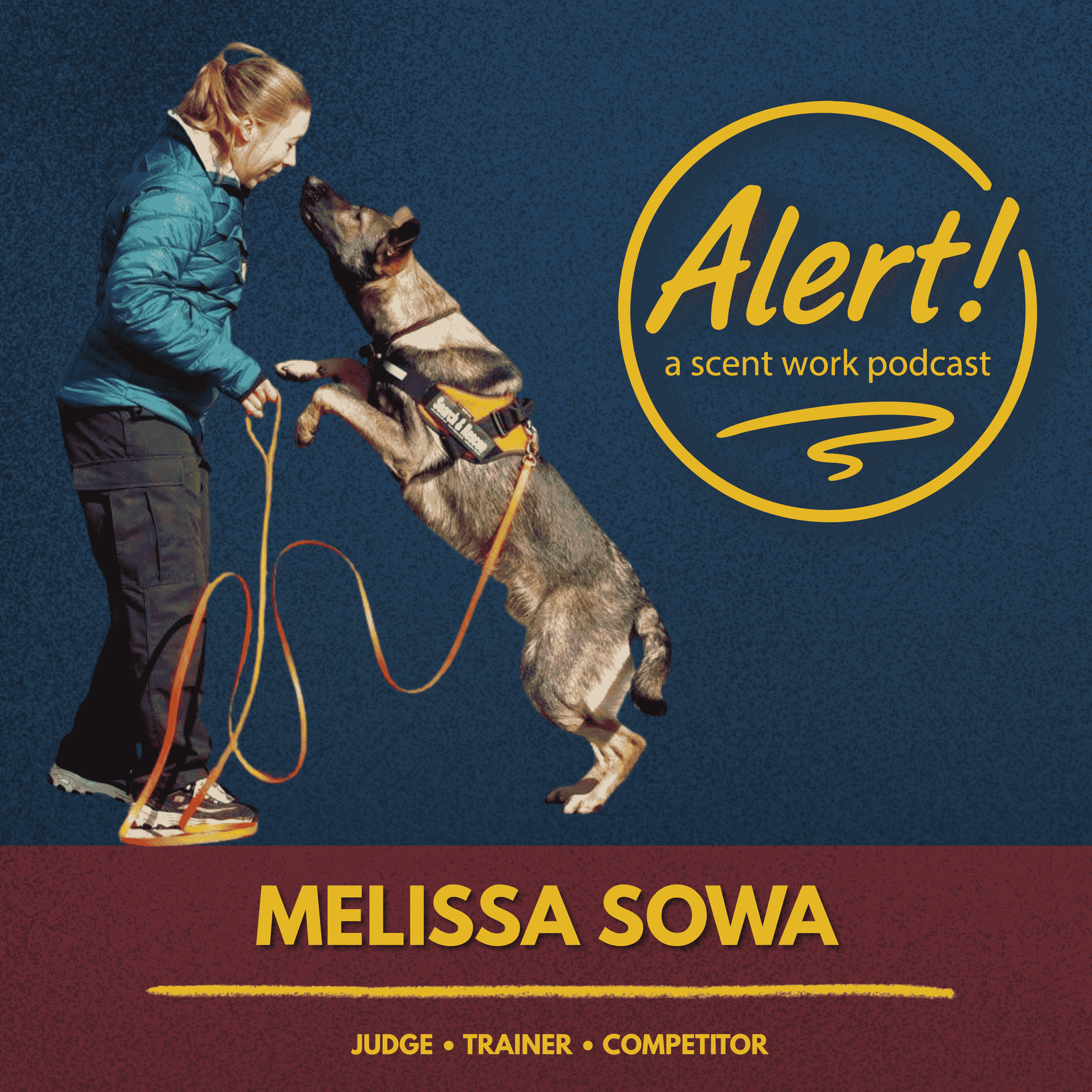


Melissa Sowa has been judging since buried hides had to be placed using a drill. She's competed through Summit in NACSW and detective in AKC, and judges for AKC, C-WAGS, and USCSS. When she talks about what works and what doesn't in this sport, she has seen it from just about every angle there is.
And a lot of what she comes back to is the same idea. Take your time. At the start line. Covering your search area. Moving up the levels. Paying your dog. It shows up everywhere in this conversation and in everything she sees as a judge.
We also spend a lot of time on the handler side of things, because in scent work we talk a lot about training the dog but there is just as much to work on as the human half of the team.
What we talk about:
- Detective search coverage, what covering an area really means, and what Melissa does before she calls finish
- One hide syndrome, why it's real, what causes it, and what to do about it
- How competing at Summit changed how detective search areas feel to her
- Memory as a skill, she said she has a horrible memory and walked us through exactly how she trained herself out of it
- How you start the search is how it's going to go
- What organizational psychology taught her about rewarding her dog
- The pay discrepancy between training and trialing and what to do about it
- Don't rush the levels, why staying and getting more practice can make a real difference
- Why you might pay for a lack of nos at the lower levels
- What she sees handlers do that costs them Qs, things that have nothing to do with the dog
- Influencing your dog, her thoughts, and how she idiot proofs her own dogs in training
- USCSS and the stupid handler trick, yes this is a real competition element
- Two judge stories, one involving a metal detector, one involving a monsoon
- Seven questions with Melissa, signature distractors, what her dogs would say about her, and what happened when she played a kitten meowing and frogs chirping as audio distractors at trials
Find Melissa:
Facebook: VForce Dog Training
Alert! Scent Work is a podcast for competitors, the parking lot conversations you'd never get to have at a trial, with the judges and community members you wish you had more time with.
Listen to the podcast and find everything here: https://www.AlertScentWork.com
Follow along: Facebook: https://www.facebook.com/AlertScentWork
Subscribe to the newsletter: https://www.alertscentwork.com/newsletter/
Who does this sound like to you? Incredibly honest, no bs, but incredibly kind to every competitor. Accomplished competitor, but humble and never condescending and a great eye for nuance with both handler and dog. You think that sounds like you?
Melissa:So, yes. But no. Like, I don't want to sound conceited and, like, cocky, because that's not me. Like, in a way it is, but in a way it isn't. So I'm incredibly humbled and flattered.
Scot:Let me just tell you, that's what the person who said you need to have Melissa on your podcast cast said about you. So you're not tooting your horn. Somebody else is tooting your own horn. And. And I love it. So this is alert scent work. I'm Scot Murphy and Keeva's dad, and today on the podcast, Melissa Sowa. Who are you dog mom to? We know Neo because Neo just got his detective and you mentioned Vader. Are there other dogs that you are mom to?
Melissa:Currently, no. So I currently just have Neo. I actually lost Vader in March. He would have been 14 this month. And then hopefully I will have a new puppy in July. We had an ultrasound a couple weeks ago and there were at least five puppies on the ultrasound.
Scot:Cool. That's exciting. All right, I. I should actually circle back around. I had one, one listener say they'd like to know what breed of dog each one of the judges have. Both of these are German Shepherds. Is a new puppy going to be a German shepherd as well?
Melissa:Yes, it will be a German shepherd as well.
Scot:That's your. That's your breed, huh?
Melissa:Yes.
Scot:Okay. Not never changing. Could I talk you. Could I talk you into a border collie?
Melissa:You probably could because I actually joke at some point I'm going to get too old and I'm not going to be able to handle these 80 pound dogs. So what am I going to get? And I definitely love pointy eared dogs and I love herding breeds.
Scot:Got it. All right. When I was doing some research, I saw you got your detective cue just a little bit back.
Melissa:Yes, yes, I have my detective cue on Neo, and then I had one on my prior dog before him, Vader, too.
Scot:I want to ask you. So now with Neo, I'm just curious, has how you think about Detective different now than it was when you first started? Is there kind of a fundamental shift in how you think about Detective, how you compete in detective?
Melissa:Hmm. So it's funny because I compete in, well, technically three venues, and to me, yes, it's definitely a different animal. It's something that I think people will need to take their time on with covering their area. And usually that's the biggest mistake I see people make is that they cover it too quickly and they usually miss it by one hide.
Scot:Is that why? Is that why? Because one hide syndrome is real.
Melissa:Yeah. Yeah.
Scot:And you think that's why we're doing. We're just trying to try to get too quick of a time. We're concerned about maybe the ribbons a little too much, in your opinion, or.
Melissa:It might be too quick of a time. It might be poor search area coverage because I'll see a lot of teams that they cover a certain area three or four times in another area only once. And so they're just not paying as much attention as they should as to how much you've covered the area. And it's like I always tell people, like, make sure you cover everything once before you cover it twice. And same deal. I wouldn't cover something four times when something else is only covered once.
Scot:Yeah.
Melissa:And then certainly if you've gotten multiple hides in a space, you might want to just double check it quick to make sure the judge hasn't put something else there and your dog maybe missed something on the way through.
Scot:I've been thinking about this a lot lately because I had a weekend where I missed three in a row all because of one hide. So I've been trying to work out what's going on. And one of my big philosophies is if I find a hide in a space, I try to hang out there a little bit longer just in case. Right. So I love that you said that. It's. It's reaffirming to hear somebody else say that. But the thing you said that really, I think is resonating with me is you'll see people covering a space four times before they have covered. You know, maybe they've only covered another area once. Do you. Do you think you should cover a space at least a couple times? Do you have some overlap and. And when you're in your coverage, if you get what I'm saying.
Melissa:So usually what I advise my students is I'll say, like, are you dwelling for a reason? Like, is your dog giving you something that you should stay for or is it just something that you, as a competitor, like, nervous or anxious about and that's why you're dwelling. It's like, should I stay or should I go? And then if I'm just dwelling to dwell, I should move on and then cover that new space and not just like, linger for too long of a period of time. So me, as a general rule of thumb for me as a handler is I try to move through the space and have like good coverage of each search area. And then when I get to the end, I purposely go, okay, like in Detective, generally you have enough time to cover everything and you're not having to rush and you're not having to be pressed for time. And most Detective searches. And so when I get to the end, before I call finish, I'll purposely kind of take like a stock of the search area and be like, all right, the exterior, did I get everything? The interior, did I give anything? Is there anything I want to go back to? And generally there's somewhere I'll go back to and just touch up and do like a quick pass of that area to make sure there's nothing I missed before I call finish and to make sure that I've got like a good coverage of that area. Yeah, because same deal when I first started in Detective, coming from NACSW, it would bite me in the butt where I'd miss it by one hide. And it was like, you got everything but one. At the threshold, you got everything but that crack hide over there. And it's like if you'd have just done one pass and as soon as I went over there and the judge let me work it like my dog nailed it.
Scot:Got. Yeah. I know how many times we all experience that, right? Yeah.
Melissa:Yeah.
Scot:And what you're referring to, just in case people aren't familiar with, so Detective is AKC and you have to be perfect. You have to get it exactly right. And in the higher NACSW levels, I think what you're referring to is you can miss a hide and you could still have a chance of. Of winning if like a lot of other people miss that hide. Is that what you're referring to? That?
Melissa:Yeah, exactly. So in I compete with my dogs in Elite and in Summit and in the Elite levels, you basically just accumulate points and you have to get enough points to keep your points for the day, but you can miss multiple hides and still keep your points for the day. In Summit, you are competing against the other competitors and only the top five competitors for the day get a title. So that definitely has a little bit more pressure there to not miss hides, but certainly in Elite or Elite P or Elite S and those levels, you can get away with missing more hides and, and those searches, you're definitely under more of a time crunch. You're not going to have typically 10 minute surges okay.
Scot:So NACSW. I haven't. I haven't. I. I've done an NW1 and that's it. They tend to have shorter search times at those other levels. Okay, all right.
Melissa:Yeah, they'll. They'll typically have two long searches that are like 5, 6 minutes with multiple hides and they're bigger search areas. And then they'll have two speed searches where you maybe have two and a half minutes and there's like four or five hides.
Scot:Got it. And has NACSW with those bigger search areas helped you in detective in any way? Like clearing a more efficiently, more quickly?
Melissa:Yeah, I would certainly say in Summit, where you have big, huge arenas. One of the first summit trials I was at, they had a huge exterior that was next to a pond. Those search areas that are just massive have made some of the detective search areas actually feel small. Where I'll do the walkthroughs and some of the competitors are like, this is huge. And I'm like, I've been in search where we had like 18 rooms and a hallway to clear. And so this feels actually quite small. And it's made it so that I'm easier able to manage the detective searches when I'm more used to these big, huge summit searches to keep track of.
Scot:Yeah, that summits. That Summit search was 18 rooms. Okay. So.
Melissa:Yeah.
Scot:All right, so we're going to get to the intro here in a second, but we've already got into such a great conversation. How do you keep track of all the things you need to keep track of? That's something I'm really struggling with right now is, you know, not only do you have to remember where you've covered, where you haven't covered, where you found your hides, maybe noticing micro dog, you know, changes in behavior to where you might want to go back to, then you got to remember where you want to go back to. In this instance, you said 18 rooms. You got to remember what rooms have you even been in, which I don't know that I could do that. Do you have a trick for that? I mean, is this a skill you had to work on or you just have a good memory?
Melissa:No. So I have a horrible memory.
Scot:Good, good. So tell us all the secrets because I do too.
Melissa:Yeah, Practice for sure. It's something that I train and I work on. And it was something that in one of the summit searches, we found nine hides. And I kept track of all nine, and I knew where all nine were when I got out to the parking lot. I was super proud of Myself that I knew exactly where they were. I counted correctly because it was something I'd worked really hard at. Because prior to that, it was a struggle for me to remember where three hides were and to walk out and know where the three hides were. So it's something that I train in my classes with my students that will purposely do a search. We'll practice where the hides were, where we found them, we'll discuss them. We won't look at the search. We'll communicate where they were. We try to train harder than what the trial is. So if you're trying to find three hides in a trial, you should be good at, you know, six hides in practice, seven hides in practice. We then try to make it more stressful for ourselves where we'll do it. And like, during the search, I'll say, like, how long have you been searching? 1 Minute, 2 minutes, 3 minutes, and try to get good at time management. And then in the middle of the search, I'll be like, how many hides have you found? What hides have you found? I'll put all of them on trash cans. I'll put all of them on picnic benches so that it's all the same type of item. And then at the end, I'll be like, what order did you find the hides in? You know, and make things more difficult in training. Then it's going to be in the trial. And then I won't let them look at the search area because you obviously can't look at the search area area. And a trial to remember where you found those things.
Scot:Okay.
Melissa:And then I'll have them practice that with each other's dogs too, where, like, you're watching, like, the other people in your classes dogs, and then you're keeping track of what hides they found in what order. So then you get that extra practice too. And then you're not having to run the dog. And so it's just practice. Like, lots and lots and lots of practice. And same deal. Like, you could even practice it if you're volunteering at a trial. Like, what order did that dog get those hides in? And then kind of recount it back to yourself at the end of a search. And I will say it definitely gets easier as time goes on. But you have to have that practice and training. And then when you go to a trial, you have to have a plan. Like, for those 18 rooms, I have fast dogs that tend to be kind of hectic and chaotic if left on their own. And so when I saw that it was 18 rooms, and that was a Bonus search that you had to check all of the rooms and you had to check all of them. So you had to go into every single room and then call, finish without, I believe, a 30 second warning. And if you did all that, you got the bonus. And so I was like, well, then I've got to manage the search. I've got to basically go room by room by room and clear it. And so that was my plan, is I'm going to check them each individually and just go back and forth left to right and check each room. Whereas if I just kind of let him loose and like Helter Skelter, like, there's no way I could have kept track of that and like managed that search. And so I think that's part of the problem too is so many people just step up to the start line, they don't have a plan, they rush the search and they just go. And then everything kind of falls apart. Whereas if you have a little bit of like a plan A and a plan B and then you take your time at that start line, like, nobody's timing you. You know that I'm a judge. I'm not going to rush you at the start line, like, take a minute, get your bearings, like get your dog together and then like, step forward and like, have a good search versus being like super stressed out and just rushing through that start line. And then typically, like, however you start the search, that's how it's going to go. So if you rush it, it's probably going to go poorly. If you take your time and set up, it's probably going to go a lot more smooth.
Scot:I love what you said about just, you know, we think of training as we have to train our dogs on the odor pictures. We have to train them on the different puzzles they might have. But we don't really ever talk. And, you know, maybe we do some leash skills, you know, as handlers, maybe we do a few of those things, but we don't really talk about like all the other things, like dealing with stress that you brought up, which I love that you put your students under stress. Because when you're at a trial, making good decisions under stress is hard. So you expose them to that. And then, you know, also all the memory exercises you do because it, it is like a muscle, right? You have to start developing that muscle and those skills and those tricks that you're going to do, that's going to work for you to remember. So the more you are forced to do it, then the more you start to develop that Skill. So I want to get into your scent work origin story. This is something I ask all my guests, and I find it fascinating. A lot of times there's similarities, but sometimes there's difference. So at one point, Melissa, in your life, there was not scent work. Could you imagine?
Melissa:Yeah, yeah. There was not scent work.
Scot:Yeah. So what was the first step into this world?
Melissa:So mine kind of started, I think, like a lot of people do, where I got a dog. I got Vader, and I actually got Vader to do agility with. And so I got him as a puppy, and I went to a breeder, and I said, I'd like to get a pet, and I want to do agility with him. And the breeder assessed the litter for me, and she said, this is the one I think you should take for agility, and it would be a good match for you. And so we took the puppy home, and we did puppy classes, and we did cgc and we actually did therapy dog. A lot of people didn't realize that I did a therapy dog certification with him, which I jokingly say, but it's true. He could pass the therapy dog certification, but he was not a therapy dog because he was obedient, and his temperament was sound for it. But he was not a kind of dog that would have just loved to do therapy work and be, like, socialize with people unless there was something in it for him.
Scot:Right. Okay.
Melissa:And then after that, we did agility, and we did agility for quite some time. And a lot of people don't know that I did agility, but it actually helped me in scent work because it taught me a lot about how our body language can influence dogs and like that if our feet are pointing at a height, our shoulders are pointing at a height, our hips are pointing at a height, and our dogs can pick up on that, and they can start to realize that, hey, every time we set these hides, we're directing them, the hides, with our body language, and we're not really realizing that we're doing that. And we can cause problems in our dogs with these subtle handling gestures that we're doing or that things that we do that we think we're not doing are putting pressure on the dogs or we're pulling the dogs off of hides. And so that agility background actually helped me with scent work. And then from there, I actually did search and rescue for multiple years with Vader, and I became the unit leader in our team and a certifying officer and evaluator for search and rescue dogs. And I started teaching others on our team, which is what led me to teaching scent work as well. And while I did search and rescue, the breeder of my dog started doing scent work. And it seems really cool what she was doing, and I really liked it, and it was very intriguing to me. And when I talked to some of my mentors in the search and rescue world about should I do scent work with my dog, quite a few of them told me that they felt it would make me a stronger handler and that it would make me a better trainer and that it would teach me more about reading my dog and search and rescue. I did have a few people tell me not to do it, that it would ruin my dog.
Scot:Right.
Melissa:But the ones that advised me to do it, I really, really trusted because they were people that had been training scent dogs for longer than I've been alive. And so I started training him on my own at home without an instructor, and the breeder was giving me advice, and we were working together and training him. And I did an ORT without taking any official classes, and we passed on the first try. Which, looking back now, is kind of crazy, right?
Scot:It is. It's totally crazy, right?
Melissa:Yeah. Like, we didn't do any classes. We didn't have any, like, formal instruction. And I trained at home and I trained at the breeder's house, and we met up and did an ort. And then while I was at the ort, I met an instructor there that taught nose where classes, and they invited me to join their classes. And then I went to an NW1, and same deal. We passed on the first try, but I didn't know the rules because, again, I wasn't really taking official classes. And so when we left, I was really confused because our time was fast enough that we should have had an overall placement, but we didn't get one. My dog smashed boxes at that point in time. And I didn't know that was a fault because, again, I didn't really know the rules. And so that really taught me to help my students understand the rules and help them before they go to trials and kind of fix all of that for them, because, like, I didn't really have an instructor, I didn't really have a trainer to, like, do that kind of stuff for me. And so that kind of helped me understand how to prepare them for trials so that they don't make the same mistakes that I did. And then we passed our two, and we passed all three of our threes on the first try, too.
Scot:Wow.
Melissa:So, yeah, Vader was kind of like, very special for me because he made stuff very easy. In some ways that was good and in some ways that was bad. He was this dog that you could basically wake up and be anxious. Like how we were just talking about so much. We talk about the dogs and puzzles and hides, but we don't talk about the handlers. He was a dog that you could be anxious, you could be not feeling well, not at your best, and he would just kind of carry you.
Scot:Yeah.
Melissa:And he did that for me a lot. Whereas Neo is very sensitive. And if I'm super stressed and having a bad day, Neo definitely does not perform as well and is like, what is happening? Like, what is your problem?
Scot:Yeah.
Melissa:So Neo has definitely taught me that, like, handlers are an important role on the team and how to help handlers better support their dogs.
Scot:Yeah. So if I'm hearing correctly, it sounds like search and rescue SAR was kind of your first foray into the dog using the nose, and then you got into scent work just to become a better, better SAR handler. Am I understanding that correctly?
Melissa:Yes. And then.
Scot:And then the sport kind of just took over. Is that.
Melissa:Oh, yeah, yeah, yeah. Actually, I don't do search and rescue anymore. I was in it for nine years, I believe. And then, yes, scent work took over, like, as my main sport. I teach it now. I also teach veterinary technicians at a college, which technically scent work. And it led me to that too. Like, I used to work as a veterinary technician out in the field and then from teaching scent work classes, I actually started teaching at a college too, for veterinary technicians. So, yeah, it completely, like between getting Vader and getting into doc sports, it completely, completely changed my life.
Scot:Yeah, it really did. It really opened it up a lot. Yeah. This is going to be a really weird question because everybody else would look at, you know, your background as a vet tech or your background as a search and rescue dog handler and trainer. I'm going to look at your background in organizational psychology. And it's crazy question, but sometimes there's cool connections. Anything you learned while you trained in organizational psychology contribute to your understanding or training in scent work or judging, judging or trialing.
Melissa:So it's funny because the big thing that I learned there is money isn't the biggest motivator for people. It's the culture, it's the environment, it's all of these other factors. It's that make people happy.
Scot:Yeah. I thought you were actually going to go a whole different way. I thought you were going to tell me that the relationship between me and my Dog is more important than the treats that I'm giving him.
Melissa:And so, you know, you're not wrong in that regard either. That's actually one of the things that kind of drive me crazy as a judge is when I see somebody come into a search and they don't treat the dog.
Scot:So pay that dog, pay that money.
Melissa:And then two, it drives me crazy when somebody comes to me as a student and they have a dog that's soft or it's low motivation or something of that sort. And they bring like dog treats. And then I have like these working line German shepherds that like Neo will eat lettuce. Like, he'll eat anything. And he, he's super high food drive. He's an incredibly confident dog. Nothing in the environment bothers him. And the treats that I use for him, like, I'll buy Dunkin Donuts, bacon, I'll buy pepperoni, salami, culver's cheeseburgers. Like, I'll have volunteers at a trial be like, what are you giving him? And I'll be like, chicken nuggets. And it's like. And it shouldn't just be food. Like, you shouldn't just be pushing food at the dog. It should be like this celebration, this event where I'm often like tossing treats away from the hide, tossing treats at my dog, throwing them up in the air. Like Vader, I had to be really calm with and keep my play kind of down to keep his arousal levels down. Whereas Neo, I have to really celebrate and be a big cheerleader to make him motivated for searches. Like, we have to play together a lot. So yeah, certainly for Neo, like, money isn't like, definitely is big. I think I could probably give him pepperoni. And if I was just lackluster with my paychecks, even if I gave him like a whole bag of pepperoni, it would not be as rewarding for him as me, like, praising him and like being enthusiastic and putting like my voice and like my energy into the play with him.
Scot:Right. I feel like a lot of dogs are probably more like that. So the organizational psychology teaches you, you know, I mean, sure, people will take more money, but it's the way they feel like because they have worked for you.
Melissa:Yes.
Scot:So having those big parties helps your dog feel a little bit better, I suppose.
Melissa:Yes, absolutely.
Scot:I want to talk about judging for a second here. You are an AKC scent work judge. Is that the only organization you judge? Just want to be sure.
Melissa:I also judge for C-WAGS and a USCSS judge, but I mainly judge for AKC.
Scot:All right. So I've never ran under you before, so I'm just curious, what can I expect when I run a Melissa saw a search? Like, do you have a philosophy? Do you have certain skills you think are important to test? Like, how do you think about the searches? You said, I really want to get in your head here.
Melissa:So to me, I look at the searches as a judge the way I would kind of want to be treated as a competitor, that it's fair for the level, that it's not too hard, it's not too easy, that I don't like, for instance, in Detective, that I don't enter it and go like, wow, that was really easy. It was just a bunch of novice hides that were out there, and that was, like, too easy. And it doesn't really feel like much of an accomplishment.
Scot:Right.
Melissa:But at the same time, it needs to be doable. Like, it shouldn't be so hard that it's impossible and that there's hides that, like, nobody's finding. And then same deal. Like, if it's a novice search, it should be easy. It should just be a basic hide that your dog can come into this novel space and find odor and let you know. And you should be able to call it. It shouldn't be overtly difficult when it's a novice hide. And so I try to set searches that are fair for the level and at the same time that are fun. I want people that pass or fail. Like this past weekend when I judge Detective, it meant a lot to me that the competitors, even the ones that failed, were saying things like, that was a lot of fun. Thank you. And I think the pass rate was 7 out of 30 or 32 docs passed. But the people that didn't pass, they weren't upset about it. And they were like, thank you. That was a lot of fun. That was a really cool search, which the club had a really nice site, and they gave me this library that was having a book fair. And so the search was also a really cool environment.
Scot:What does a fun search mean for you? Like, you're a judge. You go into a space. It sounds like. I mean, it sounds like the space can make it fun. Right? Like, if you're in a fun space, that's a big part of it. That's not something you can necessarily always control. But if you have a fun, you know, a good space. But when you're looking at that space, like, how do you think, all right, I'm going to make this level appropriate. You probably go by The AKC judges guidelines, which if you're an AKC competitor, you should read those because they tell you each level, what judges are testing for. But beyond that, how do you make it fun? Like what makes a fun search to you? Beyond just, it's not too hard, not too easy. It's kind of in that sweet spot.
Melissa:Yeah, I, A lot of times I'll have like some kind of like theme where I'm like, okay, what am I testing at this level? Do I want to have like threshold heights? Do I want to have like corner hides? Do I want to have like a cover your search area type of deal? Like specifically what am I wanting to set here? And usually that's what I'll kind of like look at the space for is like, what does this space offer me? Is this a good space to set something where it's like, hey, just cover your search area. And if you cover your search area, like that's what we're looking at here. So this is a good one for like corners.
Scot:Right? So maybe the search area is kind of complex. Got a lot of different spaces. And that space you might go, this is going to be a cover your search area space to a simple room, which might not be necessarily a cover your search area space.
Melissa:Yep, exactly.
Scot:Got it. All right, and what are some of the other things I kind of cut you off there? I just want to clarify, you know.
Melissa:Yeah, sometimes I'll do like a non object where I'll do like a crack hide or like a hide on a wall. And it's like, don't just check the chairs and tables. Like, make sure you're actually covering like the area. Because that's another thing I've seen is that you have like this big concrete pad or one time I had a search area that half of the search area was just gravel and people didn't even check it. Like they just went and checked all the stuff. And the teams that went out in the gravel, it was so cool to watch the dog source the hide through the gravel and like snake through it. Like almost like water flowing through it. And like they all got it, every single dog. But the people that just checked the stuff. And I'm like, you can even cover half the search area, like of you to just come out here and like to me like, yeah, it sucks to fail, but like a no teaches you so much more than like that. Yes does. And it then like builds so much on that. And I always tell my students when they go to a trial and they fail something, it's like, yeah, it's great to get that ribbon. And like, certainly I don't want to fail. And I also don't want to fail people. Like, I'm not out to get people. But at the same time, like, if you go through all the levels with no no's, like sometimes then you crash and burn and then you're like, why am I failing all of a sudden?
Scot:Right? Yeah, it all just kind of. It kind of all falls down at once and that could be really frustrating. I ran into that deal we at the lower levels, we did really, really well and then it kind of all came crashing down and. And we had to really figure out a lot of stuff. So I love that. I love that. Do you think about. So you think about puzzles for dogs, I'm sure, right? Like high lines, high hides, crack hides. And it sounds like you alluded a little bit to puzzles for handlers. What are some other handler skills do you kind of think are important to test for?
Melissa:So I have done. There was one detective search that at this last trial, one of the, the trial secretary was like, I'm going to check all those carts. I had put multiple hides on carts. And so it was a little bit of a memory puzzle to remember like which carts, which they can technically call them again. And it's a fault. And I always tell people, like, call it anyway, like, who cares? Get the fault. I've done it before and just called it again to be safe. And so it was a little bit of a memory puzzle. I think I had four hides on various carts and most of the handlers did really, really good with it. Where they were like, I got that one, I didn't get that one. And so I've done some of those before in the past too.
Scot:Have you been seeing anything recently that we could learn from? So as a judge, I mean, you see so many, so many teams work so much searching. Is there something that you're seeing kind of nowadays that if we did or didn't do, could really make a difference for us? And you can think of any level.
Melissa:So I think one of the biggest things I see is a lot of people will rush up the levels. And one of the biggest things I love about AKC is that you don't have to rush up the levels. And so just because you've passed novice, don't feel like you have to move to advanced or just because you've passed advanced, don't feel like you have to move up to excellent. Because then I'll see teams that they get to like Master and they'll be in eight entries for the weekend and they'll pass like one of them. And then they're super bummed and they're super depressed and it's like you can keep, keep running at X length, get that extra practice, get those elite cues and it doesn't hurt you to stay there and, you know, get that extra time and the ring for you and your team to kind of mature. And I don't know why people are in such a rush to get from like novice to master in a year or something, but I think that it really is helpful for teams that AKC will let you continue to play in the levels and then you can kind of purposely work on that and be like, well, let's just do novice. It's one hide. And then I can pay the crap out of my dog in the ring and really spend that time to make them feel good about themselves in a trial environment versus continuing to just rush up those levels. So that would be a big one. That I would say that I see people do is that it's like they move on before they're ready and then they kind of crash and burn when they get up into Master or they get up into Detective and same deal, don't rush up into Detective until you're ready. The other thing that I'll see people do is that they kind of rush into the search areas and I kind of mentioned that a little bit earlier, that they'll walk up to the start line and instead of taking time to get like their leash situated, their dog situated, look at the search area, take a minute, relax. Like, I always kind of like, let my breath out, relax my shoulders, make sure my dog's ready, make sure I'm ready. Like, if you have a sensitive dog, let it look around at the room. Like, let it make sure it's safe. Like, take that extra second I have to relax myself and then I rev my dog up and get him like, stimulated and into the right, like, frame of energy to work. And then we go. Whereas a bunch of people will walk in and it's like they're in a hurry, hurry, hurry. It's like they think that, like, I'm waiting for them and that I'm rushing them. And that's not the case when I'm judging. Like, take your time. And then when you rush through that start line, like the whole search is just rushed and then you're stressed and the dog's stressed, and then you might miss part of the search area or you might like, talk your dog into something or you might rush calling an alert or. Whereas I feel like when you take your time, the search just goes so.
Scot:Much better and smoother, you know? So what you're talking about is a start line routine. And I think a lot of people kind of have a start line routine, but maybe not taking it to the level that you're taking it. Insofar as we're always focused on the dog, you know, is the dog looking forward? You know, is the dog ready to go? But sometimes we don't consider ourselves. And I think this advice would have saved me a couple of mismatcher searches where I didn't have a walkthrough beforehand for whatever reason. And I missed. I missed a big part of the search area because I didn't have a chance to do the walkthrough process at. Think about it. Right. So just take that time at the line to do what it is you need to do and. And think about what are the. What's your routine going to be? What are the things you need to do to get ready. I love that. I think that's a great piece of advice.
Melissa:Yeah. And I've told competitors that too. When they come up and they're like, I wasn't here for the walkthrough, I'll say to them, like, is your dog okay for somebody else to hold it and we can go do a walkthrough together? And the one lady said, no, she's actually not okay for somebody to hold her. And she was like, but she'll stay here in a down if we can go do, like, the walkthrough with her in a down. And I said, that's fine. And so the dog held a down stay while I showed her the area. Whereas some other dogs, people have been like, yeah, she'll be fine here in a down with a handler and a person holding her leash. And so then, like, I'll go walk you through the area. Like, that's not a problem. If you were somewhere else and you missed the walkthrough, most judges are quite happy to give you a walkthrough if you need one or you missed one. And I especially, like, for the upper levels, for excellent for master, for detective, I think that you should always get a walkthrough beforehand. Otherwise you absolutely do. You'll miss an area or I think you even just feel like out of sorts.
Scot:Yeah.
Melissa:Like you feel stressed without seeing it.
Scot:Right, right, right. I want to circle back to the idea of at AKC. Don't rush into that next Level just quickly with a sentence or two. I just want to clarify. So NACSW make you move up after you do your NW1, is that what you're referring to?
Melissa:Yes. So in NACSW, once you have your NW1, you can't stay there unless they don't have enough entry. So, like, if a trial doesn't fill, then you can enter one FEO for exhibition only. And I actually encourage people, if you see any trials that haven't filled 100% enter them. There have been some Elite P's in our area and I think every now and then there's been like an elite or an NW3 that haven't filled. There was actually an NW2 trial here. It didn't fill. So I took my summit dog with me and I ran an FEO and an NW2. That is fantastic practice because then he's getting a trial environment, he's getting novel search areas, and since it's an NW2, it's a known number of hides, and I can, like, spend all this time paying him and partying with him at the hides and making him think that trials are fantastic. Because that's another thing I think that we as handlers get really bad at is that we go to these trials and we give them one cookie and then we're like, hurry up and find more. Whereas in training, we pay them and some dogs have gotten trial savvy where they're like, in training, you pay me really well and we have this big party and you're really cool to hang out and play with, and then we go to a trial and you're super stressed and you rush me around and you give me one snack and, like, it kind of sucks. And they get where they're like, I don't really want to work for you very well at trials, because, like, the pay discrepancy here is so different. And so it is something that I will actually advise people to do is when you go to a trial, you need to pay better, more, similar to training. And yeah, it might take you five seconds more to pay more, but. But your dog might work better and faster, and so it might actually pay off and your searches might be faster, even though you're taking more time to pay, if that makes sense.
Scot:Makes total sense. I think that's such a great idea. And I'm going to say, for akc, one of the things I did is if I wasn't quite ready for the next level, but I could move up, I would run both levels. So, like, if I was moving up to excellent. I'd do a full load of excellent runs, but then I'd also do a full load of advanced runs because you can do up to two levels and still get credit for it. And then that way it was psychologically good for me because if I tanked my masters at least, or not my masters, if I take my excellence at least, you know, I probably got my advanced, so at least I'm feeling decent about myself as opposed to leaving their own four, you know.
Melissa:So it's funny. We, like, the dogs get where they're conditioned to yes or clickers or what have you, but we also get conditioned to hearing that yes, yes. And when we don't get as many yeses, like, we feel glum. Whereas when we get those yeses, like, we feel really good about ourselves too, like, we definitely get conditioned.
Scot:We absolutely do. One last thing on being a judge, I don't know if you have a good story you'd like to share about a time that a search you set went sideways or maybe there was a particularly particular challenging search to set up, or maybe just even a funny inside story. Just either any one of those three that you feel comfortable with. Give us a little insight into judge's life.
Melissa:Technically, there's two that could go either way. I've been judging since the very beginning. I actually judged the opening weekend. So I've been judging buried since it's been in the ground. Yes, yes. And we had to dig in the dirt. And a friend of mine who is fantastic at making things, she made this drill with a drill bit so that I could drill into the ground to place the buried hides. And you also had to place, like, fake vessels that didn't have anything in them that were clean.
Scot:Right.
Melissa:And so we used this drill bit to place all the vessels and everything. And so we ran all the dogs, and it actually went pretty well. And we had a couple cues back then in that run. And we then left the hides there, and we were like, we'll get them at the end of the day and kept running like the rest of, like, the searches. Well, when we went to pull the hides, then at the end of the day, we had put them back. Then they would let us put them on, like, fishing line with, like, a little, like, keychain device to, like, pull them out of the ground. And so we started pulling them all out of the ground, and we couldn't find the last one. And we actually used a metal detector and could not find the last one. And so our only thought was like, somebody must have Come out here as a competitor and, like, taken it because literally, with a metal detector, like, we could not find it. It was nowhere to be found on the ground. Like, completely gone. Completely, like, missing, like, never to be found again.
Scot:That's crazy.
Melissa:Yes.
Scot:Did you comment on the Facebook page? It's all fun and games and buried searches until somebody has to call for a metal detector.
Melissa:Yeah, I don't know, but it was, like, ridiculous. And I'm like, I'm so glad they got rid of that.
Scot:Yeah, I laughed out loud at that post. I didn't realize that was you that posted that story.
Melissa:No, I didn't. No, I didn't post it on there.
Scot:Oh, well, maybe somebody else had a symbol.
Melissa:Maybe somebody was at that trial and, like, commented to somebody and, yeah, it was a nightmare.
Scot:The find that was never found. What was your other story?
Melissa:It was, again, very early in my career, I placed a hide outside in an exterior. It was in master, and it monsoon, like, absolutely poured. And it was a hide that was on the wall of a building on, like, a spigot, like, for a hose. And it stayed there through this monsoon, through all the dogs running. And then it was the very last dog, and she calls an alert on the ground. And I said, no, sorry. And then as she's walking away and I start walking over to, like, go pick up my hide, I see that the hide has finally come loose from the spigot, and it's on the ground where she called it. And so I then had to chase after her and be like, wait, come back. You passed. Like, that's the hide. I'm so sorry. It's fell and got dislodged finally from, like, all of that. Right? And she was so happy, and she started jumping up and down, and she goes, finish. And I was like, you're fine, you're fine.
Scot:Fantastic story. I can't even believe how fast the time went. I have so many more questions, but we got to wrap this up. I wanted to talk so much about something you talked about earlier, because this is something that I've had judges tell me about, which is my influence on my dog during. During searches. I've been getting a lot of that feedback lately, and I didn't. I thought my dog was a little bit more bulletproof than that. So, like, in some ways, I question whether that's what they're seeing. But on other, you know, the other hand, I, I. I trust them because, you know, and when I train, like, if he's on odor, I proof him against, like, I will Keep walking and he will pull against me. So it's hard for me to believe that at times. Do you have any. Do you have any thoughts? This is a selfish part of the podcast where I ask you to trouble.
Melissa:So one of the things people is so I hate giving advice as a judge, but I'm. I also give advice as a judge. And so, like, it's a love hate relationship where, like, I try not to give advice, but then I know I give advice as a judge because I'm only seeing you for 10 minutes or one minute, depending upon the type of search that it is. And so I will say that when I give people advice, I always say, take this with a grain of salt. I'm seeing you for 10 minutes, or I'm seeing you for one minute. I just noticed this. But it might just be that it's today or it doesn't apply to your dog. But generally, what I tend to tell my students is if you just get one no in a trial, write it off. It's a fluke. But if you get a two nos today and then a no tomorrow, now we got a problem. Like, now we certainly have a false alert problem because you got three false alerts this weekend. Whereas if you just got one false alert, like, don't harp on it and obsess over it, or if you just missed one hide, don't obsess over that hide. But if your dog missed like four inaccessibles this weekend, then we certainly have an inaccessible problem.
Scot:Or if it starts becoming a pattern, right?
Melissa:Yes, exactly. Exactly. And so I would say if you're having multiple judges make that comment, it would make me a little suspicious. But at the same time, like, they're only seeing your dog for a minute. So, like, what are your instructors seeing? Like, what are your training partners seeing? And then I do tend to do the same thing where, like, my training philosophy is I want to make an idiot proof dog. And I tell my students, I'm not calling you idiots because I want to make my dogs idiot proof too. Because when I go to a trial, I can be an idiot and pull them off of a hide or rush them off of a hide, or not cover a search area. And I want my dog to get a hide in spite of me doing dumb things. And so I'll do the same thing where, like, I try to rush them past the hide, I try to pull them off the hide, I'll turn my back on them when they're sourcing the hide. I'll talk while they're sourcing the Hide and be like, hey, is this in play? And stuff like that that we might do in a trial. Because I can't tell you how often I see people turn their backs on the dog in the search and it's an odor. Or they turn and look at me and go, is this in play? And their dog's alerting and they're not paying attention because they're worried about, like, what's in play and what's not in play. And it's like, I don't really want to answer you because your dog's alerting and I'm kind of hoping you'll look at your dog.
Scot:Right.
Melissa:So I definitely would say in training, like, proof your dog off of yourself as much as you can and try to make it where, like, your dog can work, like, no matter what you're doing. Like, USCSS has all of these games where, like, the handler moonwalks, the handler skips, the handler acts like a T Rex. And you have to do that in the competition and then your dog still has to source the hide.
Scot:Yeah, this is part of the competition.
Melissa:Yes, yes, yes.
Scot:That sounds fantastic.
Melissa:It's a lot of fun.
Scot:Yeah. So that was USCSS you said. Yeah, I've heard a little bit about them. It sounds really fun. They don't really offer it where I am, but I didn't know that that was part of the game too.
Melissa:They have the traditional containers, interiors, exteriors, etc. And then they also have these like, game type things. And that's one of them is where you basically pluck something out of a hat and whatever it says on the slip of paper, like, that's what you're gonna have to do is like the stupid handler trick. And then your dog has to source the hide while you're doing the stupid handler trick.
Scot:That is fantastic. I'm gonna. I even more now wanna seek out one of these trials.
Melissa:They're a lot of fun.
Scot:Yeah, that sounds like a lot of fun. All right. Right, we're gonna have to wrap this up. And I always wrap up every episode with something called seven Questions. I have seven questions for you. First thing, first thing that comes to your mind and just keep it one or two sentences. If I want more, I'll. I'll ask for more. Are you ready?
Melissa:Yes.
Scot:When you step up to the start line as a competitor, what goes through your mind? We talked about that earlier, that, you know, you should take a moment. What goes to your mind at the start line?
Melissa:So my start line routine, where I basically let my breath in and Out. I drop my shoulders. I fix my leash. I then look down at my dog and make sure that my dog is ready, that my dog's not, like, distracted looking at anything in the environment. Usually, Neo will look up at me and focus at me when he's ready. And then once he does that, I'll put him into drive, and I put his arousal level where I want it for that particular search at that particular time of the day, which is different on a different search day by day by day. And then I'll send him into the search. And then I usually also have in my head some sort of, like, search plan. Like, I don't just walk up, and I'm like, let's go. Like, there's some sort of, like, plan A, which is generally, I'm gonna follow the dog unless the dog gives me a reason not to follow them.
Scot:Okay. All right. I love it. What do you wish competitors knew about being a judge?
Melissa:The judges can be sensitive, that we work really hard, that it's a very long day, and that we put a lot of thought and effort and time into trying to make things fun for you. And then you say things like, this search was awesome. I had a lot of fun. Like, it means a lot. Whereas when you seem, like, really upset and unhappy, like, that might be something that, like, I think about for the rest of the day.
Scot:Yeah. Yeah. In that situation, if somebody was unhappy, would you want them to ever come up to you and talk about why, or do you just want to just leave it at that one?
Melissa:Yeah. 100. Like, to me, if you think that I've done something unwrong or unfair, I'm not a mean human. I will 100% talk to you about it, and we can have that conversation. And if I ever feel that I've done something wrong, I always try to err on the side of the competitor.
Scot:Is there a piece of advice that stuck with you that you just kind of keep going back to that you got early on or at any point in your career?
Melissa:Actually, there are multiple. Because I have been very fortunate in my career to have really good mentors. One of them is to always put the dog first, that no matter what you're doing, the dog comes first. And for instance, one of my certification tests, I felt my dog was getting overheated because it was 95 degrees in early April, and the day before that, it was, like, 40 degrees. And I actually called and stopped the test, which meant I failed because I was worried about my dog.
Scot:Putting your dog first? Yeah. As a judge, do you have a signature distractor? Something that, when I show up, I know. Oh, there's Melissa's distractor.
Melissa:There are a couple. One of them is a little baby Yoda.
Scot:Oh, yeah.
Melissa:Yeah.
Scot:Well, I guess you had a dog named Vader, so that makes sense.
Melissa:Yes.
Scot:What's your other one? You said there's a couple.
Melissa:There's a starfish.
Scot:Okay.
Melissa:It's a little, like, water toy. That's quite cute. That's a rainbow, like, crinkly toy.
Scot:Yeah. And you just like it because it's cute. Is that why you would bring it?
Melissa:It's cute. Yeah. And I tend to, like, if I'm gonna use a toy, like, something big, so that if a dog does grab a hold of it, like, there's no danger to the dog and, like, swallowing it or anything like that?
Scot:Yeah. That's good. If your dog could describe you in one word as a handler, what would that word be? Or you could do a sentence if you want to. What's your dog saying about you as a handler?
Melissa:That's a good question. I would hope they would say fun, because we have a lot of fun together and we do a lot of cool things, and I would suspect that it would be fun, but I also feel like they would say that I'm very fair and that we're very, like, consistent.
Scot:Cool. What still delights you about scent work as a sport?
Melissa:Work. Ah, what still delights me. So one of the things that I love about scent work, which is kind of ironic because my dogs don't have these problems, is I like working with handlers that the dogs are sensitive or soft or scared, and I really like making those dogs pushy and confident. A couple of my students, the dogs came to me where they were really meek and soft and, like, wouldn't, like, put their paws up on a picnic table bench. And one of those dogs actually jumped up on a table that's, like, my waist level the other night and, like, made my mouth drop open and kind of gasp.
Scot:Oh, that's so awesome.
Melissa:And her husband was complaining that the dog, like, got up on the counter the other night, and he was like, it's that work you guys have been doing. And I was like, don't tell him. She jumped up on that. That table. But at the same time, like, I love it. Like, she's so confident now. Like, to me, like, that's, like, life changing for that dog, that she's more confident and she's not as timid.
Scot:That's awesome. Is there a rule that you think Every competitor should know because it will really help them. Is there kind of one rule? I mean, you should read the whole rule book, even though it's, you know, not the most interesting read, but there's some stuff in there that can save your cues, you know?
Melissa:Yeah, you should for sure read the rulebook. I think another one is. It seems like a lot of people are afraid. It's like, they don't seem to know that they can restart their dogs, that they can touch their dogs, they can feed their dogs. I don't know if some of that comes over from, like, AKC Obedience and like, rally and things like that where. Or even, like, some of the other disciplines where if you give too many cues, like, you get in trouble if you touch your dog too much, like, you get in trouble if you give food in the ring, like, that's a no. No. And so I think those are some of the biggies is it seems like people don't realize that once they start the dog that they can. You can literally, like, do a brand new start line routine again. Like, you can stop your dog, like, completely redo the start line routine. You can touch your dog as much as you need to talk to them, as much as you need to, like, as long as you don't say alert, like. Like, nothing's gonna happen.
Scot:That's. That's a very great. That's a great answer to that question, because a lot of the answers tend to be, like, straight out of the rulebook. This is more like preconceived notions from other sports. And that when you come into scent work, that you can actually do those things. You can be supportive.
Melissa:Yeah.
Scot:In a way you can't in other sports, which maybe that's one of the reasons why scent works so great for dogs. Right? Yeah.
Melissa:Yeah.
Scot:All right. And finally, if you choose to have a music distractor, what's the playlist?
Melissa:Oh, so I have done some audio distractors before. One time I did a kitten meowing and everybody freaked out.
Scot:Oh, no. I mean.
Melissa:And the dogs were fine. Like, literally the dogs were fine. The people were passed. Like, the dogs were passing. The people were passing. But the handlers.
Scot:Yeah.
Melissa:Were, like, freaking out about aids.
Scot:Yeah, absolutely. And see why they would.
Melissa:The dogs did fantastic. There was another time that I did, like, frogs chirping and I think only one dog, and it was actually my student's dog was, like, distracted by it. And otherwise, like, the rest of the dogs were, like, fine.
Scot:Yeah.
Melissa:And so I thought it was funny that, like, the. And I've I've seen that before where like a lot of handlers will be like, oh my God, grass. Or like, oh my God, this. And then it's like the dog's are fine. And it's like sometimes I think we work ourselves up into a tizzy as handlers and it's like you've trained this, like you've done auditory distractions, like your dog's going to be okay. Like, don't stress.
Scot:We have a local trial that's at a year round haunted house. You know, one of these things that's set up year round and then they just run it a couple months out of the year. And a lot of people were freaked out about some of the monsters and creatures in there, that their dogs were going to be obsessed again. It was another one of these situations where it, it was probably worse for the handlers. The dogs didn't care, right? Dogs literally didn't care. Or if they did, it's kind of like what a distractor should do. You know, it distracts the dog for a couple of seconds and then they get back to work. I mean, that's fine, right?
Melissa:And I mean, I've had crazy things in searches. Like we had a live mouse in a search. We had like a cat in a search. There was a dead deer in a search. There was a. Yeah, yeah, there was a dead deer in a search.
Scot:Did you not know that when you set up the search?
Melissa:So that wasn't a search that I set up, but it was a search that I was trialing at and all of the dogs were like super distracted and I guess they didn't know it was there. And then at the end of the day, they looked and there was a dead deer there.
Scot:Oh my gosh.
Melissa:Yeah.
Scot:Wow, that is crazy.
Melissa:Yeah.
Scot:All right, but I'm gonna still nail you on the question here. If it's a music distractor, what's the playlist gonna be? I want to find out what kind of music you do.
Melissa:Actual music. So I actually love a lot of different kinds of music. So I tend to like rock, I like metal. Like I'll like old stuff like Ozzy Osbourne. I like newer stuff like Disturbed. Like we're gonna get see. Yeah, like we. We have tickets to Godsmack this summer. We also have tickets to Weird Al this summer. So I like pop music. Like I would listen to Taylor Swift. I also like techno. Like there's some bands that I could name like VNV Nation or NW1 that a lot of people are like, who the heck is that?
Scot:So if I ever show up on one of your rounds and you have a music distractor, I could, I could expect. Very eclectic playlist, it sounds like. Yes, a little bit of everything. Melissa, this is fantastic. Thank you so much for being on the show. How to connect with you. I have vforcedogtraining.com is that. That's a good place.
Melissa:So, yeah, yeah, that's my website. And then I also have a Facebook page by the same name. So either one of those work.
Scot:Yep. And some good stuff there. And I've. I've seen if you just. I googled you and I see that you teach like in a couple of different places, maybe even.
Melissa:Yeah, so I teach out here in Pittsburgh, private lessons. I have weekly group classes, but they're generally full. And then I've just recently started offering group sessions, like at random when I happen to be free, that people can sign up for that are kind of like more like a drop in group class that they sign up for. And then my training partner and I also host seminars, typically about four a year, where we bring in presenters. Like, we have Sue Frisch coming in August that we're really excited about. And then we have Michael McManus later this year and Garrett Dyer later this year as well, that we're hosting.
Scot:Wow, those are some good names. You're doing some good stuff.
Melissa:Yeah, yeah, we like to bring training to the area for like all the local people. And then we have people come from outside of the area too. So we're big fans and, you know, train with whoever you can train with. Like, the more you train with, the more people that you get exposure to, the more you can learn. To me, like, you're forever a student. Like, you should always be learning, always be learning more information. Like the dog is your teacher.
Scot:Thank you so much. If something about this episode stood out, let's talk about it. You can just go to the Alert Scent Work Facebook page where we have a lot of these types of conversations and if you like this episode, tell somebody about it. And the podcast, podcasts, you can go to alertscentwork.com and subscribe or listen to past episodes. Melissa, thank you so much for being on Alert Scent Work. It's been fabulous.
Melissa:Absolutely. Anytime.