Lena and Neo | Proving Them Wrong at Master Nationals
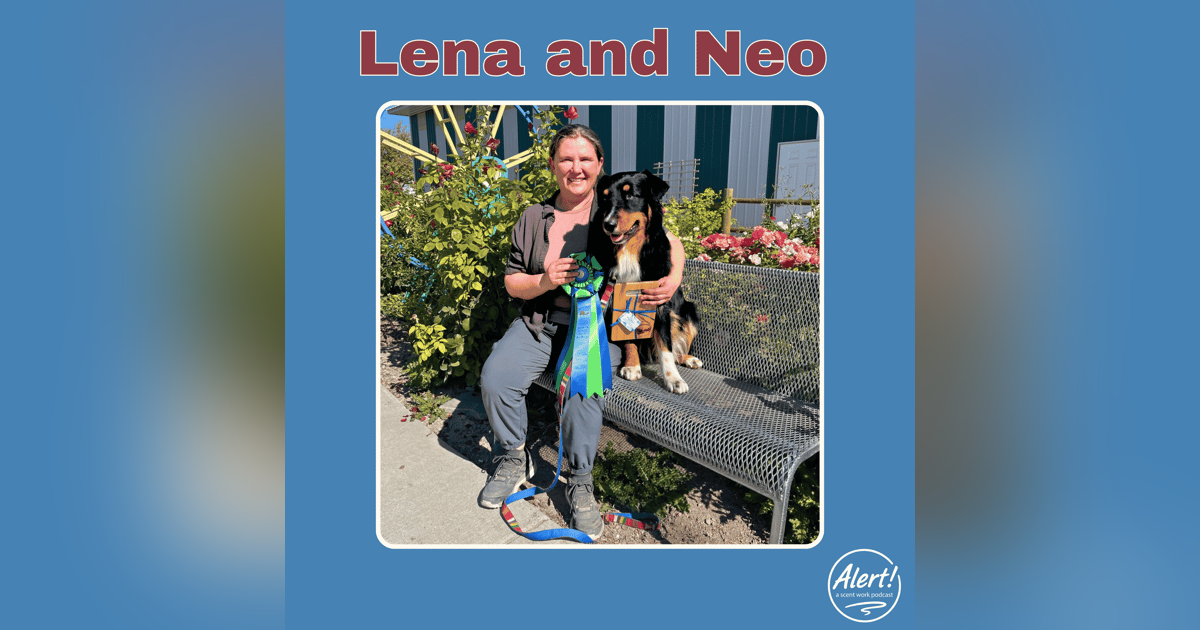


Lena went to the first AKC Scent Work Master Nationals mostly to support the event, but she also had a couple of goals. She wanted to make it into the top 100 and have the highest-placing Australian Shepherd. A few years earlier, a trainer told her Neo didn’t have the drive to be competitive, so you can imagine how good it felt when he finished sixth overall.
She talks about what the weekend was really like, the nerves, the searches, the challenges, and her advice if you're thinking about going next year. You’ll hear how she trained, what surprised her once she got there, and the mindset that helped her actually enjoy it.
00:00:00 Scot
I love Neo's story, and I love this story that a trainer told you he wasn't going to be competitive in dog sports because he didn't have any drive. That really happened, huh?
00:00:11 Lena
Yes, that did really happen. But I mean, in the trainer's defense, I picked Neo. My purpose for a dog was for him to just lay there for hours with me while I take landscape pictures, but be able to hike to those places. So I picked the dog that had the lowest drive and the lowest energy out of the entire litter.
00:00:40 Scot
But you still didn't like it when they told you that.
00:00:43 Lena
I did not like that, yes. Nobody tells me I have a lemon, so we proved them wrong.
00:00:49 Scot
What I love about it is because I think we've all had those moments in our life where somebody doubts us or tells us, you know, you're not going to be able to do this, or doubts our dog. And then you just show them. You prove everyone wrong. And what I love about your story is it's not luck. I mean, you've worked really hard with Neo. You've built a relationship. I see how much he does it for you. It's obvious you're out there together.
You've had success in rally and agility. You perform at high levels in all of those, and now scent work. He finished sixth at Master Nationals. Does that kind of make you want to just go to that trainer that told you you had a lemon?
00:01:30 Lena
Yeah, I mean, I've wanted to do that for a long time, you know.
00:01:35 Scot
Let me go ahead and introduce this. This is Alert! Scent Work. I'm Scot, a scent work competitor, also Murphy and Keeva's dad. And with me today is Lena Shuey, Neo, Remi, and Nyx's mom. And her dog Neo and my dog Murphy are littermates, so I guess I'm Neo's uncle, is that right?
00:01:55 Lena
Yep, yep, yep.
00:01:56 Scot
And I'm a proud uncle too because of his sixth-place finish at the first-ever AKC Scent Work Master National.
Before we get to that, I'd like a little bit of context. What drew you into scent work? Was Neo your first scent work dog?
00:02:09 Lena
Neo was my first-ever scent sport dog. He is my Novice A dog for all the sports.
00:02:18 Scot
Got it. And what drew you into scent work? Was that one of the first things you did, or did it come along with agility and rally and all those other things?
00:02:29 Lena
It came a little bit after. I wanted to do rally because I was always drawn to obedience. But, you know, because he has very little food and toy drive, we took our first rally class with a local trainer and we struggled because he really was like, “Eh, I don't really want to do it.”
And so then somebody told me about Hallie McMullen, and she was doing some classes on drive building. So I took a private lesson with her, and it really, really helped us. And then I learned about the wonderful world of scent sports through her, because she was just like, “Well, why don't you take my intro class? This would help you build a bond with your dog.” And so that's how we started out.
00:03:26 Scot
Curious: a lot of people I talk to on this podcast, scent work ends up being the thing for them. Maybe they were into agility or something else, but for whatever reason scent work really became the thing. Is it the thing for you, or is it just one of the things that you do?
00:03:41 Lena
It's becoming a thing. I'm noticing that I am foregoing entering other sports if there is availability of scent work. I'm not quite there where it's all about scent work, but it's getting there.
00:03:58 Scot
Alright, what is it about scent work that's kind of drawn you in like that and some of the other things are falling to the wayside? What is it that you like about it so much, do you think?
00:04:06 Lena
Well, I like that it's different every time. All the other sports are really very much the same. Obedience is the most rigid, maybe agility is not as rigid, rally is in between. But scent work is different. Every time is different, even with buried, even with containers.
And it's also just fun because you have no answers. I really enjoy that I don't know anything. We walk into the search and I really don't know anything. Whereas in all the other sports, you are guiding the dog, and this is a sport where the dog is—where you truly work as a team.
00:04:54 Scot
How long have you been competing in scent work then?
00:04:57 Lena
Our first trial was Blackfoot in June of 2022.
00:05:02 Scot
Okay, so 2022 to 2025. And then when did you decide you were going to go to Master Nationals?
00:05:09 Lena
As soon as I saw the coat. I saw the announcement and I said, “I'm going.”
00:05:12 Scot
Tell me what was going through your mind at that moment.
00:05:16 Lena
I'm going. I don't really care if we are ready. I don't care how long it's going to take me to drive, or if there is a snowstorm—we are making it there.
00:05:20 Scot
Yeah. So you drove. That was like a three-day drive from here?
00:05:24 Lena
Three-day drive, yeah.
00:05:25 Scot
Why did you go through all of that? Why was it so important to you?
00:05:28 Lena
Well, I'd like the sport to grow. And I feel like if people don't support it, these new things that AKC is trying, it may not continue. I'd like to see scent work grow into a sport that has championships and regionals and nationals.
Plus it’d just be fun to be around so many talented dogs. This was amazing—everybody there were great teams, they all had Master titles, a lot of dogs that you've met and that you admire. So yeah, it was just fun.
00:06:12 Scot
That's cool. Let's give a little context about Neo. You said you were going to go whether he was ready or not. From a third-party observer, he was ready. There's no doubt in my mind he was ready for this. Where is he title-wise?
00:06:24 Lena
He has 12 Detective Qs and he's got his Master Elite, so he is on the way to his second Master Elite.
00:06:32 Scot
Okay. Maybe I should rephrase it. You didn’t know if you were ready as a handler, but you were going to go anyway.
00:06:45 Scot
Alright, let's talk about the event. You said you've got all these teams there that have their Master titles, a lot of great teams, some of them you knew, some of them you'd heard about. Was it a little intimidating at any point? What was it like when you first showed up?
00:07:02 Lena
There was this energy of excitement, but also a little bit of tension. Nobody really knew what it was going to be. It's the first one, the rules are a little bit changed.
It was intimidating, but I just wanted to participate. I did want to make it—my goal was to take the Top Aussie. The other goal was to make it to day three. But yeah, it was like seeing all these teams with dogs that had Master Elite 5, multiple Detectives, Super Elite, even though it's not an official title. So yeah, you were like, “I don't know if I'm going to make it to top 100; look at all these teams.”
But everybody cheered for everybody. I felt supported by all the people. I didn't feel like it was negatively competitive, if that makes sense. People were truly excited for you.
00:07:58 Scot
Did you get a chance to watch any of the other teams?
00:08:02 Lena
No, I did not. There was not really a spectator area, and the volunteering that I did was more gate work, sorting sheets, that kind of stuff. So unfortunately I did not get to watch anybody. That would've been really fun.
00:08:19 Scot
Alright, so the format's a little different than what we're used to when we do our normal Master searches at just a regular trial. The first two days, every search, regardless of whether it was interior, exterior, container, buried, was two minutes, and then two and a half minutes on day three. Did that feel strange to you to have that shorter timeframe, or did that not bother you?
00:08:40 Lena
That didn't bother me too much. I didn't really overthink it. The part that was a little bit hard is the interior search was broken over two days, so that was a little bit strange.
Plus you’re like, “Am I going to remember how many hides I found?” Because it was one search but spread over two days—three different rooms, but two were done on day one and the third room was done on day two. So essentially whatever you found on day one and two still fell under that 2–6 hides. That was a little bit… I have a hard time remembering when it's 1, 2, 3, so I had to write that down.
Not knowing what you found—was that correct? You knew if you called something wrong. But if you called “Finish,” you didn't know if you found everything.
We’ve been doing some NACSW and that's kind of how their searches are, so I think that helped me be a little bit more relaxed about it because we'd experienced that in another organization.
00:10:02 Scot
And then the other major difference was it was a scoring system. So if I understand correctly, you were awarded 10 points for each correct find, but then there were points subtracted if you made an incorrect call, or if you had a fault, or if you called “Finish” incorrectly.
00:10:21 Lena
They took out the points off if you called “Finish” incorrectly. That was changed right before. They decided not to penalize people for missing hides and calling finish too early. But there were points off if you didn't call “Finish” within the time.
00:10:37 Scot
Was that scoring system a little weird for you, or did you figure that out pretty quickly, or did you just not think about it too much?
00:10:45 Lena
Yeah, that wasn't strange. I didn't feel like it affected me in any way.
00:10:51 Scot
Right. And it's finally dawning on me that it wasn't just the interior, it was all the elements. When you'd call “Alert, alert, alert, finish,” you didn't know if you'd found all the hides until you went and looked at the standings at the end of the day.
00:11:04 Lena
That's right. Unless there were, say, four hides and you found all four—then you did know. But that only happened once on day three. There was not a maximum number of hides, so yeah, you didn't know.
00:11:20 Scot
Alright, so day one. It was a perfect start. You had a perfect first day, no incorrect calls. Tell me how that felt when you looked at that sheet and you saw where you were in the standings on day one.
00:11:36 Lena
I was floored, because I thought we totally bombed the interior. And the results weren't posted until three in the morning.
00:11:47 Scot
Oh my gosh.
00:11:48 Lena
I looked and looked and looked, and nothing. So I'm like, “Ah, doesn't matter,” you know? I finally went to sleep around 2:30, and then they were posted at three.
So I got there and people told me—my friends told me—and I was just floored that he had the perfect score, because I totally thought we missed at least one in the second room.
00:12:13 Scot
That would've been… What floors me about this is we talk about getting a High in Trial, right? And you have to have at least three elements, sometimes four. And at the Master level, even putting together three successful runs—a three-out-of-three day—can be really hard. And here you are at Master Nationals and you had a perfect first day, like literally kind of a High in Trial sort of day.
00:12:36 Scot
It didn't feel like that until the next day?
00:12:38 Lena
It didn't feel like that. I doubted all my decisions in all of the searches.
00:12:49 Scot
Well, day one was good. Day two, a little tougher, I guess. You ended up missing a hide in exterior, is that right?
00:13:03 Lena
Yeah.
00:13:03 Scot
What challenges came up that day, and did you take anything away from that day?
00:13:08 Lena
It was a good reminder to maybe still go in both directions. That one was tough. I can't remember how many dogs got all four, but it wasn't a lot. It was essentially four convergent odors all set within six feet.
We were the last team of the day, so it sat for the entire day. He found three immediately, and we missed one. I didn't want to over-search the blank area, which I didn't know was blank, but, you know. So that was just—I think it was just a really tough one.
It does make me wonder if I would've gone my usual one direction and then second direction, if he would've gotten it.
00:14:05 Scot
That last run—you were the last dog to run that, is that correct? How long did those hides sit, eight hours?
00:14:17 Lena
Probably not quite that long. I think we ran it at about 2 p.m., and they were there since eight o'clock. So it was a fair amount, and it was windy of course, an exterior. But, you know, it is the Nationals, right? They have to be challenging or otherwise it wouldn't be fun.
00:14:43 Scot
Okay. Did you feel that in general, most of the searches were a little more challenging than your average Master search you'd find at a regular trial?
00:14:54 Lena
I felt like there was… I've seen challenges like that, but they're not common. I don't often see four converging odors in that type of a space.
Interior, yeah, I would say it was a little bit tougher, some of the rooms. Maybe more about the location—they were tighter. I felt like there was a hide or two that were meant to be picking out the top dogs. I felt like it was a bit more of a challenge.
It was like the puzzles were a little bit more challenging, but not necessarily meant for dogs not to find them. I think they were all findable, but that one was a challenging one for us.
00:15:58 Scot
Did you find that buried and containers were a little bit more of a challenging hide set than what you'd normally see?
00:16:04 Lena
No, that one I felt like was standard, other than only having two minutes for buried and two minutes for containers. Maybe there were a little more food distractions in containers than we normally see. I think there were two or three, and I don't feel like we normally see that many.
00:16:29 Scot
And then you did make it to day three. So they combined day one and day two scores, and if you made it into the top 100 dogs, you were able to go to the finals. And you were sitting in fourth place when you went into the finals. Tell me how that hit. What was that like emotionally?
00:16:52 Lena
That was great. But by day two, I had really calmed down. I thought, I'm going to trust my dog. We're just going to have fun. With each hide, I felt like we were making it into the 100, considering where he started out, so it relieved a lot of pressure for me.
00:17:16 Scot
Right. So it was a little intimidating going into day three, the finals, sitting in fourth place? Were you like, “Oh boy, I hope I don't screw this up”? That's what I would be thinking.
00:17:28 Lena
No, because at that point I'd already hit the goals I came with. He did wind up getting Top Aussie; that was out of days one and two. And we made it to the finals. I wasn't really thinking we had a chance of winning with all the amazing teams going into that, so I was like, we'll just have fun.
So I would say day one was the most challenging for me mentally.
00:17:54 Scot
Help me understand. I couldn't figure out on paper what the finals looked like. There were combined elements—buried was combined with exterior and container with interior. What does that mean?
00:18:07 Lena
So the interior search had multiple containers over two rooms. It was one search, but in two rooms, and there were containers all throughout. As I was told, apparently I missed a lot of them. I did not see that many containers. I saw the boxes and thought, “Wow, there's only eight containers.” But I've been told there were considerably more; I just did not see them.
00:18:47 Scot
How many times have we been in that situation where you get done with a search and you can't even remember what was in the room? That's kind of funny.
00:18:54 Lena
The funny part about that one was you knew that one of the hides was in a container. I went into the finals and said, you know, I'm just going to trust my dog. He knows odor. I'm just going to call it when he tells me, because he sits as an indication, and so it's simple to see when he's calling it.
One of the containers was on the counter, and he tried to source and I saw there was an inaccessible in the cupboard. Then he jumped up on top of it and hit something on the counter. He’s big, so I didn't see, and then he sat, so I called it. Apparently it was a container.
When we were all done, I said, “Wow, I'm surprised there were only eight containers,” and then it got pointed out that there was the full amount of sixteen—I just didn't see the other half.
00:19:50 Scot
So “combined” means essentially two rooms, hides could be anywhere. They could be in the containers or they could be placed like a standard interior hide. You just didn't know.
00:20:01 Lena
Yes. Three were just standard interior hides and one was in a container.
00:20:07 Scot
Got it. And the same with buried—you were outside and you had the buried tubs, the sand and the water that you would search, but you were also doing an exterior search at the same time.
00:20:16 Lena
Yeah, and that one was more challenging, is what I've heard. The odor was—one of the hides was placed in a tree and there was a buried tub a couple of feet away, and I guess the odor was settling in the tub. A lot of handlers called it prematurely. So that one I think was more of a challenge, because Neo investigated the tubs and he had to make a decision between “Is it in the rock, or is it in the tubs?”
So I felt like that was a bit more challenging than containers. Containers felt like they were part of the room; buried felt more separate.
00:21:02 Scot
Day three—when did you find out you had another perfect score?
00:21:06 Lena
After all the dogs had run.
00:21:10 Scot
You were one of only six dogs at AKC Master Nationals to have a perfect score. That's incredible. What was going through your head when you saw that?
00:21:19 Lena
I was just so proud of him.
00:21:21 Scot
Yeah.
00:21:23 Lena
And he told me when he was done. He walked to the exit door and he was like, “Let's go.”
00:21:32 Scot
That's right, he doesn't have patience for that. He doesn't have patience to over-search an area.
When you were preparing for Master Nationals, did you change your training at all, or did you just do the same kind of training?
00:21:47 Lena
I did start working on helping him make decisions faster. I did practice a little bit more challenging things—convergence and mirror hides and threshold hides and elevated ones.
But the big thing that I have worked with him is setting simpler things, calling it even before he called it, and rewarding heavily so he was more confident making the decision faster, so we could meet that two-minute search constraint.
00:22:24 Scot
Murphy, who again is his littermate—I will call… He has to find source. Even if I know that he's within three or four inches of it and I call “Alert” and try to reward him, he won't let me do that. Does Neo do that same thing?
00:22:40 Lena
Yeah, it's very similar. And I let him source. I probably, in the finals, could have shaved off a minute if I had not let him, but he wanted to be sure. And it's fun for him, so I let him do it. There's got to be fun for him too.
00:22:59 Scot
Yeah, right. So the fast hides and trying to call a little more quickly was more about giving him confidence and not about breaking this idea that he had to pinpoint source.
00:23:11 Lena
No, it was more because a lot of times I feel like he is not sure, even when he knows. And so it definitely helped us in Detective as well. He started being more confident in calling it. Instead of going over the area five times, he would just do it twice.
00:23:31 Scot
Were there any Neo moments that made you smile or surprise you over the weekend? He's such a character. Did he do anything that made you laugh or smile?
00:23:39 Lena
The funny one was—he's not a fan of buried. He never was. He just doesn't like the repetitive stuff of the tubs. On the second day, the first day was great, he got the three tubs. On the second day, he finds the first one, and there were only two. Then he kind of checks all of them and then finds the last one.
I think he knew my thought process was, “He didn't really check that that well, so maybe we'll hit a few of them, we've got time.” He gets to the last tub and he literally hugs it with his feet, puts his head on it, and just sits and says, “This is it. I promise. There's no more buried. There's only two.”
I did call “Finish.” I'm like, okay, I'm not going to make him do it again. But just his face! He was so happy. He started smiling when I called “Finish,” like, “Oh my God, she finally understood me.”
00:24:39 Scot
Oh, that's great. That's funny, because something I'm starting to realize with scent work is it's really a game of communication with you and your dog, and that is just classic communication right there. I love it.
00:24:52 Lena
Yeah, and he really tries. We've grown over the last year. He spells it out for me.
00:25:02 Scot
Did you learn anything about yourself or your handling or your team during Nationals? Were there any kind of insights that you had?
00:25:09 Lena
It finally sunk in—the whole “trust your dog.” After day one, where I second-guessed everything and he did so well, I said, day two and three, I'm here, I'm just going to have fun. I'm going to trust him. We're going to cover the area, but I'm not going to make him over-search. I'm not going to second-guess. It was so much more fun.
And he did amazing, just not having to do things fifteen times like I normally make him do.
00:25:45 Scot
That's great. That's a great lesson to learn. If somebody asked you for some advice—like me, for example, who wants to go next year—what advice would you give me leading up to the event?
00:25:59 Lena
One advice I would give is definitely practice. Everybody's going to have different challenges, but the one thing I would say is: don't change things when you get there. Even if things are different and scary and all that, I think that would be a big mistake. Just go in, trust your dog. You've done all the prep work. There's nothing you can do in those three days.
If you change everything, you're probably not going to do as well.
00:26:37 Scot
Yeah. Go into that event the team that you were the day before you went into that event. Don't try to suddenly be a different team.
00:26:45 Lena
Yeah. Don't try to change things, don't try to do something “better” or totally new. And just have fun. That was probably one of the funnest events—and we do a lot of different events—because especially on day two and three, I was just having fun with my dog. I wasn't really worried about winning or losing. It was just watching him do his thing.
00:27:14 Scot
You said in the email, when I asked if you'd be on the show, that it was a lot of fun. You were very adamant that this was a good time.
00:27:23 Lena
It was. And it was very, very well organized. For the first event of this kind, I felt like it was extremely well organized. You knew where you needed to be. There wasn't a ton of waiting, despite 176 dogs competing. That was just amazing.
00:27:43 Scot
Right. Were you all crating in the same kind of area? Was it a massive crating room, or how did that work?
00:27:50 Lena
Yeah, it was a really big crating room. Some people crated out of the car because distance-wise, it really didn't matter if you were in the parking lot or in the crate room. It's a pretty big ballroom where you could crate if you wanted to do it inside.
00:28:10 Scot
That didn't bother Neo at all.
00:28:12 Lena
No. He snoozed through the whole thing.
00:28:14 Scot
And you said that it was really well run and you didn't have to wait that long. So they did a really good job of letting you know what time you were going to be going.
00:28:24 Lena
Yeah. They had an app—well, a web-based tool, and if you had Android it was an actual app. They were going in order and you knew when you needed to get your dog. We never had to wait more than three dogs in staging.
There was only one staging room over all the days where it was a little bit tight, but everything else, you had plenty of room. Even if you had dogs that, say, didn't like other dogs, the flow was just amazing.
00:28:59 Scot
That's cool. How did you get to the point on day two and day three where you just decided, “I'm going to have fun”? How did you put that competitive part of you aside and get into that mindset?
00:29:16 Lena
As much as I stressed out about day one, I was like, this is ridiculous. Nobody's going to die if we don't make it to top whatever. Nobody's going to die if we don't find it, or if we find ten extra things in there.
I was completely ridiculous on day one.
00:29:39 Scot
Right. So it sounds like day one was just not fun, and you were just like, no, I'm not doing this again. I'm not going to go through this mental anguish for two more days.
00:29:47 Lena
It was fun while I was searching, but there is a long wait between searches because 176 dogs have to go. I had a lot of time to try to convince myself that we did really poorly.
00:30:08 Scot
Right, right, right. Just the story you made up in your mind.
00:30:12 Lena
Yeah.
00:30:14 Scot
So, “Let's stop making up those stories in my mind and let's start enjoying this thing.” Are you going to go next year?
00:30:20 Lena
Absolutely, yeah.
00:30:21 Scot
Alright.
00:30:23 Lena
I really would love to go next year and the year after, if they keep having it.
00:30:29 Scot
Cool. And you've got a whole year to prepare. What are you going to work on? You're not going to change anything the day you show up, but is there something in particular you're going to work on in preparation for next year?
00:30:40 Lena
I think we are going to continue to work on building his confidence and more puzzles. We are now pretty heavily involved in NACSW, which gives you a different… It's still scent work, still the same odors, except for cypress, but it's a little bit of a different way that the searches are set.
We just signed up for our first NASDA trial, and so I think we're just going to play around in different sports and build his confidence.
00:31:15 Scot
I love it. Alright, Lena, I'm going to wrap up with a segment I call Seven Questions. You ready for this?
I'm going to ask seven questions. Just looking for whatever comes to the top of your mind, and I'm looking for a sentence or two for each question.
What is Neo's favorite reward after a great search?
00:31:34 Lena
Goat cheese.
00:31:36 Scot
Of course.
00:31:37 Lena
Of course. It costs me an arm and a leg, and I have to work extra for it.
00:31:42 Scot
He doesn't work cheap.
00:31:44 Lena
Nope. He does not work cheap.
00:31:46 Scot
What's one piece of advice you would give your beginner scent work self?
00:31:52 Lena
Don't take it so seriously.
00:31:56 Scot
Alright. How do you bounce back after a tough trial day—things just didn't quite go the way you wanted, maybe you didn't get the Qs, you had some frustrating moments. How do you recover?
00:32:02 Lena
I just go up into the mountains and watch my dogs run and swim.
00:32:06 Scot
I love it. If your dog could describe you as a handler in one word, what would it be?
00:32:12 Lena
Dense.
00:32:14 Scot
Dense?
00:32:15 Lena
Dense.
00:32:16 Scot
Other than the searches, what is your favorite part of a trial weekend?
00:32:21 Lena
I love volunteering. I love watching other teams and just chatting with people that you sometimes only see at scent work trials.
00:32:32 Scot
What's something about scent work that still delights you or surprises you?
00:32:36 Lena
Just watching the dogs use their nose—that never gets old. It's still fascinating to me how they can just go and find the stuff.
00:32:50 Scot
Right? It would take us forever to find it and they find it almost instantly sometimes. I'm going to say also, I love it when you can see them thinking, you can see them solving the puzzle.
00:33:01 Lena
Yeah, that's… I don't think that will ever get old.
00:33:05 Scot
Yeah, I don't either.
What's the best compliment you ever got at a trial?
00:33:10 Lena
I think it would be, “You guys are really fun to watch.” I like when people say that.
00:33:17 Scot
What's one piece of advice you got that totally changed how you approach scent work?
00:33:21 Lena
I'd say “trust your dog” is still my favorite advice. It took me a really long time to really connect with that advice—like three and a half years—but I feel like I'm starting to really figure out what that means.
00:33:41 Scot
I want to dig a little deeper on that, because I want to know, what does it mean to you to trust your dog? Because that's thrown around a lot without actually being defined. What does that mean?
00:33:50 Lena
For me, it's really all about teamwork. It's not trying to solve the puzzle myself, but really working as a team, letting my dog do the work, watching him. He's not always sure—sometimes he asks me for help and I have to put a little bit of thought into where we go next.
But trusting your dog, to me, is really working with him, not trying to override everything and micromanage.
00:34:24 Scot
Is there a mistake that you're glad you made because of what it taught you?
00:34:28 Lena
I think my favorite mistake was going into my first scent work trial and not reading any of the rules—just taking some classes. The very first one, I didn't know you were supposed to say “Alert.”
00:34:49 Scot
What?
00:34:51 Lena
Yeah. And it was Mary Quinn who patiently waited the entire two minutes of my Novice interior search for me to fumble through all the vocabulary I knew to find that word.
00:35:08 Scot
So he finds it, and you're just spouting out random words, hoping that you're going to hit the right word.
00:35:13 Lena
Yeah. I think I said something like, “I'm going to call it,” and she's like, “There is a word.” And I'm like, “What word?” She says, “There is a word.”
Yeah, I had probably forty words before I finally got that “Alert” word out. I just had to laugh. And it also taught me that reading the rules is quite helpful. So now I do read the rules.
00:35:39 Scot
Yeah, there can be some good stuff in there that can help you make decisions and help a lot.
That is probably the best story I've ever heard. And ladies and gentlemen—
From not knowing what word to call in her very first scent work trial, to number six and Top Aussie at the first-ever AKC Master National Scent Work Championships. I love it.
What a great way to end this conversation, Lena.
00:36:06 Lena
You know, the one fun part about this for me was that the first search in Master Nationals was under Mary Quinn for us. She was our very first scent work judge, and this year he got his Master Elite—his last leg for his Master Elite Master Interior—under Donna Morgan Murray. And he finished his Master National with a search under Donna Morgan Murray. So I thought it was just really cool.
00:36:39 Scot
That's so cool. What a small world sometimes, and what a great circular kind of story coming back to where it all began.
Well, Lena, I just gotta say thank you so much for taking time and telling us all about Master Nationals and giving us some great insight. I can't wait to start training for next year so you and I can both compete against each other. I always love our friendly competitions against each other, so maybe we'll do it at Master Nationals.
And thanks for some of the great insight.
00:36:59 Lena
I think it would be really fun.
00:37:01 Scot
I think it would be really fun. And next year I hope to make the drive.
So thank you very much for being on Alert! Scent Work.
00:37:08 Lena
Yeah, thank you for having me. That was fun.
00:37:11 Scot
Did you have fun?
00:37:12 Lena
Yeah, that was fun.