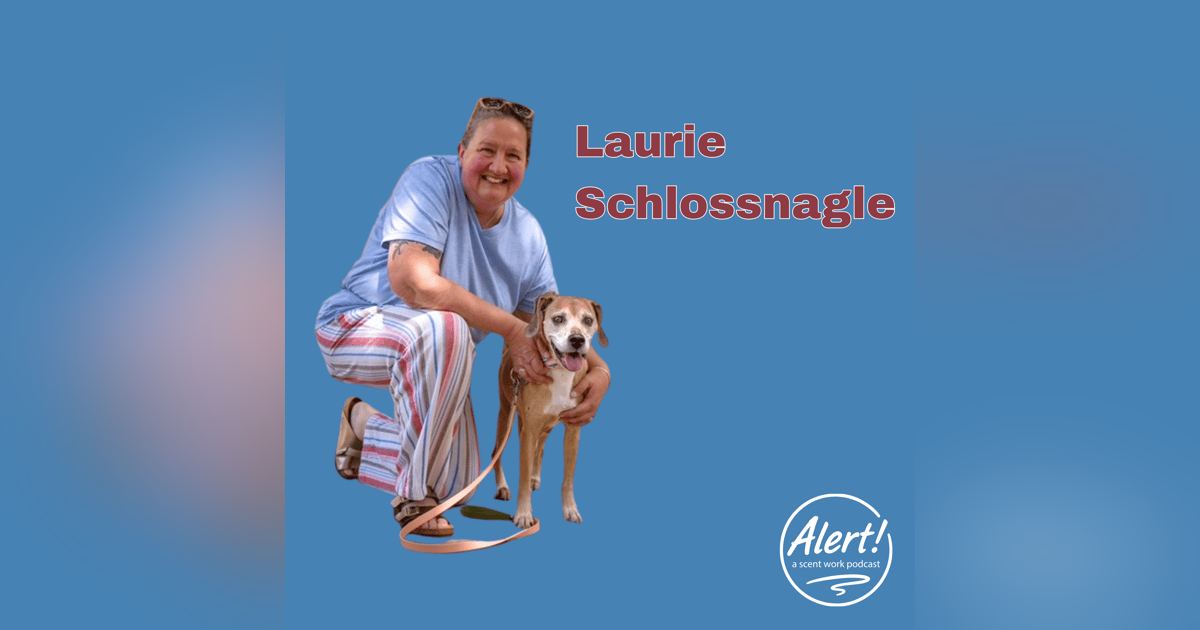
Laurie Schlossnagle | One of AKC’s First Judges, C-WAGS Pioneer


Episode Summary
Laurie Schlossnagle helped build C-WAGS scent work and went on to judge the very first AKC Scent Work trial. In this conversation, she shares how she thinks through level-appropriate searches, why stable odor matters more than difficulty, and what handlers often overlook when competing. Laurie also reveals the personal story behind her signature distractor, and what it symbolizes beyond adding challenge.
About the Guest
Laurie Schlossnagle is a judge for AKC, UKC, and C-WAGS scent work, a long-time competitor, and a trainer at Side by Side Dog Training. She has been instrumental in creating scent work opportunities across organizations and continues to judge, teach, and compete.
Key Insights from the Episode
- Fair judging starts with level-appropriate challenges, not tricks.
- Stable odor is the first test: if odor won’t stay available, the search isn’t fair.
- In upper levels, dogs usually know the odor picture, handling becomes the hard part.
- Long lines are communication tools, and teams must practice them.
- AKC, UKC, and C-WAGS each give dogs different “odor pictures” and environments and different competitive experiences
- Judges sometimes rerun classes when fairness is compromised, and they’re looking for it.
Resources Mentioned
- Side by Side Dog Training — https://sidebysidedogtraining.com
- Facebook: Side by Side Dog Training
- Instagram: @sidebysidesc
Episode Highlights
00:59 Scot’s first Q was under Laurie
03:42 Laurie’s philosophy for setting hides
05:06 How environment shapes “level appropriate” searches
08:37 Why higher levels are mostly about handling
11:02 Long-line advice for trialing and training
15:34 What’s different across AKC, UKC, and C-WAGS
17:41 Why C-WAGS was created
19:20 Laurie judged the very first AKC trial
23:23 When buried was literally drilled into the ground
27:12 A hidden food distractor forces a rerun
30:28 Seven Questions
33:12 Story behind Laurie’s signature distractor
Thanks for listening to Alert! Scent Work.
Subscribe to the Newsletter
Follow along and join the conversation:
00:00 - Untitled
00:53 - Untitled
01:19 - Who was your first Q under?
04:16 - How environment shapes level appropriate
Laurie Schlossnagle, an American Kennel Club, AKC scent work judge since 2017. Also United Kennel Club, UKC and Canine-Work And Games, C-WAGS.
This is Alert! A Scent Work Podcast. My name is Scot. People know me as Murphy’s dad. Laurie is on the podcast. Who do people know you as?
Laurie:Emme’s mom.
Scot:Emme’s mom. All right. You are a competitor, a judge, and a trainer. When it comes to scent work, you do all of it. Do you remember the judge who gave you your first scent work qualifying score, Q ever?
Laurie:In AKC? I am thinking it was probably Hallie McMullen. And it would have been with my older dog, Dolly. And probably over at Great Salt Lake Dog Training Club when they were doing trials at the Armory.
Scot:I did not remember who I got my first non-qualifying run, NQ under, and that was Hallie. I had to go back and look up who I got my first scent work Q under, and that was February 10, 2023. Nightmare on 13th in Salt Lake City, Utah, which is a haunted house, cool venue. It was you.
Laurie:Very cool. I love it.
Scot:This story is gonna show what a small world scent work is. When you are first starting, you do not realize how small of a world it is, but it really is a small world, especially in our little areas of the United States. I did not even really know who you were. I went back and looked, and I trialed under you again a couple of months later in Idaho. It was not until later that year in the fall, when I was doing some volunteering at a trial, that we met for the first time. We had some struggles at this particular trial.
Laurie:I know exactly which one you are referring to.
Scot:Moving people around was a struggle, and I just jumped in and started helping. After that, I think that is when I was like, oh, I know Laurie now. I just wanted to say that after that, when you did a detective run here in Salt Lake City, you reached out to me and said, hey, I know you are really into this. Would you like to watch me as I set, and I will explain my process? I cannot tell you how much that meant to me. That was just such an incredible thing that you gave me.
Laurie:Awesome. I love it. I am glad you benefited from that and took advantage of it. I think being part of the process can help us as competitors for sure. Judges are human, and competitors just like everybody else, and we all have our different ways of thinking. When you can see that thought process, sometimes it makes that competition a little bit, I do not want to say easier, I do not think it is easier, but it makes more sense.
Scot:Yeah, it can make it easier because when you are a novice or advanced just starting out, you have no idea the puzzles that are gonna be coming. Just to be aware of some of the puzzles as we moved up was super helpful. For sure, that was really awesome. I do have a question. As a judge, what is your approach when you are setting hides? Do you have an overriding philosophy when you are trying to set up challenges, whether it is novice or detective?
Laurie:I do, actually. My first and foremost is that it is level appropriate, that what I am testing is what people have been working toward. My next overriding thought process is, is odor available, and will odor stay available for the duration of the search? In some trials, judges show up and you set your search first thing in the morning, and it sits all day. And so we have to make sure when we set that search that odor is going to be available all day. Does the odor picture change? Absolutely, it changes throughout the day, but it has got to still be available. Otherwise, it is a moot search. I want it to be level appropriate and make sure that odor is available for the length of time I need it to be.
Scot:And just some insight for competitors. If you want to learn more about what level appropriate means, there is a judges’ guidebook. We all should have read the competitors’ guidebook, the rules, but there is also a judges’ guidebook, which is available online. What are some other aspects you take into consideration, the unwritten stuff, to make sure that something is level appropriate?
Laurie:Absolutely looking at environment. What kind of situation are we in? Is it pouring down rain? Is it windy? Are we inside? Are we outside? Even in containers or buried I am going to be looking at those factors. Sometimes you are at a trial site doing containers in a horse arena that has open sides but just has a roof, for example. So I am gonna be looking at prevailing weather conditions. I am going to be trying to set my start line for novice in a position where the dogs are going to be encountering odor a little bit sooner than a dog in excellent would need. If I am inside a room, what kind of flooring do I have? Is it a gym floor? Is it carpet? Is it matting? Is it compressed dirt? What kind of flooring am I looking at as far as how might my odor be traveling from one source to another, or from one container to the next? So I am looking at the big picture so that my little picture is level appropriate.
Scot:So when you are setting hides, you do take that horse arena into account. That could be very distracting to a lot of dogs. So that in and of itself, especially for a novice dog, could be very difficult for that dog to be dedicated to odor. So I would imagine you would take that into account, maybe place the hide a little closer to the start line, or make sure they are encountering odor right away, as opposed to in an environment that was not so challenging, where the odor might be blowing away from the start line. Make it a little bit more difficult that way. All those different variables, it must be really hard to balance all those.
Laurie:Sometimes you just take a shot. I do not want to make it sound like it is always a game of chance, it is not. Sometimes you set up a search and we cross our fingers. Going back to the horse arena, it might be that every time a trailer or a truck goes by, it alters what my search looks like because it is that open air kind of thing. Sometimes you just have to do the best you can with what you have got and hope for the best. How I set my hides is, this is what I am seeing, this is what I think is going to work. And then that little bit of crossing fingers and luck plays into it sometimes too. There is no sterile environment. Honestly, one of the places that is the easiest to set is the haunted house because there is no heating, ventilation, and air conditioning, HVAC.
Scot:Nothing moving air around other than natural airflow.
Laurie:Exactly. If you are in the interior parts of that particular space, you are not even dealing with doors opening and closing. So it makes for really nice, solid, stable searches because you do not have that as a factor.
Scot:In detective, you mentioned you focus mainly on the handler and not really on the dog skill. And I know the dog skill is definitely part of it, like how many opportunities we are giving our dogs to see these odor pictures that they are gonna encounter in detective. But the handling is what really stuck out to you. Talk more about that.
Laurie:Oh, for sure. I think when you get to detective, and this is just a personal observation, there is not really any science to back it up or anything, or any statistics. Our dogs by that time have seen so many odor pictures. If you would just let your dog go and get out of your way.
Scot:I know. I am afraid sometimes that my dog does well in spite of me.
Laurie:Absolutely. Me too. I am right there as a competitor with you on that. Because the dogs are finding them, and the most common statement I hear out of handlers’ mouths is, but that was not his usual alert.
Scot:Oh, okay.
Laurie:I hear that all the time, and my comment always is, watch your video. Because your dog did tell you. It might not have been the usual alert, but your dog did tell you that odor was there. So yeah, definitely in detective, it is about that handling. I call myself a Roomba. That is my hardest thing, getting stuck in corners, getting stuck in areas.
Scot:Wandering from place to place with no pattern.
Laurie:The corners. And my dog is, mom, are you new? And that is definitely a handling issue. If I let my dog go at the start, would my dog tell me where all the hides are? I have a pretty high level of confidence she would. It is rarely possible to just let your dog go at the start and let them find all the hides, we have to handle.
Scot:Yeah. And you do not really realize that till you do start moving up in levels, that is for sure. What are some of the handler foibles that you see? I do not want to be mean or rude or anything, but is there a common handler thing that you would say, that if people would just change this one thing about their handling, things would get so much better for them?
Laurie:In trial or training, or both?
Scot:You have experience in both, so it would be great to get your insights on both.
Laurie:In trial, use your long line.
Scot:Okay.
Laurie:I see lots of people who walk in there with a twelve or fifteen or twenty foot line, and they give six feet of it.
Scot:If you have got a line, go ahead and use it.
Laurie:Do not be afraid to let your dog use it. The training piece is related. Do not do all your training off leash.
Scot:Yep. I am guilty. Hate that long line. You have got to practice that skill. Plus it is a different way of communicating to the dog. When that line gets put on, it is like a telephone line from you to them.
Laurie:Exactly.
Scot:It is not just about it getting tangled, it is about what are you conveying down that line? I had a judge one time, and it was not a judge, it was one of my mentors, tell me, they were very kind about it. They said, how long is your line? I said, twelve feet. You want to use all of it. Sure, I will use all of it. And it is really easy to think that you are, but you are really not. Video yourself, watch, observe, make it external to yourself.
Laurie:I think early on in training, lots of trainers told their students, do not let your line get tight. You want to keep that line nice and loose, and I have come to learn since, through my own work with my dog and my coach, that is not doing any good for her. That is not giving her any information. I work on that line having some tension on it at all times. I still see people running after their dog, trying to keep that line nice and loose, and there is just not any reason to do that. Work with your dog so that you can have tension on the line and communicate with that.
Scot:Do a deep dive on having tension on the line and how that will help and what that communicates.
Laurie:So at that point in time, the dog remembers we are there. If we have that tension on the line, it is more teamwork. You are working in this corner. I am back here supporting you. I want you to know I am back here supporting you. I think the biggest thing with that is what it prevents. It prevents that breakdown or distraction in thought when the dog goes to leave that area and gets all tangled up in their line that was loose and laying on the floor.
Scot:Okay.
Laurie:So if you have got that little bit of tension in the line, it is up above their back a little bit, and you are watching them, and they are like, I am gonna turn right into you, then you can gather in that line really fast and you can be working with them instead of against them and untangling them.
Scot:All that untangling and all that business you are contending with is distracting to the dog. It is taking them out of the moment. They are not able to do their job as efficiently. Handling has been something I have struggled with a lot lately because in the lower levels, the search areas are so small and it is so quick that really you do not have to handle. If you have done your training and your dog recognizes odor and goes to it, that is all that really needs to happen. But when you start moving up, that handling becomes so much more important. It is really a struggle. I have also been experimenting with a little tighter line as well, verbally saying, I will let my dog go outside the search area if they need to follow odor. But sometimes they go in a direction we have already searched, and I am comfortable with that. Just standing and not moving and letting them get some of that tension sometimes communicates to them, hey, let us go back this way, as opposed to an audible communication, which I have found useful. I do not know, people.
Laurie:No, I agree. I do not say a whole lot to my dog while we are working. At least I do not think I do.
Scot:You have experience in United Kennel Club, UKC and American Kennel Club, AKC and an organization called C-WAGS. What is the best part of working across multiple scent work organizations like that?
Laurie:I think the challenges are different. I like the difference. The three that I am involved in, each of their odor concentrations is different. I think the advantage is pretty obvious, you get to trial more often. You have got a few more options. If you do not have an AKC trial to go to, maybe there is a UKC trial. If not either of those, maybe there is something with C-WAGS that you can do, or if you are involved in the other ones, maybe one of those. I think it gives you more opportunity to trial. But I also think that the trial environments are really different, which is presenting more pictures to our dogs. Those pictures are more varied, and they are seeing different things, different setups. Some of the rules are very similar, some of the search areas are very similar, but each of them has their uniquenesses. That difference is just that one more thing to offer our dogs for their repertoire, one more thing to put in that filing cabinet of experiences for them.
Scot:I would imagine, where you go in the United States, this would differ. I started in AKC and I love AKC, but then I started doing some UKC and found out that when you are a novice, you can make a wrong call and still get to continue to search, which, if somebody is particularly nervous, might be a good place to start trialing because of that rule. C-WAGS is a little bit more accessible to those that are even more nervous about joining. You had something to do with the development of C-WAGS, did you not?
Laurie:I did.
Scot:Tell me about that. Why was C-WAGS developed as another option?
Laurie:C-WAGS was developed originally in 2007. I know the person who put it all together and is still running it. And her idea behind C-WAGS was another venue that people could compete in that would be supportive to other things people were doing. Obedience is designed to be supportive of Australian Shepherd Club of America, ASCA obedience, AKC obedience. Rally is designed to be supportive of other venues of rally. She already had the other three sports in play and people were participating in them and loving them. And so a group of us were like, what do we think about scent? Do we want to dive in, see what we can come up with? So a group of us started working on it and looking at venues in Europe that already had scent work, looking at the existing venues here in the United States. We did not want to copy in any way, shape or form. We were very careful about that. But we wanted to capture the essence of the sport. And she adds things all the time. She just added a new section of classes that I have not even had a chance to try yet, that is based on speed.
Scot:That is pretty cool.
Laurie:And then AKC started. Their first trial was September of 2017.
Scot:And you were registered as a judge, what, 2018? Or was it 2017?
Laurie:I judged that very first trial.
Scot:The very first trial. You judged it?
Laurie:I did.
Scot:Wow. What was that like? Did you realize you were part of something that was gonna be this big a part of your life and as much a part of everybody else’s life as it is?
Laurie:No. From that perspective, absolutely not. I had no idea that it would take off the way that it did. Did I know it was part of history? Absolutely. And I was super honored to have been pulled from hundreds of judges. There were four or five of us, I would have to sit down and figure out exactly how many there were. Part of what they looked at was our involvement in other venues of scent work. I thought that was cool of them to want to have all of those different venues represented in their first judging panel. The first one was chaos. It was crazy because people were so excited. Other than the couple of existing scent work venues, many of those people had no idea how to train and be prepared for that trial. They got in, they threw caution to the wind. They are like, let us do it, let us see what happens.
Scot:What were some standout chaotic moments?
Laurie:I do not even remember exactly, a Malinois, a Terv, a shepherd, some kind of dog in that category, came into my novice interior, running into the room and jumps up on the table.
Scot:Yeah, okay.
Laurie:Or there were more than a couple of dogs that came into containers and just bulldozed them, put their nose on that first one and took every container to the other side of the room.
Scot:Were the Q rates at that first one lower than what they are today?
Laurie:I do still have all my paperwork. When I moved, of course you only have to keep it for so long, but I did bring that with me just because I think it is cool.
Scot:I heard that buried was actually buried back then.
Laurie:Buried in the upper levels. At the novice level, it was in under bed boxes, so bigger surface area, less depth. And we used potting soil. It was a mess. There was nothing on top of them. I ended up judging buried later in the weekend, so I took it to a dirt parking lot because it kept getting spilled, and we would just move the whole search area over a row, and then it would get spilled again, and we would move the whole search area over a row.
Scot:You are all just figuring things out, exactly.
Laurie:Exactly. Those are definitely the standouts. It was super fun. It was at the Roberts Centre in Ohio, and it was a big multi sport show. They had dock diving, Fast Coursing Ability Test, Fast CAT, barn hunt, and agility. It was absolutely crazy and super fun. I love when the pictures show up in social media memories because it was history in the making. There are people I met there that I still talk to, and names of people that you would recognize that now are big in this scent work world, and that was their very first trial.
Scot:I want to circle back. Tell me about the upper levels of buried that was actually buried in the ground, like you had a drill and you drilled a hole in the ground.
Laurie:Yep. I literally never, in however many trials, I would have to go back and look, I never had a single Q.
Scot:Wow.
Laurie:It was crazy. And we had to draw a little map, and then we pulled the drill out, and you did not just drill holes for the hides, you had to drill holes for the dummies because you needed dummies. Because in order to find the hides again, your best option was to set dummies out too with fishing line on them so you could pull them up.
Scot:Okay.
Laurie:It was crazy. I do not know if you have ever shown at the Blackfoot show in Idaho, but we were on the horse track at the time. We could not even get the drill to go into the ground. We were like pounding things, it was crazy. I know people do not love buried. I think it is cool. I do not like lugging the containers around, but I think it is an interesting concept. I always try to remind people, were you around when it was actually in the ground?
Scot:It could be a lot worse, for both judges and participants, with no Qs. That is incredible. Wow.
Laurie:Exactly.
Scot:When I am a competitor, I am out in the parking lot. Sometimes I call it parking lot chatter. Is there anything in particular that you notice that happens? Is there a kind of a theme, or is it just a lot of different reasons that could go into that?
Laurie:There are a lot of different reasons that could go into that. If I am seeing a really low Q rate, I am going to try to evaluate what I am seeing. Is it an upper level and dogs are finding each of the hides, but no dog is finding all of the hides? That is a big tell for me in those upper levels. If dogs are finding each of the hides but not finding all of them, or the handler is not calling finish at the appropriate time, but the dogs are finding hides, I am going to rest a little bit easier, because that tells me my odor is available. Luck of the draw, basically, dogs are not finding all of them, the handler is not calling finish at an appropriate time.
Scot:Dog skills, maybe this one particular dog does not have skill and the other ones did.
Laurie:Exactly. If it is a lower level, I am going to be a a little bit more critical of the hide itself. I have rerun classes. I actually had a situation this fall where it was one of those, I do not know if this is a handler issue, if this is a hide issue. I was really going back and forth about what is going on in this class. I just do not feel like the Q rate is what it should be based on what I had seen. It was on my third day at a three day trial up there. I had seen much better handling and much better searches. I went to pick up my search, and it was an advanced container search. I went to pick up my search, and somehow, from one of the earlier searches in the weekend, a food distractor was still inside one of the containers. I did not find it when I set it because there was also tissue paper inside the container. Over the course of the class, the food, which happened to be a couple of peanuts worked their way loose, and I went to pick up that container.
Scot:I see.
Laurie:This is an advanced level where you cannot have distractors.
Scot:So the dogs just had not encountered that, had not trained for it. So of course.
Laurie:Exactly. At that point I went to the trial chair and said, I have to rerun at least the dogs that NQ, give them the option to rerun, because that was not fair. It did not take a ton of time because it was containers, that was the only thing I could do. I have had it happen in buried too. I will stop the search and check my containers or bins, make sure that, if it is water, there are no air bubbles, make sure I have a fresh hide in the sand. I might run a demo dog again. I have found issues when I have gone back and done that.
Scot:You also compete. I asked to watch you once and you laughed. Tell me what it is like being a judge and a competitor and balancing those two things. I have a feeling it had something to do with that.
Laurie:I laughed probably because I feel like sometimes, like I said, I have already confessed that I am a Roomba, I do not feel like I have any astounding skills. Sometimes I have a really good dog who has a handler she puts up with. It is hard to shut off that judge’s brain and walk in there. It is a work in progress. It is absolutely still a work in progress to walk into that ring and not think like a judge and be like, they would not put the hide there, oh, they so would put the hide there, and just trust my dog.
Scot:Yeah. It is different, right? I think for me, if I became a judge, I would laugh because it is two very different skill sets. You could be an awesome judge and also, when you are competing, things happen. But I think sometimes competitors, if they ask, hey, could I watch you, I would be like, they are expecting to see this superstar, which might not necessarily be the case. Just because I can do one does not mean I am a superstar at the other, or vice versa.
Laurie:Exactly. My favorite trials, it has been nice to go and be unknown.
Scot:I tell you, the stress of competing can get to the best of us, even if we are judges.
Laurie:Exactly. I strongly and freely share this story all the time with people about distractions. I go to the briefing, the judge says, these are your distractions. Look and see where they are at. Do not call a hide near a distraction. There is not a hide near the distractions. Laurie walks right in and calls a distraction.
Scot:Outstanding work.
Laurie:It was in the moment, especially when you are trying to think like a competitor.
Scot:Yeah, it sounds like you have got even more going on, right? Because you are telling yourself, all right, do not think like a judge. Think like a competitor. You have got all this mental energy being expended in a way that the rest of us probably do not.
Laurie:For sure.
Scot:All right, Laurie, I would like to wrap up with a thing that I want to try here called Seven Questions. I am gonna just ask you seven questions, and I just want the quickest, fastest answer that you can give me. So whatever comes to top of mind, and I am just looking for a sentence or two. Are you ready?
Laurie:Yep.
Scot:All right. You are the first one to ever do this, so let us see how this works out. When you are judging, beyond seeing competitors successful, you love it when people are having fun with their dogs. Is there a type of search that you think teams often underestimate?
Laurie:Containers.
Scot:One piece of advice to your beginner self in scent work. What would that be?
Laurie:Do not stress the little things.
Scot:What is one thing you wish competitors knew about being a judge?
Laurie:How much heart we put into it.
Scot:Oh, I love that. What is one thing judging has taught you about competing?
Laurie:How hard it is.
Scot:How?
Laurie:Just the mental game, how challenging that can be. Judges, setting good searches is hard. Competitors, searching good searches is hard. We all have really challenging jobs that we are preparing for.
Scot:What is Emme’s favorite reward after a great search, or any of your dogs that you have had?
Laurie:Emme is a chow hound. Emme is my Beagle. Emme loves food. But I think what she really loves is just that walk back to the car. You can tell how proud she is of what she has just done. And while she loves that food reward after each hide, I think she is happy to walk through that crowd of people, that parking lot, like she owns the world.
Scot:What do you think competitors say about your searches?
Laurie:What do I think they say?
Scot:What do you think they say? Have you ever thought about that? Or is that dangerous territory?
Laurie:I think that they say.
Scot:What do you think they say, or what do you hope they say about your searches?
Laurie:Okay. I hope they say I have met my goals, that they are level appropriate, and that odor is available. I also hope, that is my goal, the other thing I hope they are saying, and I think they say this because I see people over and over again, is that my searches are fun.
Scot:What is your advice to a competitor that has had a rough day? How should they process that? How should they deal with that?
Laurie:Have a nice dinner. Have your beverage of choice. Lay on the couch or hotel bed and watch your favorite show with your dog. Tomorrow is a new day.
Scot:Do you have a signature distractor that you use in your searches? I have noticed some judges have signature distractors that they bring with them. Do you have one?
Laurie:I do, actually. I have a toy that is a fleece tug toy. It looks like a flower. It has been fashioned to look like a flower. I use it in a huge number of my searches, not one hundred percent, but it is in memory of Wendy McCleary, who was a Beagle person from Great Salt Lake, instrumental in the dog world for a number of years. She passed away during COVID. She had Beagles and was a great friend and mentor. You will often see that toy in my search areas, to honor her memory. It reminds me that our time is short, so enjoy it while we are here.
Scot:That is an amazing way to end this very first episode. Laurie, thank you so much for being on the podcast. I certainly appreciate it. If somebody wants to learn more about Laurie, they can go to her website, sidebysidedogtraining.com. Also available on social media. Facebook, it is Side by Side Dog Training. Instagram, sidebysidesc, which I imagine stands for South Carolina.
Laurie:It does.
Scot:If somebody wanted to connect with you, are you open to that?
Laurie:Absolutely. Feel free to contact me. I would love to talk with you.
Scot:Great. And of course she is available for any judging assignments that you have. Reach out to Laurie. I can speak from personal experience, she is a great judge and a lot of fun to show under. Laurie, thank you so much for being on Alert! A Scent Work Podcast.
Laurie:Thanks, Scot.