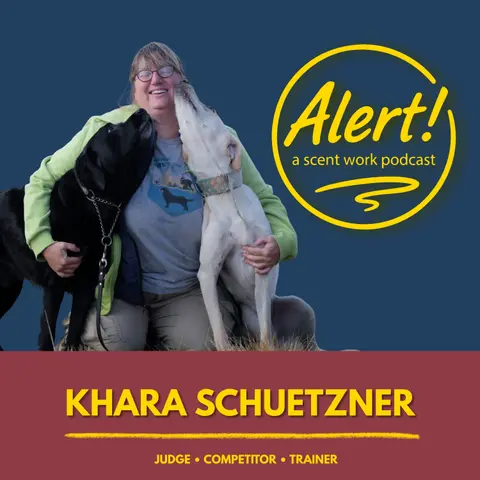


Khara Schuetzner is from Oklahoma and competes, instructs, and judges for NACSW, AKC, UKC, and USCSS. She opens the conversation the way she opens every search: by telling herself to stop thinking and watch the dog.
That idea runs through everything she covers: why handlers miss transition areas, how overthinking odor and time pressure work against you, what it actually means to call a find at the higher levels, and why the sport becomes a team sport as you move up. The dog is always telling you something. The question is whether you’ve quieted down enough to hear it.
Topics covered:
How overthinking odor theory mid-search works against you and what to do insteadKhara Schuetzner was in the second CNWI program, started teaching nose work in Oklahoma before there were instructors to learn from, and now lives on a farm with three black Labs she works in human remains detection. She also judges for NACSW, AKC, UKC, and USCSS.
The conversation starts with why odor theory can work against you mid-search and builds from there into hide placement, how she uses time as a judge, what actually changes when you move from AKC to NACSW, and what supporting your dog looks like versus getting in its way.
Topics covered:
- Judging by level: What Khara is actually evaluating at novice, advanced, and the upper levels, and why the criteria shift as the searches get harder
- Hide placement: Elevated hides, threshold hides, and transition areas, including a detective search where a handler blocked their dog at a doorway without realizing it
- Time as a tool: Why Khara varies it, why she sometimes gives a weird time like 2:45, and what she’s watching when handlers have more time than they expected
- AKC, UKC, and NACSW: The differences in odor concentration, search size, and the full-day stamina commitment, from both a competitor and a CEO placing hides
- Supporting versus interfering: Reading your dog through video, knowing when to hold still, knowing when to give leash, and why her husband spotted something in seven trials that she never saw
- Calling the find: Why handlers at the upper levels are afraid to call twice and why that fear usually costs them
- Seven Questions: Khara’s dogs, her reward style, her signature distractors, what she wishes competitors knew about being a judge, and what she looks for at the start line before the search even begins
Find Khara:
- Website: thedoggiespot.com
- Courses: Scent Work University
Khara 0:00
I'm a dangerous canine handler because I start thinking about odor and chemistry and physics, and then I'm like, shut up and just watch your damn dog.
Scot 0:09
I know. I'm glad you brought that up, because it's a struggle I've had. I'm trying to learn odor theory, trying to get all the nuance of it, and then I take that into the round and find it gets in the way. And I'm just like, maybe just watch the dog. And then if something weird happens, well, what could be going on here? Maybe that's when I implement it.
Khara 0:28
It's kind of like water. I love what Mo's work does — it takes science and it takes the dog, and there is no black or white. It's very gray, and it's dependent on all these variables. You can overthink yourself into a corner. But I think of it as water. It's very fluid, it makes adjustments. It can be solid, it can be a gas. It just forms to whatever it needs to be in the moment.
Scot 0:59
And you have to be flexible enough — water enough — to accept that, recognize it and accept it when it happens. And that's hard.
Khara 1:08
In my beginning career, I just wanted to know the one answer. I think a lot of people want to know the one answer. And then you hear "it depends" all the time, and it frustrates the life out of a lot of people, myself included. And then you get to a point in your development where you're like, oh, I get it now. I remember Ron Gaunt helping me with my first dog, and he kept saying the same thing over and over, and it was about five years into it before I finally got what he meant.
Scot 1:39
I run through that same thing with my coach. She says something numerous times, and then it just clicks. And I'm sure from her side it's just like, finally you got there. But sometimes you just have to go through the process. Be kind to yourself.
Khara 1:55
Yeah. And Michael McManus gave me something to think about the other day. This is why I love the people in my circle — it's a journey, and they give little tidbits, and you're like, I never thought of it that way. And then you think of it differently.
Scot 2:12
That new perspective — another way of thinking about it. It's not a tip or trick, not a piece of knowledge. It's a lens that all of a sudden changes everything. And sometimes those can be really amazing. All right, we're off to a great start. I probably should introduce what's going on. This is Alert Scent Work. My name is Scot. I'm Murphy and Kiva's dad. And today, Khara Schuetzner. Listen to this: NACSW, AKC, and UKC Certifying Official and judge for those organizations. USCSS Judge, Cyber Scent Work Review Official. You also handle detection dogs, you've got classes on Scent Work University, you train, you compete. What happened? How did you get to this point? I like to talk about origin stories.
Khara 2:58
It all started in 2010 at an APDT conference in Atlanta, Georgia. I do a lot of behavioral consultations with vets and other colleagues — bite cases. There was a behavioral track, and I left it because I saw this canine nose work demo and I was like, what is this? I wasn't very competitive in dog sports. My dogs did things, but I didn't go out and compete because I'm very competitive myself, and having that pressure on another being — I just didn't want to feel that. So I sat in this APDT conference session and thought this was the best thing that had ever happened to dog sports. I just drank the Kool-Aid with NACSW at that point.
I was good friends with Ian Dunbar, and he started harassing Amy, Jill, and Ron, because I'm this little trainer out in Oklahoma going, you need to put her in one of your classes. So I was in the second CNWI program in Davis, California. I flew out there, and a lot of people thought I lived in California because I was a teacher and had the summers off. I would spend the summers out there just learning and absorbing nose work. Then I came back to Oklahoma, met with a bunch of trainers, and said, hey, we need to start teaching this. Some of them let me teach classes at their facility, and that's how it all began.
Scot 4:29
You said you fell in love with it instantly. What was it about it, in such a short amount of time, that just hit you like — this is awesome?
Khara 4:40
For me, it gave all the control to the dog. It allowed the dog to explore their environment and be a dog. Dogs sniff — they have this great nose. And what was great for me was I didn't even think of it as a sport at first. I thought of it for my behavioral clients whose dog couldn't walk into a room because the ceiling fan was going or something. It gave the handler and owner an opportunity to observe their dog doing something it naturally does. I thought that relationship — being able to understand those behaviors — would help so many dogs that needed an outlet or a way to express themselves, and the handler just couldn't see it.
Scot 5:26
That's a recurring theme. A lot of my guests have brought that up. Most recently, Diana Santos talked extensively about the value of the activity — not even just competing, but the value of the activity itself. When did it turn competitive for you? And how do you balance this conflict where you're really competitive but don't want to put that on another creature?
Khara 5:50
I actually started this for a lot of my behavioral clients. At the time, I was training a rescue Labrador for human remains detection. Luckily, the rescue let me wait to neuter him. I got him neutered and he became environmentally sensitive. For 18 months I'd been training this dog, and then he completely washed out of the program. So I started doing nose work with him just for fun, because a loud noise would happen and he'd be like, oh my God, the world's gonna end. It really helped build his confidence.
I wasn't going to compete at all until Amy Herot, Dana Zinn, Ron, and Jill were like, hey, you should really compete with him. My first trial, I think I went to the bathroom about 150 times because I was so nervous. It was one of Colorado's first NW3 events — they had an NW2 in the morning and an NW1 in the afternoon, back around 2012, 2013. Drove 13 hours for an ort that we'd only done perch work with. We got our NW1 in third place, and I was a nervous wreck the whole time.
He taught me so much. I wish we had videos from when we first started, because we didn't know anything about leash handling back then. I would literally be on top of him. And then the nose work community — I've met some lifelong friends through it. I really had to learn how to decompress my competitive edge and just watch the dog. It was a good eye opener.
Scot 7:47
Not only was it good for the dog, it was good for you — which is another theme we're starting to uncover with scent work. It's not just the dog that develops, it's us. I completely forgot to ask you — I always start out with who I'm dog dad to. Who are you dog mom to? You've got a pack, from what I understand.
Khara 8:07
We live on a farm. I feel like we bought the zoo from that movie. I have two German Shepherds, which are actually my husband's — one actually can't smell, which is kind of fun. We have two Bavarian Mountain Hounds: one does deer tracking, and the other one I guess I need to start in nose work. I have Judith Guthrie's dog Whiskey, who does nose work. And then I have a Beagle-Basset-Rottweiler-Dachshund cross named Winnie, who does nose work just because I asked her to — she doesn't really enjoy it, but she's quite the hoot to run. And Snickers, who's just a go-go dancer dog. And then I have three black Labradors who are my human remains detection dogs.
Scot 8:58
Got it. Are you competing right now with any of these dogs?
Khara 9:01
I am. I have a goal with one of them that I haven't publicly said out loud yet. With another, I had a goal and we actually got it. Winnie competes in NACSW, UKC, and AKC. And I need to get back into USCSS. I used to host trials in Oklahoma, and my students are asking to bring them back. It's just finding the time.
Scot 9:25
Because you're not exactly unbusy. It doesn't sound like you've got just a few things going on.
Khara 9:31
Yeah.
Scot 9:31
I want to talk a little bit about you from a judge's perspective, because this is one of my favorite parts of this podcast — having a prolonged conversation with a judge. Normally it's just a brief moment after a run, maybe a couple words while they're moving between elements. I love getting your perspective. So the first question: if I show under you, what should I expect? I'm asking you to go beyond the judge's guidelines. We all know what those say. What should I expect beyond that?
Khara:It depends on the level — there's that word again.
Scot:Yeah.
Khara:With a novice dog, I take in all the factors — the stackable challenges in the environment. I know Judith uses the Hundred Rule; I do something similar without calling it that. My goal for a novice dog is being able to detect odor in a novel environment. In advanced, can the dog work a larger area? Can they remember the F word — fun, not the naughty one? When you get up to the higher levels in AKC or NACSW, it becomes more of a team sport. You can have a really great dog and a not-so-great handler, or vice versa, and still make it through NW1 or Advanced or even NW2. But at the higher levels, it really is about teamwork. Can you work converging odor problems? Can you work a threshold or transition hide? Can you work a deep, inaccessible hide?
Scot:Okay.
Khara:And not just can you work it — can you work it with your dog? Because your dog is telling you something through changes of behavior. Are you able to recognize that?
Scot:That's my big struggle. I don't know that I've ever recognized converging odor on my own. Other people have pointed it out after the fact. So that's what you're talking about — recognizing those changes of behavior in the moment. That's the team sport piece.
Khara:Right.
Scot:There was a debrief you did that I found intriguing — you gave max time, and said you did it to see if handlers could manage calling the finish sooner. That's beyond the judge's guidelines. Were you testing the handler with that?
Khara:I actually let them decide. Everyone said, give us max time. So I said, fine, I'll give you max. Because with a detective search — or was it master?
Scot:I can't remember if it was a detective search or a master search.
Khara:It's a little like gambling in nose work. You have all these factors, and sometimes when you have max time or a short time, people overanalyze that.
Scot:Yeah, right.
Khara:The dog is basically trying to leave the room, or they've already been to the hides and are showing all these behaviors, and handlers are like, let's search over here. They start over-handling or panicking. And in that search — if it was a master interior — it was great, because handlers would look at me like they wanted an answer from me.
Scot:Like, we found it in 45 seconds, but you gave us max time. What's going on here?
Khara:At the higher levels, I think it's not only about reading your dog but also knowing where you've been. I don't love the term "search plan" — every dog has its own search pattern. But as a handler at the higher levels, your dog is giving you clues and you don't always know what to do. Do I stand still? The dog looks at you, and you have to think: where has my dog been, and where have I not been? Because your dog may have covered everything, or maybe it missed a corner or a section where odor was collecting but no one had moved through that area to disturb it.
Scot:I found the max time interesting because I've known some judges who think they're doing handlers a favor by not giving too much time — protecting them from getting into trouble. For you it felt like a test.
Khara:It pretty much was. Because as a judge, I do sometimes think I don't want to give max time and set someone up to fail. But I also think sometimes you need max time because it can calm a handler's nerves. If you have a handler or dog that's a little slow and you're always giving shorter time — I went through quite an education about that myself. I had to give myself permission to give more time. When you think about giving max time, you always worry that this will lead to that. But sometimes you have to play with it.
Scot:So you're not always consistently giving minimum time to protect people. You vary it to be fair to different types of teams.
Khara:And sometimes I like to give a weird time — like 2:45 or 1:15. What the heck is that?
Scot:Right. I think the takeaway is: regardless of the time, unless it's super short and you're worried about coverage, don't assume a super long time means a super challenging hide. And if your dog is telling you you're done, you kind of have to go with that.
Khara:Right. And if you don't play with time in training, you're shortchanging yourself. Try a 15-second search in a large area or something crazy. We can never fully emulate trial stress in training — we're not being judged, so it's just not the same.
Scot:A couple other things I noticed in your debrief videos. You've judged thousands of rounds; I watched a handful. I noticed some trends. Tell me if they're accurate. You seem to like high hides. Do you like high hides a lot?
Khara:Actually, no.
Scot:Okay. All right.
Khara:At certain levels, if there's a good spot for an elevated hide, I'll use it. But not every area has a great elevated hide placement.
Scot:Yeah. And I had no idea about elevated hides at first. I'd put it up high and wonder why the dog couldn't get it, until I learned that odor doesn't necessarily drop — it rises. So in trial, your philosophy is it has to be just the right situation to make sure odor is accessible.
Khara:Correct. If you select an elevated hide poorly, you can create a scent void underneath it where nothing drops and the dog isn't catching it at all. And when you over-train elevated hides, you teach the dog to fringe because they can't really get to source. In most situations, if there's a nice area where I can set an elevated hide and have dogs catch it or work it — including everything from a Chihuahua to an Irish Wolfhound — I'll place one. And that's usually at the higher levels, because I think that's something teams should encounter there.
Scot:Seems like you like thresholds too. Do you use those a lot?
Khara:Thresholds are usually the most missed at the higher levels because people forget about them.
Scot:Interesting.
Khara:I try to use a die when I go somewhere so I'm not setting the same thing. But everyone has patterns, Scot.
Scot:Yeah.
Khara:Right.
Scot:That's cool. I've heard other judges use dice to randomize it. I like that idea. The last thing I want to talk about with hide placement is transition areas. You mentioned them a lot in the debriefs I watched. Can you talk about transition areas — why they matter to competitors, and how we should be thinking about them?
Khara:The easiest explanation: a transition area is when you're going in and out of a room — like a doorway. Similar to a threshold hide, but you're moving from one space into another. Most places have a door or a hallway that takes you from one room or area to the next. That's a transitional area.
Scot:I'll add that you mentioned a transitional area in one of your searches that was an exterior — from a covered patio to an uncovered area. You called that transitional. How is that transitional in your mind?
Khara:Because the covered area is going to have odor drop and kind of shield it. When you transition out, you have this open space where the odor moves quite differently than it did under the covered area.
Scot:Okay.
Khara:I think of it as having a curtain. If there's odor underneath the covered area and one on the outside, the odor may not move outward at all — it may get sucked back into that covered space, depending on what's going on in the environment.
Scot:Re-explain what might get sucked where.
Khara:The odor might just stay in that covered area.
Scot:Got it. So it could stay tight instead of drifting out.
Khara:Right. And when we move through a space — especially a tight one, like a hallway to a classroom — how we move through it is going to affect how the odor moves too. A lot of people, when moving through a transition area, don't think about who leads and how they walk through that space while working odor.
Scot:Well, hopefully the dog is leading, but.
Khara:Hopefully. But sometimes we tend to walk through tight spaces side by side — the dog's on the left or the right. And maybe the dog doesn't get a chance to get to that side because we're moving together and effectively blocking part of the dog's path. Does that make sense?
Scot:Yeah. So in a trial, are you saying I should really pay attention in those transition areas — make sure the dog is ahead of me, not blocked — because otherwise I'm losing information from an area that could actually be productive?
Khara:Yeah. Or if you do move through together — because sometimes that just happens — at least be conscious that you're watching your dog and not just focused on where you're going. I'm thinking of a detective search I did that I'm going to show on Scent Work University. The dog came into the room beautifully. There was a hide on the transitional space at a propped-open door, and they didn't catch it on the way in just because of the airflow. But on the way out, the handler stood between the dog and the door. The dog was leading, but at one point it tried to turn back — and the handler didn't notice because they were already focused on their own movement. It's a small thing, and it's what I call armchair quarterbacking when you're judging or watching. Everyone on the outside sees it, but in the moment the handler doesn't, because they're focused on something else. We have to be really cognizant of that if we're watching and spectating too — we know exactly where all the hides are, so it's easy to pick up on.
Scot:When you know the answers to the quiz, everybody else seems dumb for not getting them. So are you saying that there's something psychological happening in transition areas — like, we've already passed through here once, so we're not paying as close attention?
Khara:Yeah, I think it's just our nature — how we walk through spaces. We're like, we passed through it once, we got this. And it's especially hard in tight spaces because passing through quickly is just natural movement for us. I don't want people to go out and load up on transitional hides and work their dog to death — your dog is going to catch it. Just be more conscious of your movement through those spaces. Whether you slow down or not depends entirely on you and your dog, because I don't know your team.
Scot:Because we always just want to get to the next room. The hallway isn't interesting unless it's a big, long hallway that calls attention to itself. Those little transitional areas are almost invisible.
Khara:And I think that's why they get missed most — people just don't think of them as productive spaces. You see this even with professional canine handlers. We have a warehouse to search and there's a hallway, and no one wants to search the hallway because they're thinking, where would you even put a hide in here? And sure enough, there's odor in the hallway, and the dog can absolutely work it. But people are quick to dismiss it.
Scot:I want to talk about your experience with multiple organizations. Specifically, I'd like to compare AKC and UKC, because I think they're fairly similar. And if we agree on that, especially when compared to NACSW — I moved from AKC to NACSW, and we just finally got our NW1. We bombed our first one, even though I have a master-level dog and a detective-level dog. That hurt a little. For somebody in a similar situation who competes in both — are there a couple of things to keep in mind when making that transition from AKC or UKC to NACSW?
Khara:I didn't do UKC for a while. I started because I had a dog that did NACSW but didn't like vehicles, and UKC gave me an opportunity to train for vehicle searches in a trial setting. So I'd just go do a bunch of vehicle searches there. They're a little bit different — you only have to pass twice in UKC to get your official title, and then they have elite legs like AKC. But it's pretty similar. UKC uses more odor than AKC. Their container searches aren't the varied containers that NACSW or AKC uses — they're literally square boxes. And I feel like UKC can be a bit object-focused because they tell you how many objects can be in the search area at a time. That's a little different for people who aren't used to it.
Scot:Got it. What about from a competition or preparation standpoint? I've done AKC for a long time, and I'm moving to NACSW. Are there things that could burn me if I'm not prepared?
Khara:I started in NACSW. To me, it's the gold standard. But —
Scot:You're not alone on that. But —
Khara:I love it because I have a client who has 40 detective legs and finally passed her NW3. And she has a very good dog. She just got in her head. I think the big thing is just getting used to being there all day for NACSW, searching all elements, and knowing it's pass or fail — you have to pass everything. It's a stamina test for both the handler and the dog. Whereas in AKC, you can sign up for just containers at a trial, or just exteriors. If you're in one level, you're probably done in a couple of hours without staying all day. So mentally preparing for that full-day commitment is huge.
Scot:What was the tripping point for your friend getting those NW3 legs? I've heard NW3s are brutal. Some people have joked that's why they drank — W3s.
Khara:I love NW3. I think I love the handler mind game of it. As a competitor, I just love it. I'm in it right now with one of my dogs.
Scot:What is the handler mind game for you?
Khara:It's the unknown — zero to three hides. It could be zero to three.
Scot:But master is also zero to three. So how is NW3 different?
Khara:The searches are much larger. I'm actually currently working toward Master Interior with my NW3 dog because those are smaller searches and the odor is more prolific in AKC for her. I actually have to wear a timer now for AKC Masters interior — that's the only way I can pass with her. I discovered in the last interior search that I feel rushed and don't give her enough time to work it out.
Scot:Oh, okay.
Khara:Right. For NACSW, I give her the time to work because the searches are much longer.
Scot:So I'm kind of hearing: when you move from AKC to NACSW, just take a breath and allow yourself to use that extra time. You also mentioned odor feels more available in AKC than NACSW.
Khara:Yeah. Think about the concentration strength — two drops on a Q-tip versus NACSW where you have 30-40 Q-tips in a jar diffusing together. So the odor presence is quite different.
Scot:Do dogs that are more detail-oriented tend to do better in NACSW? Or is that not a fair statement?
Khara:I don't think that's fair. It really depends on the individual dog.
Scot:Yeah.
Khara:There are dogs that do great in both. I have a dog that does well in UKC and NACSW at the same level, but Master Interiors are a struggle for both of us. I think she just gets overwhelmed — the odor is everywhere, it's converging, and she needs to be right on source. That's her thing. My other dog isn't that way.
Scot:As a CEO — because in NACSW it's the CEO who places hides, not the judge — are there things you keep in mind when placing hides for one organization versus the other? For instance, I've heard that in NACSW, since it's not all-or-nothing at every level like detective is, as a CEO you still need all hides to be solid. But if one hide goes unfinished, it doesn't tank the whole class. Is that something you keep in mind, or are there other considerations?
Khara:Well, if no one got a hide — I mean, it kind of —
Scot:You still don't like it, right? But —
Khara:There may be no titles.
Scot:Fair. That's good to hear.
Khara:We've all had situations as a CEO where you run a dog in white, it's fine, and then only four dogs pass a search because the odor went somewhere else. And then you're having to explain why the hide didn't hold up.
Scot:Right. They monitor the stats pretty closely. If something looks off, you hear about it.
Khara:They really want you to be thoughtful about placement. And the hide has to be there all day. The difference between NACSW and AKC is that for a morning session with 38 dogs, that hide has to hold for two hours or more. In AKC, a hide might only be out there for an hour or an hour and a half.
Scot:Because of smaller classes, possibly?
Khara:And the eight-hour time restriction they put on judges.
Scot:So there's a little less pressure on the hide's durability in AKC because it doesn't have to be stable for a full day.
Khara:Yep.
Scot:Any other thoughts on that before I move on?
Khara:People always ask me how I keep the rules straight.
Scot:Right, because that's important not just as a judge but as a competitor — the rules dictate strategy.
Khara:Right. As a competitor, judge, CEO — whatever I'm doing that weekend — if I know I'm running a UKC trial, I reread the rules beforehand. That's how I keep everything straight. And competitors can now buy those laminated cheat sheets off Etsy that keep the differences in front of you. But as a CEO, you have to make sure your integrity hide is going to hold all day, whatever the weather throws at you. I've co-trialed through a 30-minute lightning break where my poor dog sat out in the exterior search area for an extra hour and a half because we couldn't go out there. You just have to make sure the hide can survive the full day. The odor concentration and search area sizes are just different between the two organizations.
Scot:Got it. You have a Scent Work University webinar called "Supporting Versus Interfering: Becoming a Better Handler." That's exactly where I am right now. You mentioned earlier that when you first start — novice, advanced — you're amazed the dog finds it, they give their final response, and you think this is great. And then excellent, master, detective — suddenly you're not as successful. Not only is the puzzle harder, but the human is now more involved. You said humans need to listen more to what the animals are telling us and learn to work with them, not against them. That's probably the core of supporting versus interfering. How can I do this better?
Khara:It always depends on what's happening in the moment with your dog. And you have to know your dog. I think as handlers and dog owners, we don't give ourselves credit for how much we actually do know our partner. We're at a trial, somebody says, hey, did you know your dog does this? And we're like, I had no idea. But then you think about it and you really do understand your dog — it's just that at trial, your brain goes to mush. How you get better is by understanding what your dog is telling you in the moment, and that comes through training in different environments, different scenarios. Have you ever trained with a cat running through your search area? Maybe you need to do that. Go to a grooming shop and ask for cut hair and put it in your search area, because at a trial your dog is going to run right after a dog they've never met, and they might be sniffing the ground because that's interesting. It's knowing when to support them, when to give leash, when to hold still. It all depends on what's happening in the moment.
Scot:A little bit earlier you mentioned watching for supporting versus interfering. And of course, like you said at the top, we all want absolutes. But I think there's a great practical idea there: when you watch your videos, instead of watching for change of behavior or bad leash work, put on the supporting-versus-interfering lens. That's all you watch for. I bet you could learn a lot about yourself that way.
Khara:Yeah. I used to video everything because there were no nose work instructors when I started — I was it. Every mistake I made, I only had myself to blame. I'd set up my phone and walk my search area to make sure I could see myself in frame. Then I'd run the dog, watch the video without the sound on, watch what I was doing, then watch what the dog was doing, and break it down to the ten changes of behavior. I even did a podcast episode on that.
I was struggling in NACSW one time with Super Duper Cooper — I almost wanted to quit. I called Amy up, and she said, why did you get into this sport? I took a break. There's nothing wrong with taking a break. Then I was watching a video and my husband comes in and says, hey, did you notice his tail drops about ten degrees when he's really on source? And I was like, you couldn't tell me that in seven trials. So sometimes, if you're too deep in your own head, let somebody else watch your video — somebody who doesn't even do this sport. They're going to see something you don't.
Scot:Or just give your video to other people and see what they see. They'll catch things you're completely blind to.
Khara:Yeah.
Scot:That's brilliant. All right, I could do a six-parter with you, but we're just about out of time. Hopefully you'll want to come back.
Khara:Oh, I do. I love your podcast and your seven questions at the end.
Scot:Good, because that's where we're at. Seven questions. Looking for a one- or two-sentence answer, just the first thing that comes to mind. Ready?
Khara:Let's go.
Scot:What's your dog's favorite reward after a great search? Get specific.
Khara:A tug, and very joyful jumping — just really screaming with excitement where I almost fall down on my face.
Scot:You go all out in that reward party. What's one piece of advice you would give your beginner scent work self?
Khara:Enjoy it.
Scot:That's so big. You go through a journey — it's fun at first, then you get serious about it, you want to be a great competitor, you want people to think you're great. And then eventually, hopefully, you get back to just having fun. Right?
Khara:That is exactly the cycle.
Scot:What's the best compliment you've ever gotten at a trial — as a judge or a competitor?
Khara:"You set fair hides." That's what I want. I want to be fair for all types of dogs.
Scot:Pick any of your dogs — or even your detection dogs. Something that happened during a search that made you laugh.
Khara:The look they give you when they're like, why are you not calling this.
Scot:The look of frustration?
Khara:You guys all know the look. My dog is cussing at me. I don't swear, but my dog does.
Scot:That's great. Do you have a signature distractor? Something that's going to show up every time at one of your trials?
Khara:In AKC, it's probably a dog leash or dog collar.
Scot:Oh, okay.
Khara:And I also use plain rice cakes. The boring ones.
Scot:I'll proof against that before I show under you. What's something you wish competitors knew about being a judge?
Khara:How much we really want you to pass.
Scot:Give me a little picture inside your brain. I'm doing a search, I'm getting close. What's going through your head?
Khara:Just follow your dog and trust it. And don't be afraid to call it, especially at the higher levels. People are afraid of the double fault — they think, I called it once, so now I'm afraid to call it again. But chances are you probably didn't call it wrong the first time.
Scot:I know that intellectually, but my ego won't let me do it most of the time — I don't want to be the guy who doesn't know what he's doing. But that's good advice to hear again. Last question: what's one thing you love seeing in a team, even if they don't Q?
Khara:The relationship.
Scot:Expand on that just a little.
Khara:I like to watch the team as they're walking up to the start line to see how their relationship is. And then I like to take a moment at the start line and just observe the look of how they are right before the journey begins.
Scot:Yeah.
Khara:Because that tells you a lot about how the team is probably going to work the area.
Scot:That's fabulous. Thank you so much for being on the podcast. If somebody wants to get a hold of you — you have courses at Scent Work University — what are some other ways to reach you?
Khara:They can email me. DoggySpot.com is my website. If they Facebook message me or email and don't hear back within about 48 hours, give me a nudge — I travel a lot and sometimes I'm in spotty service, especially when I'm out working the human remains dogs. That's the best way to reach me.
Scot:Do you do virtual coaching?
Khara:Yeah. People will just send me videos and say, can you take a look at this? And I do. That's what I do.
Scot:Awesome. The website is thedoggyspot.com and the Facebook page?
Khara:I think it's thedoggyspot.biz, so.
Scot:I trust people can find it.
Khara:Yeah.
Scot:Thank you so much. It's been so much fun. I hope to get to show under you sometime. This has been a lovely conversation. If you liked this conversation with Khara, share it with a friend who might enjoy it too. You can also follow us at facebook.com/alertscentwork, where we discuss episodes — if something resonated with you, post it on the page and we can all talk about it. And if you're not a subscriber, please do — you can go to alertscentwork.com or wherever you podcast. Thanks for listening to Alert Scent Work.