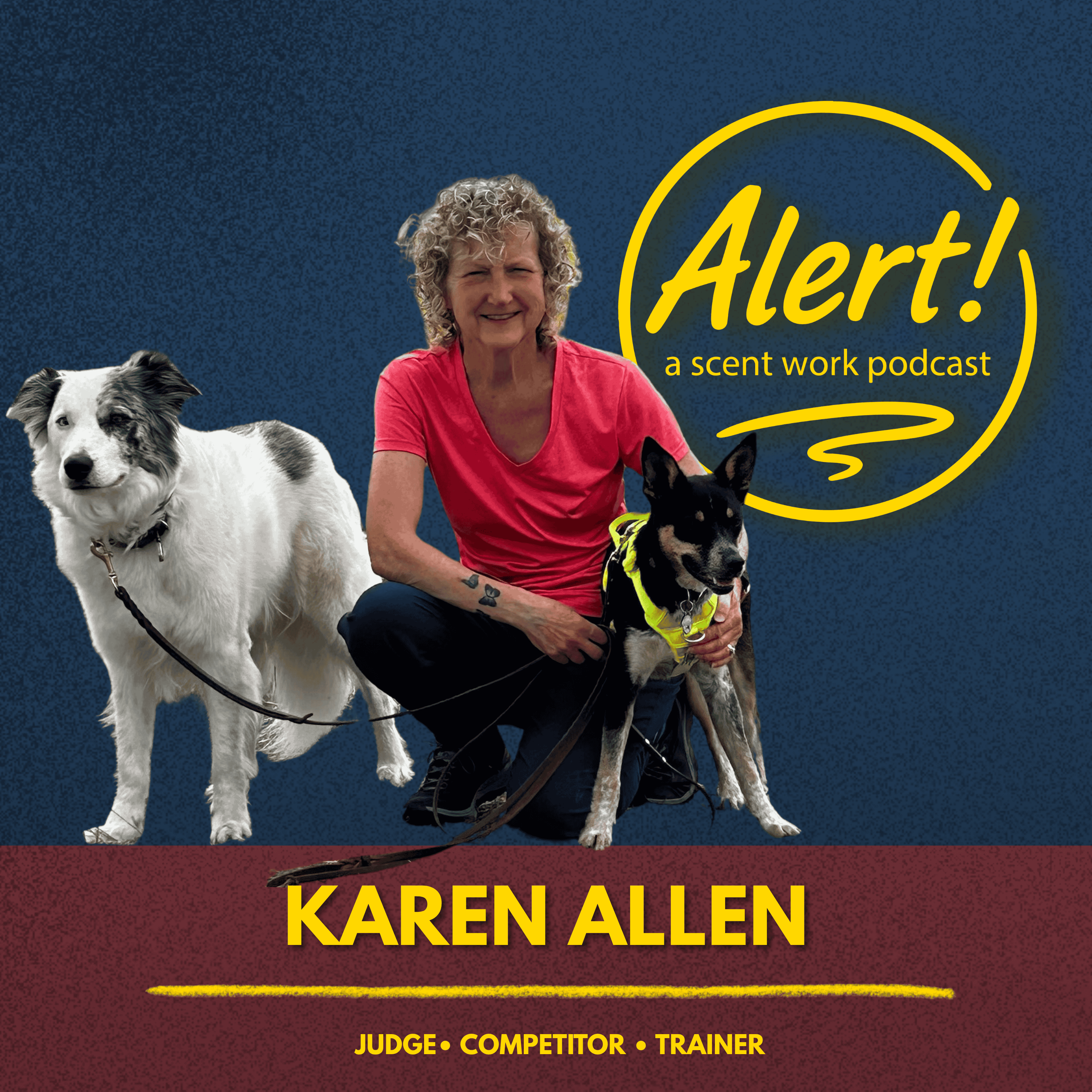


I ran under Karen Allen at a detective trial and didn't Q. What stayed with me wasn't the result, it was the feeling walking away. She was rooting for us. That's who she is as a judge, and it's a big part of why I wanted to have this conversation.
One of the threads running through this whole conversation is how much we impact our dogs without realizing it. Body chatter. Disappointment going down the leash. Turning away at the wrong moment. Not opening your body to give permission. A lot of us are probably in that same place.
We also both got into something we're each actively working through — what happens when your dog stops searching and starts asking you questions.
And inaccessibles. What makes them challenging, and she and Scot talk about how their dogs each handle them.
What we talk about:
Karen's origin story — a cattle dog rescue who was hard to do activities with, and how scent work became the thing that finally worked
What changed in Aspen after scent work
Newton, who is deaf in one ear and very sound sensitive — and Larkin, who can shut down easily
How Karen plans a search — the Cirrus tool, the yes zone, and videoing search areas before trial day
Sniff and dismiss — and why patience matters more than most competitors realize
Collection, false alerts, and nerves — why it's more complicated than it looks
What Karen loves to see in a team when she's judging — and what she admits she's still working on herself
How much we impact our dogs without realizing it — what Karen sees as a judge and what Scot admitted about Murphy
What counts as a win when you don't get the Q
The boundaries — what newer competitors get wrong about them
When your dog stops searching and starts asking you questions
Inaccessibles — why they're hard to call and why we don't practice them enough
Escential Nosework ABCs — Karen's new business and what it focuses on
Seven questions with Karen
Find Karen: AKC Judges Directory — search Karen Allen
Escential Nosework ABC: noseworkabcs.com
Alert! Scent Work is a podcast for competitors — the parking lot conversations you'd never get to have at a trial, with the judges and community members you wish you had more time with.
Listen to the podcast and find everything here: https://www.AlertScentWork.com
Follow along: Facebook: https://www.facebook.com/AlertScentWork
Subscribe to the newsletter: https://www.alertscentwork.com/newsletter/
Karen, I wanted to start by talking about a run that I had under you. It was a detective search. Didn't go quite the way I wanted. What really stuck with me was the feeling I had afterwards. When I walked away, just something in the way that you were, the way that you talked to us afterwards — I was like, she was really rooting for us. And that really felt good to me.
Karen:As a competitor, I'm really invested in every dog searching. In every team. I'm in there, I'm watching. It's almost like I'm at the end of the leash, but I want everybody to be successful. I think that's just my personality.
Scot:All right, so let's get the intro out of the way. This is Alert Scent Work. I'm Scot, Murphy and Keeva's dad. And today, Karen Allen — mom to Aspen, Newton, and Larkin. Did I get all the dogs there?
Karen:So Aspen has passed at 16, but I trialed her until she was 14. We didn't start trialing until she was 8 years old.
Scot:Wow. And that was your entry into scent work, right? Aspen?
Karen:Yeah, it was definitely.
Scot:One of the things I do love about the podcast is getting the origin story. So at one point in your life, Karen, there was not scent work in it, and then the next thing you know, there's scent work in it. And now you're a judge and you're a trainer and you're a competitor. How did you get into scent work? What was it with Aspen that kind of drew you in?
Karen:Aspen was a cattle dog mix, a rescue that I got from the pound. It was really hard to do activities with her because she was never an aggressive dog, but she wanted you in your chair — strangers in a chair — so she didn't have to keep track of you. So I tried to do musical freestyle. We did have success there, but in rally we didn't because she would stand in the ring and just watch everybody. Because I hike a lot, my friend suggested I should try scent work. And that's just where she was very comfortable. We really enjoyed it.
Scot:When you used to go hiking, she was just using her nose all the time. I understand she was always out at the end of a 10, 12 foot leash.
Karen:I never wanted my dogs at my side or behind me. I always wanted them in front of me. And that's what she did.
Scot:And did you see some changes in Aspen after scent work — like in the confidence, or the ability to just ignore people that aren't in chairs?
Karen:Yeah, she did. She ignored people. I remember one trial though — we were doing an interior, and I said, we can't let exhibitors look in that room because all she's going to do is bark at them. You're a stranger, you don't belong there. But if people were just standing around watching, then she was fine.
Scot:I hear a lot of people talk about how once they start using their nose, all that kind of shuts off and they just focus on the job.
Karen:Yeah. It gives them a different focus.
Scot:Were there any other struggles you had with your dogs that are unique — that you have to work around in order to make this sport work for you?
Karen:Well, Newton is deaf in one ear, so he hears sounds differently, and he's very sound sensitive. So like any of those distractors — like a plastic frog that vibrates. Well, a plastic frog doesn't do those things. And so if we came across those in our searches, I had to be really careful to avoid them. Or if he needed to exit and quit searching, then we just exited and quit searching. He was very sound sensitive — bangs, all those kinds of things. And then Larkin is very environmentally aware. So I'm kind of dealing with a different struggle with her. She can shut down easily. Those things can shut a dog down until they build that confidence — okay, I see that frog, we're just going to make a beeline around him and we're good.
Scot:What is it that you love about judging?
Karen:I love the community of people. I love that community. I love travel. When I set a search, what I like is the dog — that change of behavior that you see, especially for those environmental or sensitive dogs. That building of confidence. And then it makes them feel good too.
Scot:When you look at a search area you've been given, what goes through your mind as you plan that search? Let's say an exterior or an interior — you show up, they say this is your area. How do you reason through where you're going to put your different hides and what kind of puzzles you're going to set up?
Karen:I look at the environment to see what it offers me. And then I get my Cirrus out. And for everybody that doesn't know, Cirrus is this little thing that produces smoke so you can see how airflow is moving. And then I just kind of look for good options in that environment.
Karen:If it's a classroom and I see a heater and then a window, I'm going to set my search away from that because I want to have a stable, secure yes zone for me. I really think through all that — what's going to make this even? If you set it on a bench, where is the wind going to blow that hide? How can I keep my yes zone very clear?
Scot:How do you decide what puzzles or challenges you want to set?
Karen:It kind of varies, and it goes from what I see — like the trial before. It's like, oh, I want to see — can they get in this corner? I see a good place I can put a corner hide. Those challenges, it's just kind of what the environment offers. Like, oh, this crack looks really nice.
Scot:Ever since you became a judge, cracks and sidewalks all of a sudden take on a whole different meaning, don't they?
Karen:They do. And then I look at what the environment offers. I really think a lot, write a lot of notes. I video my areas, and when I get back to a hotel, I'm looking at it for potential hide locations. That's where I kind of put my plan together. So I'm one of those judges that arrives early and stays as late as I can.
Scot:When you first started judging, was there anything that kind of surprised you or that you didn't expect?
Karen:Yeah, I had some unsuccessful buried searches. And though all my hides were found, I realized what could have been happening after the fact. It's like — you have to really look at not only your environment and HVAC, but look at the lights that are around, the height of the ceiling, because sometimes the odor travels. If I'm using the cafeteria tables to block line of sight, are they too close? Are they going to get hung up in those? Is that maybe going to help or is it going to make it worse? And it's always sad when people come up to the line and say, we aren't going to Q anyway, so it doesn't really matter. And it's like — it's a new day. And I hope I set this so you will Q. And then just staying out of the way of your dog. I like to give my dog that freedom to work stuff. He's methodical, and so sometimes he works everything. Sometimes he works it differently. But it's about giving him that freedom.
Scot:So that's something, as a handler, you like to do — give your dog the freedom to do the thing that they do. Is that something you love seeing in other teams as well?
Karen:Oh, I do. I love that. And then just being able to step back and watch and letting them complete that puzzle. Sometimes people call things too soon, and it's like — give them that chance to sniff and dismiss. I got to sniff this. Are we sniffing dog information? Because as everybody's nose goes across, there's information of who was there last time. Patience. Right?
Scot:Yeah, patience is hard because you've got the time pressure, you've got the pressure of the judge watching you, you've got the pressure that you want to get the Q. Some people put more pressure on themselves because they want a placement ribbon. And I think when you move up into the upper levels of buried, that's super important. I love what you said about sniff and dismiss, because sometimes it takes — any of this could apply to interiors and exteriors as well.
Karen:Right, right. Sometimes it just takes a dog a second to process — what's going on here? Or they just want to check out what the other dog smelled like for a second. We can misinterpret that if we get too quick to call things.
Scot:Yeah, for sure. Newton really likes buried. Is that your favorite event with Newton?
Karen:It just depends. Some days on, some days off. But buried — it's just very contextual. There it is.
Scot:Right. Just go up and down the rows or around the circle or whatever. So a lot of us want our dogs to just go up and down the rows, because it's easier for us as the handler if they just go box, box, box, box. But when Newton starts following odor and goes in one direction and then all of a sudden veers off to the other side — how do you keep track of where you've been? Do you have a tip for us on that?
Karen:You just have to count. And I know they all look the same. With him, if he doesn't sniff them all and he says there's only two — if I don't call it, then it's like, okay, maybe you want collection instead. Even though that's not something I was taught to tell you about. So if I'm understanding correctly — in a round of buried, maybe he goes out there and he kind of knows there's two, and maybe there's two or three he didn't sniff. If you make him sniff those, then he might actually give you some collection. He won't freeze, but he'll sniff it, and then he'll look at me with a question. And sometimes I have a hard time in that moment reading that question — is it an alert or is it a question? Because he has a freeze. When you let him work on his own, he actually freezes and then pivots until he can make eye contact with you.
Karen:So it's in that moment of that pressure — because I feel it just like everyone else — sometimes I have that whoops and see it too early. Or I do talk him into hides of collection because I notice that change of behavior. I don't dismiss it. I keep thinking, oh, maybe I'm missing one. And so I hang there too long, and then he will — he won't necessarily freeze, but he'll look up, especially on door hinges, and hold. I didn't see that change of behavior like bracketing or anything. But sometimes you blurt out an alert anyway because of nerves.
Scot:Yeah, nerves.
Scot:I think that's a valuable takeaway, because I remember when I first started out and my dog might alert on a buried tub, and I'd be told — no, that's not it. Or in a container round. What's going on here? And I think just knowing that maybe your dog is unsure — what am I looking for right now? Maybe they're like, all right, collection of odor, that seems pretty good. You described a lot of variables going into a possible false alert. First of all, going to some container that might have collection, you get a look from the dog. It's not quite an alert, but we're nervous, so we move in a little bit closer. That makes the dog maybe not move where normally they might just dismiss. So then now we're calling — it's pretty complicated, really, isn't it?
Karen:Right.
Scot:One of the big things that you talk about — and that really matters to you, from what I understand, correct me if I'm wrong — is the relationship with the dog. That's a big deal to you in this game. When you're watching a search as a judge, what does a strong partnership look like to you?
Karen:What do you see when people are really engaged? They're engaged in watching that change of behavior just as much as I am, instead of thinking — where do we need to go? And turning away from the dog. Another thing is being open, because I'm very guilty of that — not realizing that I can be 10 feet away from my dog, but if I don't give him permission, such as changing the leash from one hand to the other — which I was told I needed to do and I keep forgetting — it doesn't open my body to say, okay, you can go check this area. And when a dog's a little bit hesitant to tell you because of that relationship, that makes it even harder. You just have those dogs that are like, man, I've got the world in my pocket. And then you have those other dogs that don't.
Scot:And then you've got dogs in between. I used to be in denial about my dog. I thought he was one that didn't care about any of that stuff that I did. But I've learned since then that he does — I do impact him.
Karen:You know, everybody just tries the best they can.
Scot:Yeah. So with Newton, if you go to a search and you don't get that Q or that placement, what counts as a win for you?
Karen:Was he engaged? Did he enjoy it? That's always important to me. Or did I do something to unintentionally interfere? But I like to see him engaged and trying to keep him up. Because if I am disappointed — and it's not because of him, I've never been disappointed in him, I've always been disappointed in myself — that still goes down the leash. He still feels it. If he wants to go say hi to someone, that's really the reason he goes — he likes people and likes to say hello. So I try not to diminish that as we walk to the line. If someone wants to say hi, but then when he's ready to work, he's not going to talk to that person.
Scot:Do you think about your role as a handler beyond just staying out of the dog's way? That's something I've been thinking about a lot lately — this is a team sport, and the dog has a job and I have a job. Do you think about what your job is as a handler?
Karen:I need to be aware of the search area. I need to know where we need to go and then find a way to encourage him to go that direction. But generally I let him take the lead. A lot of times we time out because we just don't work very fast — it depends on the search. So I just have to be aware of where we haven't been and the time. And then just being okay with the NQs.
Scot:That's part of your job as a handler, huh?
Karen:Yeah. Because it's going to happen, but I'm always going to learn something from it. Or you just miss things. You come out of a detective search and you call finish, and your dog worked really great. And then the judge says — you missed this whole area. And it's like, oh my gosh, I did. That's our job as handlers — to remember where the hides are so we can reward appropriately when they find a new one, and to make sure that we do get in all the areas. And it sounds like you use subtle body language to help communicate that, as opposed to dragging them over there.
Karen:That's what I try to do. But that's a work in progress.
Scot:It's all a work in progress. All right, you ready for seven questions?
Karen:I'll give it a try.
Scot:Okay. Just looking for a quick one sentence answer, whatever comes to mind. And if I want more, I'll ask for more.
Scot:What's your dog's favorite reward after a great search?
Karen:You know, they like treats, but it's more that engagement, that talking to him, that eye contact all the way back to the car. And the words — super smart, super smart. You know, you get the ears up and it's like, this is the best. Then he prances off like a show dog, even though he's not.
Scot:That's perfect. What's one piece of advice you'd give your beginner scent work self?
Karen:As a competitor, I would say to always give my dog the permission to move on. To always stay open.
Scot:What do you hope competitors say about your searches that you place as a judge?
Karen:They had fun. It was engaging. They enjoyed the puzzle put in front of them, and their dogs enjoyed it too.
Scot:What's a type of search or hide that you think teams often underestimate?
Karen:Well, the inaccessibles are hard to call. We all kind of struggle with those. And we don't practice them very often because we shouldn't — because they can't get their nose on source. But when you see an obvious change of behavior, it's hard for people to call those.
Scot:Yeah. It is hard because we want that final response. And you want to let your dog finish working the puzzle.
Karen:Yes. That's the other big thing — which is actually with my dog Newton. If he gets too far out, I'll whistle them back or I'll say, this way. And it's like, yes, patience in scent work. I do believe that when I think about particular searches, I have little checklists in my head. And if I know a search is going to be particularly complicated, that's actually something I remind myself about. I'm like, you're not going to fast call these. You're going to have a little bit of patience, just to make sure that my dog has time to work this puzzle out.
Scot:What's one rule from the scent work rulebook you wish more competitors kept in mind because it would help them?
Karen:Well, I think for the people just starting out — the boundaries are just boundaries, and the dog can find odor outside the boundaries. Just don't call it. Because I've seen some people — and again, they're new people — they don't let their dogs go outside the boundaries, and then they expect him to solve it in that small space. So like if you have an exterior or even the buried, just the boundaries — it doesn't mean that dog can't go out to that pole and keep collecting information.
Scot:Yeah. So you're telling me you're not going to smack them on the nose if they go outside the boundary?
Karen:No. If they get too far out, then I will remind them they're outside the boundary.
Scot:Yeah. I've watched a couple of competitors that actually have the word boundary, and they'll tell their dog as soon as the dog goes outside of the boundary. They're like, boundary, boundary. Why are you doing that? The information's out there. Let them indulge your animal for a second.
Karen:Yeah. And if my dog gets too far out, then I'll whistle them back or I'll say, this way.
Scot:Do you have a signature distractor as a judge? Something that kind of tends to show up in many of your searches?
Karen:I do like my fish.
Scot:Tell me about your fish.
Karen:Well, he's actually one of those cat toys that flops, but she took the motor out of him. Like a little salmon laying on the ground that somebody dropped.
Scot:How do dogs react to it? Do most dogs ignore it, or do they get a little action off of it?
Karen:They check him out. The toy dogs might pick him up and drop him. But he doesn't flop — he's just a flat fish.
Scot:I love it. What's your dog's biggest search quirk or funny habit?
Karen:Well, with Larkin, it's to go say hi to the audience. She gets up on her hind feet and waves her arms at everybody. It's like, okay, Larkin.
Scot:That's fantastic.
Karen:Newton doesn't really have any quirks.
Scot:No little search quirks or anything? No little expressions?
Karen:Well, he asks a lot of questions. He'll put his ears up and around, look at me, and ask me a question — when I keep him in a blank area too long or he's not finding odor. It's like, okay, what do you think? That's how I kind of describe those as questions.
Scot:I know this is seven questions, I want to dive in on that a little bit deeper. How do you deal with those questions? What goes through your mind when that question is asked at that point?
Karen:Well, that's kind of what I'm having struggles with right now. I try not to panic. I try to get him to another area. But sometimes that's a skill — I need to learn how to switch roles with him. I need to figure out some exercises so we can switch roles and he can go back to work. Because if you get too involved in answering those questions, then he becomes — okay, you're going to help us finish the search. And I have no information. I just have boundaries and time. So sometimes I do stop him and restart him — just do a little collar grab and pull back and say, find it. In a very positive voice, I try to get him to areas. But it's a struggle with those questions. Usually if he keeps engaged and I stay out of it, then we're okay.
Scot:Yeah. The questions is something I've been dealing with too lately, where I get asked those questions. And I found what I started doing was taking over the search — I'd start walking towards where I wanted to go. And one of the things — it's really hard to do this during trial because we're so cognizant of the clock — I'll just stand there. I won't give him any information whatsoever until he goes back to doing his job, till he goes back to searching on his own. And then I will start to accompany him.
Karen:Yeah. And that's hard. Sometimes it's hard to wait that out. Or even just taking a step forward to get it restarted — instead of you standing still, if you can take that step, that movement gets them going. Or again, making sure I'm always open. Because sometimes the way you turned might give them the impression you don't want them to move on.
Scot:Yeah. And so this has been fabulous. I learned so much from you today and I'm really glad we had this opportunity to sit down and have a prolonged conversation. It makes me happy.
Karen:Well, thanks for having me and making me feel more comfortable.
Scot:I have my job, you have your job — just like the dog has their job, we as handlers have our jobs. Do you want to talk about where people can find you and some of the other things you have going on right now before we sign off?
Karen:Sure. So my email address is on AKC's judges website. And a friend of mine and I just started a new business — it's called Escential Nosework ABC. Our website is noseworkabcs.com — that's a brand new business that we started this year. Just kind of to give back to people in our area on skills that maybe get missed in classes.
Scot:What are some of those skills that you might be focusing on?
Karen:Converging odor, spatial pressure, introduction to inaccessibles — how do you introduce that concept? Getting a dog to work, keeping a dog confident to work through those things. Confidence is a huge thing for me. I want that dog to just enjoy life, and the more areas I can make that dog confident, the more he's going to enjoy his overall life.
Scot:Karen, wow. What a good episode. Thank you so much. So many good little tidbits in there. I really appreciate you being on the show. If you enjoyed this episode, share it with somebody that you think might like it. You can also check out alertscentwork.com for more episodes and you can go to our Facebook page — that's where we talk about episodes and just talk about scent work in general. It's becoming a very cool community. So facebook.com/AlertScentWork. Thanks for listening to Alert Scent Work.