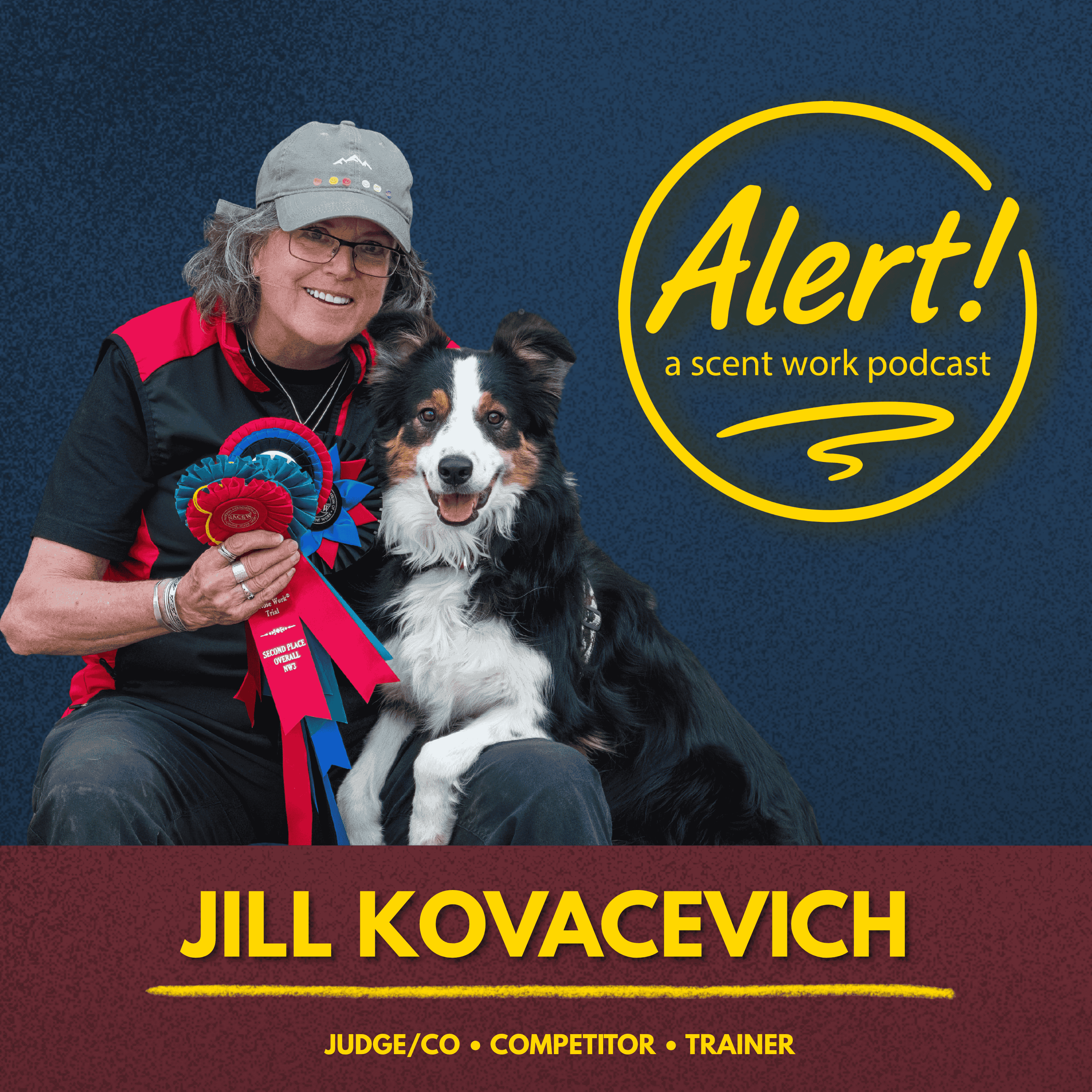


I almost skipped the Box Mania. Containers sounded boring. But during the session, Jill started narrating the searches and the behavior she was observing. And she talked about pathways to odor. That was one of the moments that split my scent work journey into before-and-after. I almost skipped, and I haven't seen a search the same way since.
From clear interstates straight to source, to faint hiking trails that disappear into the overgrowth, Jill explains how dogs collect information long before they reach source — and why searching is a process, not a moment. She also talks about tendrils: the smaller threads of odor that branch off the main pathway, sometimes connecting back, sometimes breaking off entirely.
We also dig into how NACSW judging and certifying official roles differ from AKC, how judges determine a yes versus a no in a search — and what happens when a judge realizes mid-trial they got it wrong. Plus the challenge of wearing multiple hats at a trial without letting those roles bleed into your own searches.
What we talk about:
- Pathways to odor — why this framing changed how Scot reads his dog in a search
- The difference between an interstate to source and a hiking trail that disappears into the brush
- Odor tendrils — the smaller threads that branch off the main pathway and how they help explain pooling and trapping
- Ron Gaunt's influence on Jill — collection of information, the conversation the dog is having, and why Ron hides were set the way they were
- Why scent work made sense to Jill when other dog sports didn't — and what it means to be on even ground with every other dog trainer when a sport is new
- The difference between a certifying official and a judge in NACSW — and why AKC combines both roles
- How NACSW works toward consistency across regions so that an NW3 on the East Coast feels similar to one in Colorado
- What judges are actually evaluating — and what happens when a judge realizes mid-trial they got it wrong
- The challenge of hosting a trial and competing in it — and why Jill's results are showing her a different story than the one she tells herself
- Why miles matter more than a pre-search routine — and the ritual Jill doesn't realize she has
- Seven questions with Jill — including what she loves to see when she's judging, her dog's favorite reward, the best piece of advice that stuck with her, and what her dogs would say about her as a handler
Find Jill: MountainDogs.org
Scent Work University: ScentWorkU.com — search Jill Kovacevich
K9 Scent Fix podcast — with Aleks Woodroffe
Alert! Scent Work is a podcast for competitors — the parking lot conversations you'd never get to have at a trial, with the judges and community members you wish you had more time with.
Listen to the podcast and find everything here: https://www.AlertScentWork.com
Follow along: Facebook: https://www.facebook.com/AlertScentWork
Subscribe to the newsletter: https://www.alertscentwork.com/newsletter/
So I wanted to start off — I've been really excited about this conversation. I'm almost giddy. So excuse me if I fanboy out a little bit.
Jill:I hope I meet all your expectations.
Scot:You will. You were one of my turning points in scent work. Did you know that?
Jill:No.
Scot:I mean, how little have we really interacted? Not much. So anyway, the first time I met you was at that ORT that Mountain Dogs hosted. You did the Box Mania afterwards. And I remember thinking — should I sign up for this? I don't even know what this thing is. Containers. This sounds kind of boring to me. But anyway, I ended up doing it because I'm there, I'm gonna try this.
Scot:And it turned out to be transformational to me. To paint the picture — it was this big open room, and I don't know how many containers you had.
Jill:About a hundred and something.
Scot:Yeah, like a hundred in this huge open building. And you had some hides in some of them. But what was transformative to me was you were narrating what the dogs were doing. And that was really the first time somebody had done that while I was trying to learn what changes of behavior look like. I didn't know how to read my dog at this point. You used this term — they caught a pathway to odor. And I heard pathway to odor, and all of a sudden so much made sense. It was just incredible. It really opened something up in my mind's eye. Up until that point I knew about plumes and less is more, but pathway just made everything click differently. And that was really the first time I was able to see Murphy's odor behavior clearly. So I wanted to thank you for that.
Jill:Oh, absolutely. And that's kind of one of my passions. I can't really pinpoint a time and a date of when I moved away from individual changes of behavior while the dog is searching — because I think then we get stuck in the minutia — to the concept of a pathway and a process. Because for me, that was transformational with my prior dog. You used to get so stuck as soon as you'd see the dog show interest in an object — oh, that must be it. So once I started to look at it as a process that began from the start line all the way to source, that helped me have the patience to recognize different levels of odor collection — that the dog was working the map, or the pathway, to source.
Scot:Yes. All right, so let me do the formal intro. This is Alert Scent Work. I'm Scot, Murphy and Keeva's dad. And this is Jill Kovacevich, Zeke's mom. And Igor and Izzy. Did I leave anybody out?
Jill:Nope.
Jill:Digger passed now, but he's still formative to all of my learning, that's for sure.
Scot:Okay. And I just love — I want to dig into this metaphor a little bit more because I think this is super rich for people. How something is said or phrased can be magical, and it can make all the difference. And also in that Box Mania, the containers were a great visual reference for me as the dogs worked around them. And another term you used in that process was — oh, they're collecting information. And again, that differentiation of this process from the start line to sourcing — like they didn't know where it was yet, but they were picking something up. That subtlety I had never really recognized before.
Jill:Some of that collection of information goes all the way back to working with Ron Gaunt. He was major formative in my very early years, and he used that phrase — collection of information. And then the other phrase he used was the conversation the dog is having, and the communication the dog is giving you while they're searching. And I can remember many times going — well, that's fine that they're doing collection of information, but would they just get busy and go to source?
Scot:Yeah, give me that trained final response.
Jill:Just show me the answer. Why do I need to do all of this calculation on the way? And then the communication piece — I can remember because he used to set hides, and we always called them Ron hides. And some people think that they were purposefully set to be so exceedingly difficult that the dog couldn't solve it. I firmly believe that it was more set so that the dog would have a length of time working odor, so that the handler would observe instead of just looking for the answer. Which is — we keep jumping to the result. Anytime we even say, I missed a hide in a trial, that's a result. That's not the process of what went on in that search.
Scot:I want to expand on that metaphor — pathways to odor — just a little bit more. Because to me, part of what happened there was — some pathways are like an interstate to source. You're at the start line and your dog, you might see a little nose twitch, but just straight to source. So that's like an interstate. And then some are a little less obvious. Maybe a country road that meanders a bit. If you've ever been lost out on a country road, you know, like — where am I? What road do I need to take to get where I'm trying to go? Sometimes that's a little harder. And then some are like a hiking trail that could be really faint. Maybe they get lost in the overgrowth — like these big clouds of odor that are just like bushes and stuff that's tough to get through. And sometimes you get so far in that brush you don't have a trail anymore, and you've got to work your way back to those trails. So that's like what my brain did with that pathway to odor thing. It helps me better understand maybe what I'm seeing with my dog — why some are so confident and why some take a little bit more figuring out.
Jill:Well, and I think part of it is as we come up through the ranks too — all the way from RT up to NW3, and even then at Elite, we have that nine second expectation. We've called enough alerts where the dog just barely even gets in there. So I think part of that is what we build as our expectation as a handler coming into those more complex odor puzzles.
Scot:The other thing that I've heard you say is that odor gives off these tendrils. So pathways to source — you call the tendrils the little pathways. And that also helped me understand how multiple pathways might exist. This idea of the slender thread — like climbing plants, like pea vines or grapevines, how they have all these tendrils that come off the main vine but they eventually connect back. And then eventually they'd go back to the plant. Sometimes those break off, right, and now they don't go anywhere. Again, that whole pathways and tendrils has really helped me, in my mind's eye, figure out maybe what the dog's doing.
Jill:Well, especially when we start to talk about pooling and trapping within a particular search. You can set that up purposefully, but the concept is just that I have disconnected some quantity or collection of odor from its source with objects, a corner, or something like that. Odor has moved away from source a sufficient distance — and it might even be fairly close — but it's just that the environment is really prevalent there in terms of breaking that direct pathway back.
Scot:I want to get into your origin story. So what was it about scent work that just lit you up?
Jill:For some reason, it made sense to me as a handler because I always struggled with shaping obedience. I'm not a very patient person. I was not a natural dog trainer, let's put it that way. The other sports just didn't make sense. The dog training didn't make sense. But for some reason, the scent work did. And I think it was elusive enough in its requirements that I was on even ground with every other dog trainer.
Scot:Right. Because it was so new at that point.
Jill:Oh, yeah. So the certifications, whatever initials anybody had after their name that qualified them — and they're wonderful people and they have great depth in behavior, this isn't a slam against any of that — but I was able to say, oh, none of us know what the dog is perceiving at any particular point in time.
Scot:Yeah.
Jill:And I've kind of been that way ever since. As soon as we start to talk about changes of behavior or behaviors of the dog during a search, I become — oh my gosh, let's look at the process. I'm not good at looking at my dog's ear flicks. I'm not good at looking at my dog's tail wagging and what that might mean, and grabbing some kind of consistency or correlation to — oh, it's an edge. Do you see that? When your dog got out to the edge, their tail went up. So for me, it was really the wonderment of the process that they do to go from wherever you release them to find source. I mean, that's just amazing. Still to this day.
Scot:It is, isn't it?
Jill:Offer a toy, a tug, a cookie, or even a good dog — just praise. And when you put that odor out there and the wind's blowing towards you and they're going parallel to it, and they just do that snap. It's 40 feet away. You're like, how did that even happen?
Scot:Yep.
Scot:Which is one of the reasons I love watching dogs at trials. Competing is a lot of fun for me, but I also have a lot of fun watching the trials as well.
Jill:Well, and when you can get time to do that, it's really, really important. It's going to make you a better self trainer and it's going to make you so much more able to honor your dog in this sport.
Scot:I want to talk about — you're heavily involved in NACSW. I've primarily participated in AKC, a little bit of UKC. I did the ORT, have yet to be able to do an NACSW trial. You're a certified nose work instructor, you're a trial judge, trial certifying official. Your company, Mountain Dogs LLC, you host several trials a year in Colorado and surrounding states. So I really want to tap into your knowledge for those who are listening, like me, who may not be familiar with NACSW.
Scot:And I want to start with one of the differences — you have a judge, which we get in AKC, and then you have a certifying official, but they do different things. What does each role do?
Jill:Actually in AKC, it's a combination — they do both the roles of certifying official and judge. So they're the hide setter, they're also there to oversee and make sure that the event is going according to AKC rules, and they're also judging. So within NACSW, we could do an element trial, which is just like containers in a half day — a mini trial. And in the past we had our certifying officials also act as judge. And I can tell you from that experience of judging my own hides — hides I have set for a trial at a trial level appropriate for my competitors — boy, that's hard. You become very married to your hide. You also become very enthusiastic about wanting people to pass. Your objectivity just becomes a little murky.
Scot:Let me get this straight. So certifying officials — they set the hides and then they're kind of responsible for how the trial's running. Is that correct?
Jill:Correct. And we have a whole division for certifying officials for education. We have oversight — we have our fearless leader, Jean Richardson, who oversees our department. She will literally look at — if you go to the debrief videos online, she will look at those and look at your results from that particular trial, as well as the hides you set and the search areas you set. And we're really working towards not a structured consistency that says you must adhere to this. It needs to be more flexible because we understand that the environment and everything that happens for any one search has so many variables. But at least get some consistency so that if someone is doing an NW3 on the East Coast with NACSW, they're getting very close to that same level appropriate search as they would in California, as they would in Colorado, as they would in Iowa.
Scot:And then the judge is somebody who has had a working detection background, and they're the ones that evaluate the actual runs. I think one time you said that judges don't judge dogs, they judge odor — but they're the ones that evaluate the actual runs. Is that correct?
Jill:Yes. And the relationship between your certifying official and your judge is very respectful. In NACSW we run a dog in white. In AKC you run a demo dog. The judge who's also setting the hides in AKC can run their own dog, but they're doing it for purposes of understanding what that hide may or may not do — so we can stay within the realm of level appropriate measuring. Because trial is a test. It is a test of your skill sets that you're bringing to the table on that day, at that moment, in that search, with that dog. So we want to make sure that we've at least considered what odor may or may not do in that environment. And we're relying on our judges to be consistent among the dogs that are searching. They're not deciding ahead of time what they think odor should do. We run a dog in white, we have a discussion about what we think that search will provide, as opposed to dissecting every single hide. And then they start to watch the dogs and do their judging accordingly. And they're not perfect. As a judge, I've given yeses where I went, oh, that probably should not have been a yes. And then once I give one, then it's like, okay, in fairness I can't now go back to a no. And we are also very good about — if as a judge I give a no, and then later on, maybe only two dogs later, it becomes very obvious to me that that's a hard, hard indication by the dog — they're telling me whatever's going on, that's where the decision's being made — I may call my certifying official in and say, hey, I just gave a couple nos, these should be yeses. So we can actually change that.
Scot:That's cool. Yeah. Because you can continue to search even if you miss one.
Jill:Right. And we'll let our handlers know. And obviously, what goes on in Vegas — we try to have it stay in Vegas. You know, it gives the concept, oh, you guys really don't know what you're doing. And yet in reality, it's just that it's a very variable sport where we don't know every given moment what's going to happen with odor or the environment.
Scot:This is my selfish question. It's my podcast so I get a selfish question, and nobody else listening might care about this. I really love volunteering at trials. To me, it's just as enjoyable — all right, that might be a stretch, but it's pretty enjoyable — as showing. But sometimes I find that that bleeds into my own runs. I'm so busy helping out. Now, you hosted and competed at the same events. What's your advice to me for keeping those roles from bleeding into each other? And do you have a transitional routine that you do when you start to go into show, to get out of that other role?
Jill:Oh, my goodness. So I could give you this really eloquent answer — and then let's talk to my host crew and they'll say, she cannot separate those two. She never separates those two. It takes me 16 trials to get through NW3 because of that.
Jill:But I spent a lot of those using them as training, which I get the option to do because often I can enter my own trial. But that is a challenge. It's a big challenge. And I'm working on that challenge every time I host a trial and compete with my dog. I like to think that it doesn't bother me. I like to think I'm better than that — that whatever I had going on with the volunteering, oh, I can just grab my dog, leash him up, and head in and do a great search. But the results are kind of showing me a different story.
Scot:So you haven't found any tips yet? Like, I'm working on some sort of two or three minute routine — visualizing the search in my head, going through what my search plan's going to be, doing some breathing exercises. You don't have anything like that yet that transitions you?
Jill:I think it's more the miles. The more miles I put on in searching with my dog, the more confident I'm going to be about doing any search anywhere, anytime — regardless of what was going on one minute before. So now I'm finally kind of to that point with Elite. I've got enough miles under my belt with this dog. Because it's going to be different for every dog. And at the lower levels — NW1 and NW2 — that was pretty easy. Like, oh yeah, totally. I was just like, slam dunk, I'm just gonna go do it. And I can even help out in the parking lot after that.
Jill:At those higher levels, it's become a challenge for me.
Jill:So my routine is more like — just do the same things that I would do with any search I put on. I have an apron. Get the toy out, focus on my dog. I really like to make sure that I'm not letting my dog go environmental going into searches. If I can connect with him the whole time, that makes me feel so much better than if I'm fighting that. Some dogs can just sniff the ground forever and handlers don't care. That's not me. I want my dog to connect. And then once we get to the start line, there we go.
Scot:I want you next time you are doing dual roles to see if you have some sort of a transition routine that you don't realize. And I could even — I'm almost hearing a little bit of a routine. Like when you go into the search area, you're almost hyper focusing. And what I like to do is hyper focus — all right, here's my search area, am I covering my areas, was I there, was I there? Like, maybe that's even part of it. But two or three minutes before you go in, are you doing kind of the same things over and over? I want you to check that out and then report back to me.
Jill:No, I think I definitely do. And I think some of that has become consistency because of all the miles. So I'm not really — and maybe that's why I can't give you the steps, because I don't think about it anymore. As soon as I put on the collar that is our search collar, and I grab that leash, and I put on my apron and I've got the toy in the middle and the treats in the first pouch — it's all business. And I even get weird about talking to people.
Scot:Like, yeah.
Jill:Like, you don't need to tell me the story about the search.
Scot:No. And I have that superstition too — when people come out of the search I'm going into, they'll give you the thumbs up or thumbs down. I do not ask them because I don't want to know.
Jill:I will talk to people about their searches all day long, but I will not ask them when they're coming out because I don't want to know at that point.
Scot:I don't want to know either. And that's all we're supposed to talk about, but I just don't want to know at that point.
Jill:Yeah, I actually seclude myself in my vehicle.
Scot:Okay.
Jill:Oh, yeah.
Scot:All right. Well, there's part of the routine. You seclude yourself for a few minutes.
Jill:I write my little parameters, I go in, I try to remember how many hides I got, and I come out and I actually try to say where they were.
Scot:Got it. All right, well, pay attention to that routine because I would love to know.
Jill:Okay.
Scot:You have some insights for me? All right, Jill, it is time for seven questions. It's a quick fire segment. I'm going to ask seven questions, just looking for one or two sentence answers — whatever comes to your mind, top of mind. This is going to be very revealing about you.
Jill:This is going to be really hard, guys. I have no idea how to shut up.
Scot:All right, well, just try. What do you love when you're judging, beyond seeing competitors succeed?
Jill:You love it when the dog works odor beautifully.
Scot:Ah, that's beautiful, isn't it? What's one thing you wish more competitors knew about being a judge or a certifying official?
Jill:How passionate we are about nose work — as opposed to the results.
Scot:All right, I like that. What's your dog's favorite reward after a great search? And get specific — if it's food, tell me what kind of food.
Jill:Tug. It's actually a fleece tug, but I have a new ball — it's a Chuck It ball, it's huge on a rope, and he's decided he loves it. It's really hard to carry into the search, though.
Scot:All right. What piece of advice would you give to your beginner self in scent work?
Jill:Hang on for the ride because this is going to be a lifetime.
Scot:I love it. What's your most memorable search moment as a judge or a certifying official? I mean, probably so many — but does one come to mind?
Jill:I just love it when the dog is working so hard, makes their decision, and the handler is confident enough to call it.
Scot:Yeah. The communication is just on point. Exactly.
Scot:What is something that you love seeing in a team, even if they don't Q? Sometimes our runs aren't successful, but there is beauty in all of them.
Jill:The bond. The bond and the mutual trust. And it can just be amazing because you may have a dog that wasn't all that successful based on our standards of success — finding source — and that handler just supports that dog and loves that dog and honors the dog.
Scot:Give us a piece of advice that really stuck with you in your own journey.
Jill:You can't break your dog.
Scot:That's good. That's good. Thank you for that. I need that. I'm about to tear up. The best compliment you ever gotten at a trial, either in an official position or as a competitor.
Jill:Amazingly caring for the dogs and the handlers — making sure that our events support our teams.
Scot:If your dogs could talk, what would they say about you as a handler?
Jill:Get out of my way. Oh my God. Turn off her brain.
Scot:And — do they have distractors in NACSW?
Jill:Yes.
Scot:So there could be toys or dog items. And I've asked my AKC judges — do you have a signature distractor, one that you tend to take with you and use a lot? Do you have a signature distractor?
Jill:So we don't have intentional distractions in the search outside of a container search. In the NW2 containers, NW3, or Elite and Summit — we will put food in our containers during a container search.
Scot:All right, so do you have a favorite food item that you like to put in the container?
Jill:Barbecue beef.
Scot:Okay.
Scot:Jill, thank you so much for joining me on Alert Scent Work. I really appreciate it. If you want to learn or connect with Jill, you can find her at mountaindogs.org. You can also check out courses at scentworku.com, and she's also at dogsofcourse.com. Do you teach online elsewhere?
Jill:So no, actually — I will be launching something out of mountaindogs.org, but that's about it.
Scot:Cool. And then you're also part of the K9 Scent Fix podcast, which I've just been binge listening to lately. So many great conversations between you and Aleks Woodroffe. It's just so insightful — I take notes.
Jill:Our whole intent there is to really try to bring — be more inclusive, be more accepting of all of the venues of nose work. I mean, it's just so amazing, this activity, this sport, participating and doing this with your pet dog is so huge. It can be life changing. We want to make sure people feel included and not excluded.
Scot:Yeah. That's what we're trying to do here as well — because everybody plays for a different reason. Let's include all of those, and let's include all the dogs and all the handlers. So I love that we have similar missions.
Jill:Yeah.
Scot:Jill, thank you so much for joining me on Alert Scent Work. I really appreciate it. And if you like this conversation, be sure to subscribe to Alert Scent Work wherever you get your podcasts. Or you can go to alertscentwork.com for more information. Thanks for listening. Go have fun with your dogs and I'll see you at the next trial. Thanks, Jill.
Jill:Thanks, everyone.