Jennifer Hamilton | From First Trial Struggles to All-In on Scent Work
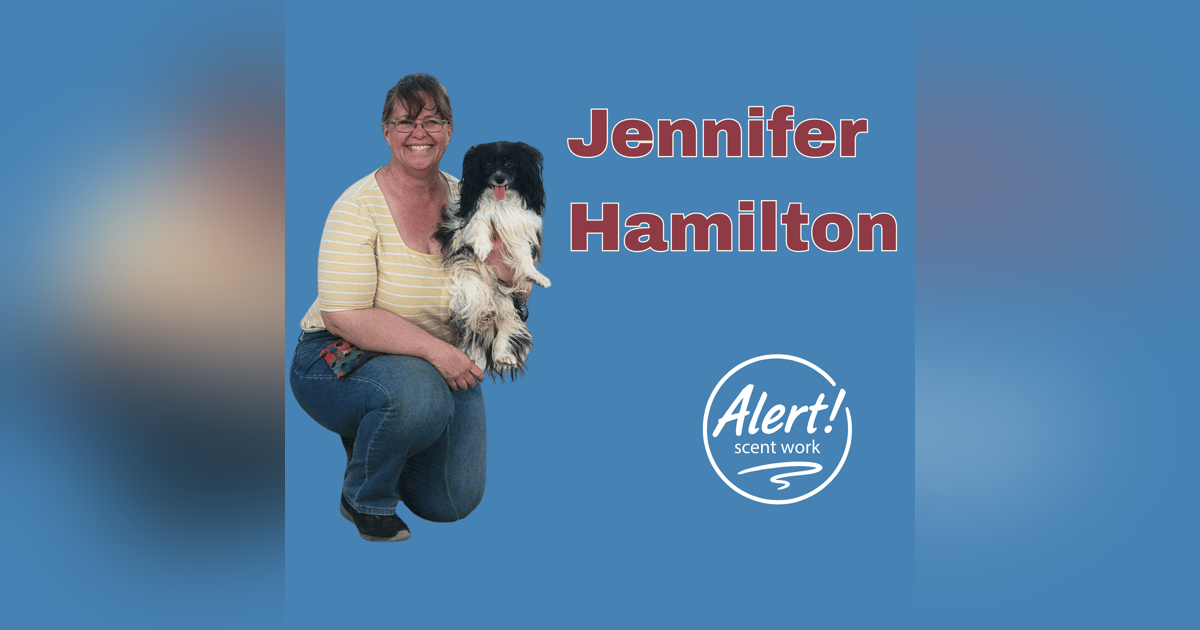


Excused from the crate area and rattled through her novice searches, Jennifer's first scent work trial was anything but smooth. Instead of quitting, that moment lit the fire.
Jennifer talks about the overlooked skill that becomes critical in higher-level searches — especially buried; the hidden power of reward rituals that go beyond food; and how “my dog lies to me” usually means the dog is giving feedback, if we’re willing to listen. She also explains the smartest way to approach a judge if you want meaningful feedback after a trial.
But ultimately, it always comes back to joy, connection, and celebrating the dog, and that perspective just might change how you see your own searches.
We met in Colorado at the trial, and I just wanted to tell you that right away I could tell you were really into scent work. You're one of those people. You're not just into it, you live it. And when I started doing a little bit of research on the things that you do in the scent work community, I think I was right.
Am I right?
Jennifer:Yes. It is definitely my passion. I had no idea how much I would dive into this headfirst and just keep swimming. I live, breathe, eat, read, everything. It is all encompassing.
Scot:It didn't take long for me to realize that. And you've only been at it for about, what, six years?
Jennifer:Yes. I trained hunting dogs with my dad growing up, so I don't know how well that translates, but I have been, quote unquote, training dogs for a long time. I guess the natural ability of connecting with dogs and creating a bond with dogs and then training dogs translated very, very easily into the sports career.
Scot:Well, I probably should say this. This is Alert! A Scent Work Podcast. I'm Scot Singpiel, Murphy and Keeva's dad, and today we're talking to Archer and Yoda's mom. Do you have any other dogs you're mom to? Are you a dog mom to anybody else?
Jennifer:Yep. I have Buddy. Buddy's my old man at the house. He's fourteen and he's a dog that I literally picked up off the side of the road. He is my Novice everything dog, did Novice Obedience, did Novice Rally, and of course Novice scent work.
Scot:And I should also mention you're Jennifer Hamilton and you're out of Tucson, Arizona. So thanks for being on the show.
My first question, Archer and Yoda. I'm thinking Star Wars for sure, but is there a deep cut Cartoon Network reference in there too with Archer or is that something else?
Jennifer:No, the breeders actually named both of them, but Yoda just fits him. He's very mindful, very Jedi, methodical, thoughtful dog. It absolutely fits him as a dog.
Archer's registered name is Anali Straight Through the Heart, so his name is Archer for that, and it absolutely fits him as well. He is a very sensitive, loving, eyes straight through your heart dog.
Scot:So the first trial was six years ago. You did say you've had some training and whatnot before that, but that first scent work trial was six years ago. How did that start? How did you end up in that first trial?
Jennifer:I belonged to the German Shepherd Dog Club of Southern Arizona, and I was actually the Rally instructor for that group. All of a sudden, the American Kennel Club, AKC, says, "We're going to offer scent work." So this is 2017, and the club needed a certain number of people to sign a piece of paper that said they were involved with scent work, were interested in scent work, actively trialing in scent work, so that we could then become a club sanctioned in offering the AKC scent work trials.
The leaders of the group were like, "Who's interested?" and I was like, "Me, me, me." And of course I was the most willing and active participant in that. I said, "Let's go." We dove headfirst into this new sport. I found out that it was basically a huge void in understanding, and I quickly took over as the quote unquote scent work person.
I became the trial chairperson for their first trial. I dove into reading rules and regulations, talking to judges. In fact, one of the very first judges I ever hired was Judith Guthrie, your good friend.
Scot:Oh wow, okay.
Jennifer:Yeah. She judged at my very second scent work trial.
Scot:Can be a small world sometimes, huh?
Jennifer:Yeah. I've known her for a while. I just dove in, and then I realized how much I don't know, how much I don't understand. I think that was really evident when I showed up at my first trial. I was excused from the common crate area because my dog was a little rowdy.
Remember, I picked him up on the side of the road, so he was very energetic. I wouldn't say reactive, but he got nervous and then it manifested as barking. So we were excused from the common crate area. We had to go back to the car. It completely frazzled me. By the time we got in to do our searches in Novice, I was a complete wreck.
I was like, "Oh my God, these people are judging me." I think we only qualified in that whole weekend in one Interior run. I was like, "Okay, I've got some work to do." Instead of it turning into a massive defeat and walking away from the sport, it energized me and created a monster, and that's where my passion dove in.
Scot:So it wasn't necessarily, well, the trial made you go, "I'm going to dig in. I really want to learn this," for whatever reason. But it sounded like there was a path you could have gone one of two ways. When they said, "Hey, AKC is going to do scent work, who's in?" you said you put your hand up and went, "Me, me, me."
Why such enthusiasm as opposed to just, "Alright, we'll see what this is all about"?
Jennifer:Buddy was kind of reaching the end of his Rally career. He was not really enjoying it at all. He actually went into the Obedience, the competition Obedience ring, and peed on me during his sit stay.
As funny as that is now, it was horrifying then.
Scot:I'm sorry.
Jennifer:It was, but to me it was a huge signal from my little dog from the street that he did not want to do the structured environment of Rally and Obedience anymore. He was still young at that time. He was only seven years old and I knew I needed to find something for us to do. Scent work was the perfect opportunity.
Scot:Alright. And it sounded like you were a little frustrated with the knowledge level. Is that what I understood? That's why you jumped into all the roles and now you find yourself president of your scent work club. You chair three to four trials a year, you do a little bit of coaching for your club, you compete, you're a judge. Did I leave anything out?
Jennifer:Nope, I think that's it.
Scot:That's a lot. Do you have a regular job, because this certainly doesn't sustain you?
Jennifer:I do. I laugh and say whenever I go to work, I am a nurse and I do infusions in people's homes for the biologics, intravenous immunoglobulin, IVIG, different neurological conditions.
So I travel all over Tucson and Southern Arizona, Monday through Friday, nine to five. Every time I leave the house, I always tell the dogs, "Somebody has to pay your entry fees. I gotta go."
So yes, I do have a full-time job and everybody in my club thinks it's absolutely nuts how much I get done inside and outside, not only working a full-time career but also training my personal dogs, trialing with my personal dogs, judging as much as I do, and then on top of that being a show chairperson for the club.
Scot:I need to shadow you and find out what your secret is because you're doing something right for sure.
Jennifer:Organization. I can put it all in my head and piece it out and I can see the big picture from up above.
Scot:Alright, so you have so many roles and that gives you a front row seat to a lot of teams. I wanted to transition into things that you've observed. This is the learning part of the podcast maybe, that I could learn from and some of our listeners could learn from.
When you see a team, you hear this word, "Oh, that's a great team." What does that even mean? What does that mean to you based on all the dogs you've seen?
Jennifer:I think the standout teams, if I was ever at one of those trials where they give the judges the opportunity to award a judge's certificate or best team of the day, it does not necessarily have to be a team that is fast. It does not necessarily have to be a team that is accurate and drives to source.
It does not have to be a dog that is completely independent. It does not have to even be a dog that's confident. What I feel makes a really good team is the bond that the dog and the handler have. When a handler is truly tuned in to watching their dog.
I give this little pep talk to everybody when they're like, "I'm just struggling, I'm struggling, I'm struggling." Ninety-nine point nine percent of this game is learning how to read your dog, learning how to read your dog in odor, in critter smells, in food distraction smells.
Learning how to read your dog is where you are going to win this game. That starts with having a bond with your dog and understanding your dog's little nuance behaviors.
So I think that the teams that really resonate with me are the ones that truly have that connection with each other, that look, that feel. It is just fluid.
On the one occasion I did have a Judge's Choice award to honor a dog that is a Staffordshire Terrier. He was a really anxious dog. I believe he was pulled from the pound as a rescue dog and this dog was afraid of everything, his own shadow, leashes, harnesses, the handler, other dogs, everything.
The handler took this dog from being absolutely terrified of everything to now, I've seen the progress of them because I judge in Arizona quite a bit, celebrating just being able to walk to the start line, to now nailing Advanced and Excellent searches.
I chose to honor that dog and that handler team because I felt they put in the work. They may not always win and they are definitely not the fastest, but they have overcome so much adversity. That is a great team.
Scot:I love that. That's one of the things I love about scent work too. There are a lot of different ways you can play this game. You can play it super competitively, nerd out, get into it, want to get the ribbons, or you can play it that this is an activity that I can do with the dog that I know. When they use their nose that helps build their confidence, it builds the bond between us.
We celebrate the win of getting to the start line and being able to go into a search area and having that dog who normally might not be able to focus, focus on that task for that moment, just to be proud of them. I love that.
It took me a while to appreciate that. It took me a while to appreciate that everybody plays for a different reason.
Jennifer:Yes. I think that's something that a lot of people get caught up in, the ego of it. I think there's a really good saying out there that comparison is the thief of joy.
Scot:Right.
Jennifer:You'll see people posting that a lot in the scent work blogs or Facebook groups and I think that truly resonates quite a bit for me. My Master level dog Yoda, he is not a competitive dog. I look back at the number of Qs he has. He has a great number of Qs. He does not have a great number of placements.
He is my heart. He is the dog that has taught me how to be a better handler. Then Archer, my third dog, teaching him how to do this, he's my ego. He is one hundred percent my ego. I pull him out of the crate and I'm like, "Let's go rock this."
Scot:One of the lessons I had to learn was I was on the other side of that ego. I would watch teams and I'd be like, "What's wrong with you guys? What's going on, your dog's not even searching."
After being in the sport for a while I realized I don't know their story. I don't know where they were. So they play their game their way. I play my game my way and I respect everybody that wants to play it the way they want to play it.
I love that you have your ego dog and your heart dog. That's funny.
When you see a team, what do you love seeing? Is there something beyond that connection, even if they don't Q in your ring?
Jennifer:I am a huge advocate for celebrating the dog. When I give the briefing in the morning, when they're introducing us at the club general briefing and they say, "Hey judges, you guys want to have anything to say?" I usually have a little speech that goes something to the effect of:
You chose to be here. Your dog did not. They want to be with you. They did not say, "Hey mom, I want to go to that scent work trial or that nose work trial." They have chosen to be with you. They did not choose this as what they wanted to do for the day. You need to honor that and you need to celebrate the fact that they are willing to drive two or three hours or stay overnight in a hotel or an Airbnb and do this with you.
So I like to see the teams that, whether they qualify or not, the handler is celebrating that dog, paying attention to that dog, and having a party all the way back to the car. That is something that I feel is so important.
You can take the joy out of this very quickly if it is just a robot taking the dog out of the crate, hooking up the harness, walking to the start line, running the search, taking them back off the harness and putting them on their flat collar, walking them back to the car, throwing them in the crate. That is robotic. No dog is going to like that.
They want to play with us. They are the only other mammal in the world that has that play drive like humans do. So play with them, have fun, celebrate it.
Scot:I might have to take that to heart. Sometimes I can be a little robotic. So thank you for reminding me that it's about the bond. It's about having fun with this animal, doing something together, and not just the search. The ritual going into the search, the ritual coming out of the search, all of that should be meaningful to both the team and the dog.
Jennifer:Yeah, absolutely.
Scot:Is there something, one of my favorite questions I like to ask if a judge is open to it, if I happen to get a chance to chat with them afterwards, is: did you see something in there that I was doing that you wish maybe I would not do? Is there a habit or something I was doing that you wish I would break that would kind of make things a little bit better?
Are there any common things you see in the ring that a lot of people could benefit from?
Jennifer:I will give you my pet peeve first and then I will go into habits. My pet peeve is people that say, "My dog lies to me."
They step up to the start line and they're like, "This is my third search of the day, if my dog doesn't stop lying to me." I just cringe. My emotions are on my face, and when people do that I have to put my clipboard in front of me and take a big deep breath.
I don't feel like the dogs are lying to you. That is a training issue, and somewhere along the line you have reinforced something incorrectly. Dogs are smart. They know how to end the game.
If they do not want to be there, you better bet that they know how to walk up to the first box and say, "This one, dad, I'm done." They know how to go back to the crate. They know if they false alert on something or if they pee on something what happens. They go back to the car, back to the crate. Dogs are smart.
We do not give them enough credit and they know exactly how to end the game when they are not having fun. So pay attention to that too, because I believe you can better understand the bond that you have with the dog. If they are ending searches early, what are you doing to make it that they don't want to be there?
Scot:That lying thing is a little bit of a pet peeve of mine and I think it could be a lot of different things. You mentioned one which ties back into if the dog's not having fun or if it's not enjoyable to be there with you because the handler's so stressed out and not having a good time and they're angry at the dog because the dog's lying to them.
Why would a dog want to continue to be in that environment?
On the other hand, sometimes like you said, it's a training issue. The dog does not understand exactly what it is they're supposed to be doing to get the reward and the praise. Sometimes that's what it is. Sometimes it could be the dog's going to do a little bit of experimenting. They are smart. The dog might be like, "Alright, I get a cookie if I do this. What if I do it over here, does this get me the cookie?"
It is not lying. I love that you brought that up. If a person ever catches themselves saying, "My dog lies to me," there are a lot of different reasons that they might be doing what they're doing, but lying probably is not it. Dogs are not capable of it.
Alright, so that's your pet peeve. What was the other thing you wanted to talk about?
Jennifer:Habits in the ring. I would love to see people stop chattering at their dog while their dog is working and with the leash dragging on the ground. Those are my two habits.
Scot:I'm probably to blame. Going from the fourteen to the twenty foot leash was a huge jump for me. You would not think that extra six feet, but I struggle with that and probably drag my leash a little. I've had a couple of judges mention that, so I'm glad you told me that is something I need to work on.
That is something we do not think of. A lot of times when we first get into scent work, it's all about what the dog does. It is not about what we do. That leash handling control is a big part of that.
Jennifer:It is something to be practiced and videotaped. Have a friend videotape you so you can see what you look like in the search area.
Scot:Is there a training opportunity or something that you think competitors miss based on what you see in the trial? Like, if only they would train this a little bit more, they would have more success.
Jennifer:Inaccessible hides. That is kind of my thing right now. I am enjoying them. Now everybody that trials under me for the next couple of months is going to be like, "I need to look for an inaccessible."
I feel like people do not understand what their dogs look like when the hide is inaccessible. We teach the dogs to put their nose on it, get as close to source as you possibly can, and we drill that into them over and over. When you're presented with an inaccessible hide, the dog is confused. That is the behavior that you need to be rewarding, the confusion.
Because they cannot put their nose on it, which is what we have taught them, that if you want the reward you have to put your nose on it. So we are looking for a completely different behavior and then teaching the dog that it is okay not to put your nose on the hide.
If you think about that in terms of what inaccessible looks like, your dog needs to know what inaccessible means. You need to understand what your dog looks like at an inaccessible hide. Now apply that to Buried sand.
Scot:Right, because a Buried hide is just essentially inaccessible.
Jennifer:Correct.
Scot:So if you have not successfully taught your dog what it means to be inaccessible, what it looks like to you as the handler watching your dog, an inaccessible Buried is going to be very difficult for you as a team.
Do you think the other thing applies, that if you train Buried a lot more, then your dog's going to have a better understanding of inaccessible?
Jennifer:Yeah, it is going to go both ways.
Scot:Okay. That was a great little nugget. Thank you for that, I appreciate that. I think that's going to help a lot of people.
I want to transition to your life as a judge now. I love hearing this insight that you've been able to give us watching other teams, but sometimes I also enjoy if I get an opportunity to overhear some judge stories. Some crazy stuff can happen sometimes, unexpected or something just goes sideways.
Do you have a story that you'd be willing to share with us? I want everybody to realize sometimes these things are beyond a judge's control. You cannot predict everything. You try to predict as much as possible, you try to keep the search as controlled as possible, but have you ever had anything happen in your search that was just crazy?
What is the first craziest thing that comes to mind?
Jennifer:In January, I was judging in Albuquerque and a windstorm came up. I'm not talking about a windy day. I'm talking about forty to fifty mile an hour gusts of wind, blowing people's easy ups all over the parking lot.
Scot:Yeah.
Jennifer:Of course it started in the afternoon and of course it was about the time that we needed to start running Excellent and Master Exterior, the hardest ones. I was like, "No big deal. My Master search, I'm going to do two ground hides. It is going to be easy. They are going to stick to the ground as best I can," try and find a little pocket that they can hide in.
Then I was like, "Oh God, I have to set Excellent. I have to set three hides in this wind. How am I going to do this?"
Scot:What were your major concerns in the Excellent level with those three hides?
Jennifer:That the odor was just not even going to be available.
Scot:Okay, not convergence, none of that, just odor being available.
Jennifer:Right. So I go out there with my trusty little scent cone indicator and I am given a playground, a children's playground, big tall structures with the little rock walls on it, the slides, the whole bit.
I go out there with my little indicator and I literally searched every single, I detailed this structure with my wind indicator to find three places that I could put three hides in that would be level appropriate even if there was not any wind, and be like, "Alright, let's do this."
I bring out the group for their briefing and their faces, you could just see it. They were like, "Oh my God, why do we have to do this?" And I am like, "You guys are the ones inside at the grading area. I am the one that has to sit out here and get sandblasted judging twenty-six dogs. Are you kidding me? Come on."
So twenty-six dogs and I would have to go back to my numbers, but I think I had fourteen qualifiers.
Scot:That's amazing. In a windstorm, and on a playground where there probably were not a lot of little covered areas where you could put odor where it would not blow away. Where you could contain it enough for it to stay there for twenty-seven dogs too. That is crazy.
Jennifer:Yeah, exactly.
Scot:That is something to be proud of. I love that.
Jennifer:I know. That is my yay moment.
Scot:Is that your most memorable moment as a judge, or do you have another?
Jennifer:Setting Detective and being the first judge to give somebody a yes for a Detective run, that is their first Detective Q, that is the most amazing feeling in the world.
Scot:That is really funny. Are you a hugger in that moment?
Jennifer:Oh, absolutely. I am hugging them, I am giving the dogs treats out of my pocket, you name it.
Scot:That's so funny because I've run, I don't know, probably sixteen to twenty Detective runs now and judges can be so different. I had one judge where I almost felt like they were disappointed that I got it.
I said, "Finish," and they were like, "Yes." Then I've had judges like you that get really super excited or they will say something like, one of my proudest moments in Detective was I had a judge say, "Thank you for not wasting your dog's time," because I just called finish when I thought we covered all our areas, as opposed to running the time.
I still was four minutes longer than the first place team, so I wasn't blazing the trail, but in that moment they thought so. I appreciate that you like to celebrate those moments.
Are there other ways you like to support competitors?
Jennifer:I enjoy the briefings. I really enjoy bringing the handlers to the start line, whether it is Novice, Advanced, Excellent, Master, Detective. I enjoy giving them little nuggets of information, a pep talk, an encouraging word at the briefings.
We as judges are not supposed to be coaches. We are not supposed to be instructors. We are not supposed to tell you what you did wrong, how you can improve, what you need to do to fix it. That is not our job as a judge.
So I feel like when I have a captured audience for the briefings, that is my moment to encourage them, put them at ease, remind them that we are doing this for fun and have a good time.
Scot:If I, when I came up to you and I was asking you for advice after you were out of the judging ring, does that bother you?
Jennifer:No, not at all.
Scot:Okay.
Jennifer:I would absolutely love it.
Scot:So for you, when you're in that ring, you have that clipboard, that's when you're the judge. That's when you're not giving coaching advice. But you do not mind people approaching you and saying, "Hey, do you…?"
Jennifer:If you're going to come over and help me move all my Buried containers and you want to chat my ear off while you're doing it, I do not care.
Scot:That's what I did.
Jennifer:I know.
Scot:Alright, there's an important lesson, folks. If you want some judge feedback, you have to scratch their back a little bit, I guess.
Do you have a signature distractor you like to use? I think you know what it is. It is funny, this was a throwaway question I decided to start asking and just about every judge has one, which shocked me. I love these little moments of things that we don't think about as a competitor that might be consistent among judges.
So what is your signature distractor?
Jennifer:My signature distractor is my duck, and this is a throwback to the quote unquote way back beginning of scent work, which actually started with a retriever, a duck retrieving dog.
This is one of the mimic distractions that I will use in your Master or Detective runs. It is literally the duck decoys that you would tie out in the water to draw ducks into your hunting area, and it is the duck.
I cannot tell you the number of people whose dogs show interest in this duck. It is a different kind of interest. You need to know what your dog looks like on interest in odor, and they're like, "Oh, my dog's really interested in that duck. I'm going to call alert," and I'm like, "No, that is a distraction."
So now I bring it out in every possible way that I can and I always make sure that people know there is a mimic distraction in the search area. Please make sure you put your eyes on it.
That duck has been bleached. It has been through the dishwasher because everybody's like, "You must have odor on it." I have had it sitting in vinegar. It has been through the dishwasher. It has sat in my backyard in one hundred ten degree weather in the hot Arizona sun. I guarantee there is no odor on that duck. I can put it next to my dogs. None of my dogs will alert on it.
Scot:At least there is no essential oil odor on it. Who knows what else will be on there. It must be interesting.
Jennifer:Yep.
Scot:So that travels with you. That fits in your suitcase, goes wherever you go?
Jennifer:It does. It even made an appearance in Hawaii. If you look at my judge debrief videos from pretty much everywhere, I will make sure to point out the duck.
Scot:I do have a question. You had briefly mentioned this, but I want to get back to this reward question. You shared a post online that I really liked and it said essentially the social bond is as important as the food when it comes to rewarding your dog.
That was based on a study. Talk to us a little bit about that and then what does that look like for you. How do you implement that to make sure that social bond is happening in the reward ritual?
Jennifer:Yes. This actually was a scientific study and they highlighted it in a PBS Nova special that talked about the bonds between humans and dogs. Dogs and humans are going to be widely studied.
They figured out a way to put dogs in MRI machines and measure their dopamine response to different stimuli. They measured this response to the handler's face and then just a treat being offered, and their dopamine response to the handler's face was better and higher, more rewarding to the dog. There was more of a dopamine dump or positive thing that happened when they saw the handler's face and heard that praise they were giving the dog in that moment.
So they studied it through MRIs, and reading that, scientifically it has been proven that the bond and seeing your face and hearing that praise is more important than just food.
Scot:I'm going to interrupt there. I have a hard time believing that because I swear that my dog Murphy is just in it for the food. He could give two whatevers about me, but likely not the case. It sounds like maybe there is a little something there.
Jennifer:Oh, absolutely. I have a dog that is very food driven. Archer is all about the food, all about the treat. He will actually help himself to my treat bag if he thinks I have not rewarded him quickly enough for his find.
Where I see it the most is with Yoda, my smart, methodical, slow dog. Sometimes he just needs me to get in his face and be like, "Can we do this? Are you ready to play? Let's go." He sparks up, he starts to sparkle, his ears perk up, and he's ready to play.
Scot:So you use it as a start line ritual there in that instance?
Jennifer:Sometimes. It is actually my restart ritual. If he is distracted and not really searching the way I think he needs to be, then it's kind of a pause in the search area.
Scot:What does your reward ritual look like then after a great run with your dog? How do you incorporate both of those aspects?
Jennifer:My verbal praise is, "There it is, yes, good job," and I mark it with a "Yes." I come in and when I'm feeding them, I do not just give one treat. I have a treat in my hand and I am breaking it up into little pieces. Remember, I have Papillons, so I am not able to give them a thumb sized treat and they can just swallow it.
A thumb sized treat is probably eight or nine reward events for them. I am breaking it up into little pieces and as I'm giving it to them I'm like, "You are so smart. Look at you being the most awesome dog in the whole wide world. You're the best dog."
For every hide that we find, that is it. Then as we are leaving the search area I'm like, "Look at you being the smarty pants. You are the most awesome dog," and I am chattering with them the whole way. You can see it. They start lifting their ears up, they're prancing next to me, they're like, "Oh, mom thinks I'm important. What else can you give me?"
Scot:So even both dogs, even your food motivated dog, will get a little perk up?
Jennifer:Yes, he will.
Scot:That's something else I think I need to pay a little bit more attention to, my reward ritual afterwards. First of all, I feel a little silly saying all those things you just said.
Jennifer:I have been in class with guys. The Saturday group that I train with, there are a couple of guys in that class and they're like, "Oh gosh." If you go back and look at detection handler work, army, border patrol, any of those groups that are running kennels for military, they teach their handlers how to get excited with their dogs and how to have that squeaky voice to get their dogs amped up. It is part of the class that they are teaching these detection dog handlers.
Scot:So I can't just use my, "Hey, good boy, you did it. Alright."
Jennifer:You just had inflection in your voice that raised and was squeaky.
Scot:So that was okay in your mind?
Jennifer:Absolutely.
Scot:Alright. Let's go ahead and start to wrap this up. Jennifer, this has been fabulous. Now I'm going to spring a little something on you. I'm going to end this with what is called Seven Questions.
Jennifer:Oh yes.
Scot:These are not ones that I sent to you ahead of time.
Jennifer:No.
Scot:No. This is the whole point. I'm going to ask seven questions and I just want you, off the top of your head, one or two sentence answers. It is a quick fire round.
Jennifer:Okay.
Scot:Question number one. What is your dog's favorite reward after a great search?
Jennifer:Turkey meatballs from Trader Joe's.
Scot:What's one piece of advice you'd give your beginner scent work self?
Jennifer:Get an instructor, an in-person, live instructor.
Scot:What's one thing you always pack in your trial bag?
Jennifer:I like to make sure I always have my recording device so I can record my searches.
Scot:How do you bounce back after a particularly tough trial day? How do you and your dog bounce back? What do you do?
Jennifer:I think that is the mental management part of it. I am a nurse, so nothing can be as bad as working in an emergency department. I always tell myself nobody is going to die in dog sports.
Scot:Right. What would your dog say about you as a handler?
Jennifer:I think Archer would definitely say that I do not give him his treats fast enough. Yoda would just be like, "Why are we still doing this? Can we just be done?"
Scot:Nothing positive though?
Jennifer:That is because I always strive to be better for my dogs and I am always trying to improve myself, so I consider it constructive criticism.
Scot:Alright, fair enough. What's your favorite search that your dog likes to run in, or that you like to run your dog in? Which event?
Jennifer:Yoda loves Exteriors, anything Exteriors. He just excels at it. I absolutely love it. Archer, I love watching that dog on Containers. He gives me chills.
Scot:What's a compliment that you got from a fellow competitor or a judge that really stuck with you?
Jennifer:I love it when people say, "Your dogs are really fun to watch."
Scot:What has your dog done in a search that made you laugh?
Jennifer:I love it when they show creative sourcing. I have short Papillons, so sometimes I actually find it hilarious when they jump up on benches and chairs and tables to try and find something.
Scot:If you choose to use a music distractor, what's the playlist going to be?
Jennifer:I am going to use Pandora's Adult Hits radio.
Scot:What other judges do I need to get on this podcast?
Jennifer:I would say you need to reach out to, I'm going to guess you already have Judith online. I do not know if she would do it, but Mary Quinn, I love her. I think getting some of the Texas folks on board.
Scot:I have a couple of them. Do you have anybody in particular?
Jennifer:Two people that were huge mentors to me, Carolyn Oldham and Michelle Munson.
Scot:Carolyn judged a UKC trial up here. I had very little interaction with her, but she seemed to know what was up. She was here with Lori Schlossnagle. Do you know Lori?
Jennifer:Oh, I love Lori. Lori, Judith, and I shared a cabin at the Chinook event. I've hired both of them multiple times.
Scot:Lori and I have a great relationship as well. It was fun listening to Carolyn and Lori talk about the beginning days of scent work because they were there from the very beginning. They went to the very first scent trial.
Jennifer:Lori is one of the very first judges for AKC scent work and she actually judged the very first trial.
Scot:Coincidentally enough, she was my very first scent work Q ever, which I had to go back in time after I had her on the show to look up. I love that.
Jennifer, I just want to thank you so much for being on the podcast. If you want to learn more about what Jennifer is up to, you can check out the Sonoran Desert Scent Work Club Facebook page for upcoming trials and events in the Tucson area.
If you've ever checked out the AKC Scent Work Judges Debriefs Facebook group, you've probably seen some of Jennifer's posts there, so you should keep an eye out for more of her posts in that group.
Jennifer, are there other places people can find you?
Jennifer:That is about the best. A lot of competitors do ask for a Facebook invite for my personal page. There's not much there that is different than what I have on the debriefs and the club page. The stuff that I think is important for competitors to know is going to be on those two resources.
Stuff that you're going to see on my personal page is going to be me bragging about my dogs.
Scot:That's okay. We should brag about our dogs.
Jennifer:Yes.
Scot:Thank you so much for sharing your time, your stories, and your insight. I love how much you love this sport. I think we're kindred spirits in that way. I've fallen head over heels for it as well and I'm doing all the things, trying to get involved every way I can. I appreciate you doing everything that you do to try to make sure teams succeed and trials succeed.
So thank you so much, and thanks also for joining me here on Alert! A Scent Work Podcast.
Jennifer:Absolutely. Thank you for putting this together for people, to give us another vehicle to raise awareness, to raise positivity and learning. I love it.