Hallie McMullen | Fun and Fair Searches, Funky Odor Behavior, and “My Handler’s Never Done That
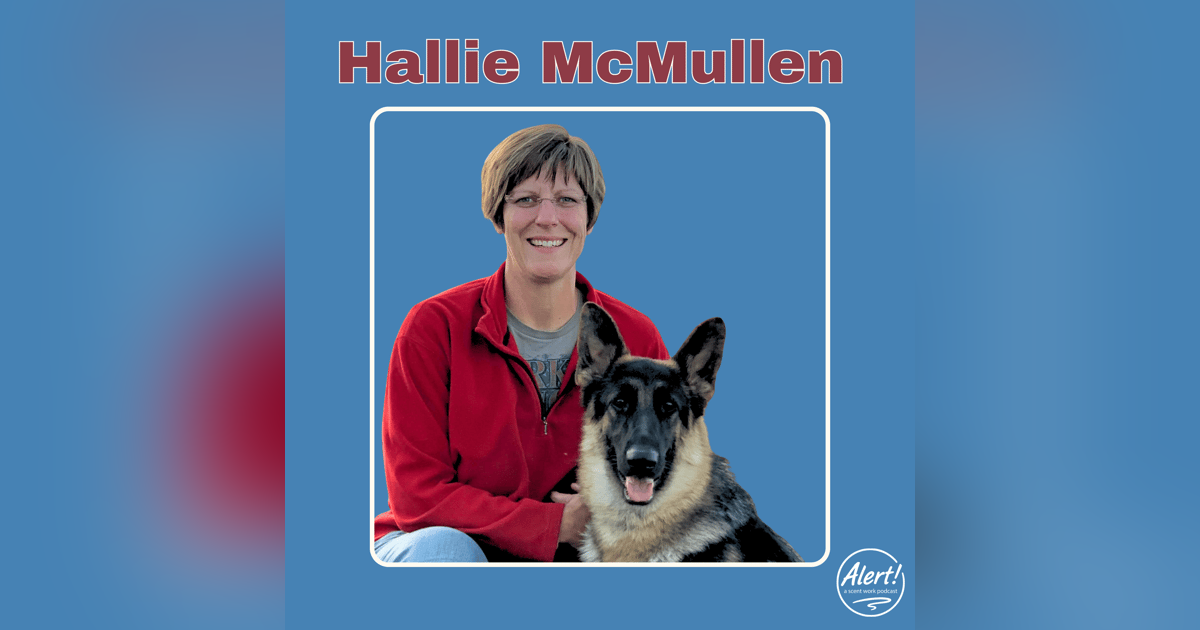


From first Qs to Detective titles, Hallie McMullen has been part of the journey for countless teams. Now she shares her judging philosophy and training insights.
Hallie has judged for NACSW and AKC, while also competing with her own dogs and coaching teams through every stage of the sport. With more than 25 years of experience, starting in detection dog work before moving into sport, she brings a depth of knowledge shaped by thousands of searches.
Hallie talks about what makes a search fair, challenging, and enjoyable. She unpacks how environmental factors like wind, heat, and elevation change odor. And she offers candid insights on the role of the handler—how nerves, habits, and over-handling shape a dog’s performance.
Hey, for fun, finish this sentence. I do not want to say I have been judging scent work for a long time, but back when I started…
Hallie:Back when I started, everything about what we were doing was new, and I have learned a lot since then, and the sport has morphed a lot since then as have the handlers, and it has been exciting to be a part of watching everybody make their changes and growth over years of experience.
Scot:That is a cool answer, actually. The answer I was really looking for was they used dinosaurs instead of dogs, but your answer was good too.
Hallie:Yeah, well, you got to remember, I was doing this before I started judging, so that would have made me really, really old.
Scot:Our guest today is Hallie McMullen. She has judged for a long time, set a lot of hides, seen a lot of dogs, and I hope that we can learn a little bit from your experience today.
My name is Scot. I am Murphy’s dad. I am a scent work competitor, and this is Alert! A Scent Work Podcast.
And Hallie, you are Whitney and Purple’s mom, is that right?
Hallie:Yes, and Misty and Hetchi and Misty.
Scot:Because we all know each other, we do not know each other’s names. We only know our dog’s names in scent work.
You will find Hallie judging for American Kennel Club, AKC, Australian Shepherd Club of America, ASCA, and National Association of Canine Scent Work, NACSW.
And also in her professional life, she teaches canine cognition. She trains fitness enrichment too.
We were talking at the top about how long you have been doing this. My very first guest has always been doing this for a long time too. Laurie Schlossnagle. You know Laurie, right?
Hallie:I do, yes.
Scot:She told me she got her first Q under you. I do not know if that is true or not. She was not even sure if it was true or not, but your name was the one that was pulled out.
Hallie:It is possible. I have been doing this since AKC started this. I started as one of their expert judges.
Scot:You were certified as a judge for AKC June, 20th, 2017. She was certified on June 28th. Also, my first Q was not under you, but my first NQ was.
Hallie:There is that. So I can be notorious as well, apparently.
Scot:I want to start with a question that ties into the fact that you are a competitor and a judge. How does being a competitor inform how you judge?
Hallie:I think it is important that judges are competing. It helps you keep perspective. When you are judging and setting hides, you come at that from the judge’s perspective, and running your dog in trials helps you remember what it feels like to be a competitor and the factors that come from that. One of the things I have thought a lot about is how my hides to me at times can seem obvious. I am setting them.
Scot:Yeah, it is like if you are taking a test and you know the answers.
Hallie:You can get caught up thinking they are going to seem that obvious to everyone else, and that is not the case. The degree of difficulty, the most important thing for me, and something I talk to new judges about a lot, is you have got to remember the environmental factors, the climate conditions, the search areas, bring a certain degree of difficulty before it even comes into play where you are going to put a hide. You have to remember that.
Scot:What about the stress competitors are under? Stress can impact someone’s ability to know what is going on in the moment or even remember a minute later.
Hallie:I started my career professionally training and handling drug dogs and bomb dogs. Sport does not bring as much stress. I find it fun. Yes, you are nervous, you want to do well, but things do not blow up. If I miss a hide in a trial, we just do not pass. You have to find that perspective. As judges, if we are not competing, we can overlook factors that keep us balanced in what we are doing and how we set difficulty for competitors. You also learn a lot watching what other judges are setting. It is great to run searches other people have set. You get ideas and expand concepts.
Scot:How would you describe your approach to setting hides? What are the things you consider?
Hallie:First, I look at what is in front of me. How large is the space? How congested? What are the environmental conditions? Is it windy, hot, cold? All of that presents itself first.
Then I look at appropriate level set hides, and then I factor those together. What are appropriate hides, what is available, and how do I make the search fair and reasonable for the dogs?
I need to check hide placement. I need to know it is going to work the way I want it to, that hides will be stable. Conditions can change over a class, especially now that classes are big. It is sometimes imperfect, but you do the best you can to give everybody the same search.
Scot:What about fun? Competitors say, that was a fun search. What does that mean, and how do you incorporate it?
Hallie:Fun can be a loaded term. I want people to enjoy searches. Competitors enjoy a search when it is interesting, not too simple or too difficult, and when it has flow and they can work through it successfully. I have had people fail searches and say, it sucks that I failed this, but it was fun.
Sometimes judges say, I put this hide out, it is going to be really fun. Sometimes hides that are fun can turn into overly creative hides that end up being tricks instead of functioning the way you think they will. For me, fun is about an enjoyable search that teams can work, feel successful about, whether they passed or not. Versus overly creative and quirky, because those can be problematic.
Scot:I love that you said a search has a flow to it. Sometimes it really does feel like a dance between you, your dog, and the space. Another thing I find fun is unexpected hide placements. Sometimes we see the same things over and over, so it is fun when my dog alerts, and I am like, really? Then I call it, get a yes, and it is cool. I also like legit environments like classrooms or warehouses, where it feels like real detection work.
Hallie:You never have the same search. Even if you ran it again, it is different. We have so many venues and clubs at different places that you get a lot of opportunity for variety. Different hide placements, new challenges. Dogs might not want to go into a bathroom with a drain, or walk over shiny floors. There is always something new.
Scot:What do you think makes a successful team in scent work trials from your observation as a judge and competitor?
Hallie:People think it is about having a great dog and skillset, but I do not think that is necessarily the case. I love to see a dog and handler in sync. My dogs are all different. I have to change myself to be the right partner for each. When you are savvy with your dog, it looks like you are reading each other’s minds. They do not have to be fast or flashy, but they are in sync, and both absolutely enjoy what they are doing. Those are the best teams.
I also enjoy seeing non-typical breeds doing a great job because the handler acknowledges who their dog is.
Scot:When you watch a lot of trials, you see trends and barriers. What are common barriers getting in the way of teams being successful?
Hallie:The first one is nerves. Competitors forget what they know. Then they start doing things that are not predictable to the dog, and the dog reads that.
Handlers then lose confidence in their dogs. One of my hangups is when a dog makes a find, and the handler does not call it, and they make the dog keep working because of one anomaly in training. You cannot let anomalies get in the way. You can impede your dog’s confidence in you, and teamwork falls apart.
Scot:We put so much attention on what the dog is doing that we forget what we are doing. As you said, the dog might be different because the handler is acting differently. As you move up levels, handling is important. Other than nerves, what are some handling issues you see?
Hallie:We need to trust our dogs. If we have trained correctly, we have to let them do their jobs. We all get weird when we get nervous. Some get chatty, some quiet, some cannot give their dogs space, some forget their dogs are on the leash.
In novice and advanced, the handler does not have to do a lot if the dog values odor. The job is to stay out of the way and observe. Learn how your dog works.
In excellent and master, you take that information and use it to help solve problems. But do not abandon your dog when they need assistance. When they are working but struggling, that is when handlers should help. If you do not read your dog well, you will not know when to help.
Scot:Reading when they are on odor, when they will find it, but also when they are struggling.
Hallie:Start training upper-level skills earlier. Do not wait to work blank rooms or other skills. Otherwise, people push their dogs into trials they are not ready for and say, I am just going to try it. That can be unfair and make the sport not fun for the dog.
Scot:Do you think it is okay to try the next level even if you are not sure, as long as you go in with no expectations?
Hallie:There are two things to that. Too many people say, I finished level x, so I am moving up tomorrow. If your dog has never worked two hides, or has not seen certain challenges, you are not prepared.
First read the rule book and judge’s guidelines. Understand the expectations. If you feel your dog can meet them, it is appropriate. But if you have never seen a convergence problem, throwing your dog into excellent just to see how it goes may not be fair.
Scot:There are things you can predict in the next level. You should be prepared for those. But you might still discover things you did not know.
Hallie:Make sure your dog has a basic skillset. In detective, you should have all the skills to get there, but there is nothing like running it. You are never going to feel fully prepared. Just make sure your dog has the skills.
Scot:Nothing prepares you for detective. Hides can be so close. Watching a judge set detective hides helped me a lot.
Hallie:We should all be thinking about what comes next way before we get there. Novice dogs should try blank rooms. That makes handlers more nervous than anything. You need to be comfortable with it ahead of time.
Judges vary in degree of difficulty. Novice handlers should watch detective searches if that is their goal.
Scot:Even within a level, there is a wide variance. Excellent is not always just excellent.
Hallie:Conditions matter. Elevation impacts searching. A cool day versus heat changes difficulty. I have set hides I thought were hard, but conditions made them easy. You never know.
Scot:Do you have any advice for someone just starting in the sport?
Hallie:Know the rules. Do not enter until you and your dog are ready. You need confidence in your dog.
Be okay with making mistakes. The first time someone fails, it usually takes the pressure off. Nothing bad happened.
People from other sports often struggle because scent work requires calling something you cannot see. That unknown makes people uncomfortable.
Observe a trial before you compete. Volunteer. Watch dogs run. It will make you feel better.
Scot:You have judged in many places. I have noticed differences in trends. Do you see different themes in different areas?
Hallie:Some trends come from clubs and how they do business, like the containers they use. But handling trends usually come from instructors. In some areas, I can almost tell who trains with who. Instructor influence is strong.
There is value in getting out of your area. A different climate, different people, different challenges. Diversity is one of the most important things.
Take advantage of different resources. Parking lot talk, blogs, books, podcasts. Not every method works for every handler.
Scot:Parking lot conversation can be a great resource. People rarely ask, how did your dog work? That is one of my favorite questions.
Hallie:This is a community. Using peers as resources is valuable. Watching ten dogs run the same search teaches you so much. If you cannot watch, talk to the handlers.
Scot:Training challenges and learning how others solved problems can give ideas, even if you must experiment to decide what works.
Hallie:We often run more than one dog, and they are not the same. Tips that do not work for one dog might work for another. My dogs are complete opposites. It makes you a more flexible handler.
Scot:I want to wrap up with seven questions. I will ask short questions, and you can answer with whatever comes to mind. If I ask for more, just tell me more.
When I am judging, beyond seeing competitors successful, I love it when…
Hallie:I see competitors and their dogs happy.
Scot:What do you hope competitors say about your searches?
Hallie:That they are fun and that they enjoyed running them.
Scot:One piece of advice you would give to your beginner self?
Hallie:Take your time and be patient.
Scot:What do you wish competitors knew about being a judge?
Hallie:That we are always trying to give them the best searches, even though it does not always work out that way.
Scot:How should competitors process a tough day?
Hallie:Give themselves time to decompress. Think through it, then get rid of it and move on. Do not let it interfere with training or the next trial.
Scot:What do you love about scent work?
Hallie:I find it amazing that dogs can do these tasks and that they love doing it with us, and it is always new and interesting.
Scot:Most memorable moment as a judge?
Hallie:The first time a dog that ran under me in very beginners and novice got their detective title.
Scot:That is cool to watch that journey.
Hallie:Mm-hmm.
Scot:Bonus question. Do you have a signature distractor?
Hallie:I have a stuffed cat. Her name is Catalina. Competitors expect to see Catalina in master or detective. There is a story behind it. A friend of mine, Mary, judges with me. Everywhere we go, there seem to be cats. So she gave me Catalina as a gift.
Scot:That is incredible.
It has been fun and insightful. If you want to learn more about Hallie or connect with her, check out her website. It is ScentsationalK9.dog, S-C-E-N-T-S-A-T-I-O-N-A-L K9 dot dog, the letter K, the number nine. You can also find her on Facebook at Scentsational K9.
If you have enjoyed this episode, do not forget to follow Alert! A Scent Work Podcast on your favorite platform and share it with your scent work friends.
Thank you for listening, and we will catch you next time on Alert! A Scent Work Podcast.