Ellen Parr | Learning Rules the Hard Way, Reading Beyond the Final Responce, and Still Getting Goosebumps
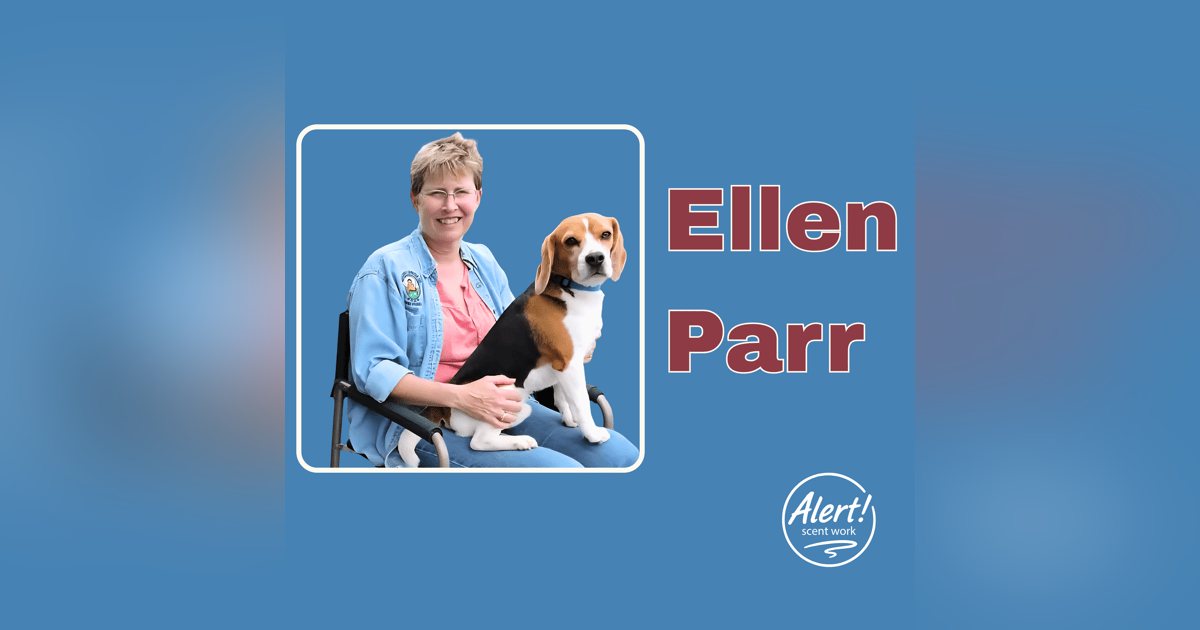


The distractor rule I learned the hard way from Ellen, and it can make the difference between qualifying or not. It was awkward in the moment, but unforgettable.
We came back to that story, along with something I’ve noticed in Ellen's runs: when it looks like an alert to me, but she moves on. That led to a great discussion about the subtle signs of reading your dog and how every dog is unique.
We also talk about odor when judging long trial days, how to get more out of watching and video, and the kinds of moments she loves when judging.
And through it all, what really stands out is Ellen’s passion. Even after years in the sport, she still gets goosebumps watching dogs solve odor problems, and it’s contagious.
Do you wanna share our inside joke? Do you wanna be the one to do that, or should I start that story?
Ellen:I'll let you tell that story.
Scot:I'm not exactly sure how, so here's what I remember. I remember we were at a ribbon table at a scent work trial, and I saw you putting your stickers in a little notebook as opposed to on the green ribbons. I thought, that's pretty cool. And we started chatting. You had mentioned that you were a judge and I don't know, did you remember me at this point or did we have to do a little bit more talking before we get to the inside joke?
Ellen:We had to do a little bit more talking.
Scot:That's how I remember it too. Yeah. So we come to figure out that I had shown under you and I had just started scent work. This was my first year. I probably did something that you told other judges about. I don't know if judges talk about competitors when they do silly things.
Ellen:Yes
Scot:Okay. So I'm sure I was the topic of conversation, or if I wasn't, I could have been. I'm doing an advanced buried for the very first time. We figure out that this is how our paths intersect. Actually, I don't know if it was the first time, but I had just recently moved up to advanced. So I'm doing this advanced buried. You're the judge. I call alert on the first box. I call alert on the second box. You were not happy when I called alert on the second box. Why was that?
Ellen:Scot, because there was a distractor on top of the box, which meant that there couldn't be a hide there, which also meant that someone hadn't read the rules before.
Scot:That's right. And what did you say to me? Do you remember how you reacted? Because you apologized later. I think you thought you were a lot harsher than you really were, because I actually have video of that.
Ellen:I seem to remember saying something along the lines of, are you kidding me?
Scot:And I remember my response was, I have a feeling I'm gonna learn something about the rule book that I didn't know. So the inside joke, in my opinion, is two inside jokes. Now, whenever I do a buried with Ellen, I'm pretty sure that I'm gonna see at some point over the weekend a distractor on top of one of the bins, and I chuckle every time. So I appreciate that we have that as an inside joke. The other inside joke is, that's not actually in the rule book, Ellen. We argue about this every single time we run into each other in a playful way. It's in the judge's guide.
Ellen:It is in the judge's guidelines about where we can place distractors.
Scot:Yes. So I had read the rule book. The accusation that I didn't read the rule book, I felt, was unfair. However, I'm going to say I did not realize there was a judge's guidelines, and if you haven't read that, you should read that because there's a lot of really good stuff in there for competitors. So ultimately, I do thank you for introducing me to the judge's guidelines. Thank you, Ellen.
Ellen:Yes. And I'm very glad that you were not upset at my reaction.
Scot:Alright, this is Alert! Scent Work. I'm Scot, Murphy and Keeva's dad, and today we're talking to Barley and Jenny's mom, Ellen Parr. She's outta Nampa, Idaho. You also have some other dogs I haven't met. Who are those?
Ellen:We also have a 12-year-old standard wire-haired Dachshund named Secret. My husband did show her in a little bit of scent work. I think she has her novice and a few advanced legs, but she has a thing for fluffy toys and my husband wasn't interested in taking away her joy of fluffy toys, so he kind of let that go with her. And then I also have two younger dogs that are in training. I have Allie, who is Jenny's daughter, and Gigi, who is a Harrier, and they're both in training, kind of waiting in the wings for the older girls to move up and move through things, and the budget to allow trialing all that many dogs.
Scot:Right. I know I've trialed two dogs sometimes at trials, and it can get expensive pretty quickly. Pretty quickly. You also had mentioned there's a dog named Axel. Was Axel your first scent dog?
Ellen:Yes. My first scent work dog was Axel.
Scot:What got you into scent work with Axel?
Ellen:We had just moved here to Idaho from Oregon, and I had been trying to find a scent work class in Oregon that worked with my schedule for a couple of years and nothing ever worked. Then I came here and I can't even quite recall how I came across it, but another local judge, Hallie McMullen, was holding classes for scent work. And I'm like, I'm all on that. So I started going with Axel, and Axel, being the most amazing dog he was, took to it like a duck to water and just reeled me in. I found it fascinating from day one.
Scot:Expand on that a little bit. There's one thing to want to do it and then there's another thing to start it, but then to get sucked in to the point where you've shown three dogs, now you've got two in the wings and you've become a judge. What is it about scent work that you love so much?
Eellen:There's a couple of things about it. For years before I started scent work, and I still do, my favorite sport is tracking. Scent work has eclipsed it now, so it's my second favorite sport, but to me there is something really special about watching dogs do things that are innate to them and incomprehensible to us.
Scot:Yeah.
Ellen:How does my dog follow a three hour old track through a field, over ditches, and through water? You just sit back in awe of what they're capable of doing. And that translates just as well into scent work where, yes, we're playing a game, but there are dogs out there saving lives every day with their noses. To me it's an astonishing skill and I love watching it and I love being a part of it.
Scot:How did it replace tracking then? What was it that helped it become number one?
Ellen:Probably a couple of things. One is the availability to do it. There's a lot more opportunity to do scent work than tracking. Tracking is becoming harder and harder as it is to find places to actually go and track. Scent work is more of a puzzle. In tracking, I kind of know how the outcome is going to be. In scent work, every judge is setting something different and I never know how my dog is going to work, what they're going to do to find it, and watching them figure puzzles out like that is almost spiritual to me.
Scot:Yeah. I think I'm there with you on that one. I think that's a great way to phrase it too. It's a puzzle. It is an unnatural thing. A judge is setting up scents in a particular way. If they're a better judge, they can create very unique and different puzzles that a dog might not normally see, and it is fun to watch them figure that out in training and in trialing as well. I love that. Alright, I want to talk to you as a judge here for a little bit. You're an active competitor, you're a judge, so you have a ton of perspective from both sides of the clipboard, and that's what I want to dive into. First of all, has judging changed the way you train or handle your dogs?
Ellen:A hundred percent. I see things that I take home and instill into my training, and I see reminders of things I shouldn't do.
Scot:Off the top of your head, and this is putting you on the spot, can you think of one thing that comes to mind that has helped you as a competitor, being a judge?
Ellen:Probably remembering to give my dog space. Not stand in one spot.
Scot:Yeah.
Ellen:And to let her work. The amount of people that nag their dogs and push their dogs, they don't let them actually work, and they miss the signs that the dog is actually working because they're in such a rush to find something. It reminds me to slow down, take a deep breath. A minute, three minutes, five minutes is a long time. Take your time. Enjoy it.
Scot:Yeah. The thing too, about watching, because I've watched a lot of rounds. I like to sit in and watch rounds. That's one of the things that I love to do. I see a lot as well. I will say it's interesting because I'll see competitors doing things and I'll be like, why are they doing that? And then in another trial or another round, I'll realize I'm doing that. When you see somebody else do it, sometimes it's hard to make that connection that you're doing it as well. You ever run into that? I think leash, giving my dog leash, is one. I think I'm giving my dog so much leash. When I see other people not do that, I'm like, why don't you give your dog more leash? And then I see me and I'm like, you're not giving your dog leash either. It's so bizarre, isn't it?
Ellen:Yeah. And that's where watching, whether you're judging or not, is so crucial. I wish more people would take the time out and watch, especially the novice people, to watch both novice once they're finished, obviously, and then also watch the higher levels. The higher levels have spent a lot more time at this and they're doing things better just because they've been doing it longer. They've made a lot of the mistakes. Well, not all the mistakes. Nobody can make all the mistakes.
Scot:I'm trying to make all the mistakes.
Ellen:Me too. People benefit so much by watching. Every single time I've said to somebody, if they've come to me after a search and said, what went wrong, and I recommend that they go watch, just go watch, they come back to me afterwards and say, wow, that was so amazing. I learned so much. And it is a spectator sport. You're allowed to go in and watch. Some spaces don't allow it, but you are allowed to. So take the opportunity to learn both what you should do and what you shouldn't do.
Scot:Another reason I love watching, I just have to say, is because it comes back to what you said at the top. It's amazing to watch these dogs do what they do and there's such a diversity of different types of dogs in this sport. One of my favorite things is seeing a Chihuahua just nail it, going out there, having a good time, just a dog you would not expect to do well. I love that. I love watching teams compete and have a good time. I'm cheering on everybody. It's a lot more fun. I love parking lot discussions, but you get enough of those. It's a lot more fun than just sitting around not watching. I don't know why more people don't do it.
Ellen:I don't either. Go watch.
Scot:Go watch. Okay. When you're watching competitors, what are some of the little things you like to see, or some of the things that you celebrate when they do them, whether they're little or big things?
Ellen:Like I said before, I like people to let their dog do the work. You are there as your dog's helper, not your dog's guide. They're the ones with the nose. I appreciate people who stand back, work quietly with their dog. You can obviously give direction to your dog, but the people who walk around a search going, search, search, search, search, okay, you said it once. If you've done your training, your dog knows what it's there to do. Your dog knows what it's there to do anyway. Just let your dog work. It's the number one thing. Let your dog do his or her job that you've trained them to do. That's what I like to see, people truly being the backup for their dog, helping them make sure they get through every area of the search, but being soft and quiet and letting them work.
Scot:Another question for you. When I come into the ring, one of the things I notice that a lot of people do is they just kind of come in and they're really sheepish and they really don't talk much. I like to chat up the judge before we start. I'm not killing time. I'm there to have fun. I think you're there to have fun. Do you mind when I do that or would you rather me just run my dog and say thank you when I'm done?
Ellen:I enjoy chatting to people. Obviously, I have to keep a schedule going and it can't take forever, but taking a second to say hello and relax yourself is welcome, especially if I know you from outside of the ring. While you're searching, I want you to be concentrating on searching and not chatting to me. Some people can get away with that and it's okay. Afterwards, if you have questions, I always welcome brief questions. If it's going to be a lengthy discussion, find me after I finish judging. I don't mind people chatting to me at all.
Scot:Yeah. I like to come in and be like, alright, Ellen, what kind of caper do you have planned for us today? I will say that I'm doing that for the judges, trying to have a little bit of fun, but I'm also doing it for me because that does relax me. That little bit of joking around actually is part of my ritual. So that doesn't drive you nuts. I think some judges, it bothers a little bit, quite frankly, but whatever, whatever. There is another, I think we're thinking of the same competitor. There's one competitor that will kind of narrate their searches when they're searching and they're hilarious. They're great. That was the person that kind of motivated me to be a little lighter in the ring. So anyway, yeah.
Ellen:I have no problem if you narrate your search. I've done that on occasion as well, but I'm not expecting answers from anybody. Don't expect answers.
Scot:Okay. Fair enough. What's a training opportunity that you think competitors could take more advantage of from your perspective, judging?
Ellen:They don't train enough. They haven't trained enough to understand their dog's behavior. They're entering before they're really ready, and people jump right into trialing without training. Trialing is a test. It's a test of all the training and practice that you've done. Train your dogs in as many different environments as you can think of. People don't let odor sit. They set the hide, they go back ten minutes later, they run it, and they go home and they're done. That's all fine and dandy if you're the first dog on the line. It's not so fine and dandy if you are the thirtieth dog on the line.
Scot:Right. It's a completely different odor puzzle at that point.
Ellen:Exactly. And you need to expose your dog to that so that they can learn what odor does over time.
Scot:We could have a whole conversation about what training means. Showing your dog different odor puzzles, you as a handler doing those things that we talked about earlier, like not standing in one place for a long time. There's a lot of things you can train, but one thing really popped out the way you described it, and that is just spending hours with your dog doing the thing, observing what they do. I've heard other people say reading your dog is so critical. I think that's a big part of it. It really hit me there. The more hours you spend watching your dog, what it acts like in different search scenarios, the better you're going to be in the trial, even beyond training specific puzzles, even beyond the other stuff.
Ellen:And video, video, video, video.
Scot:Video, and watch it in slow motion. Watch it in fast motion.
Ellen:Don't just use a GoPro. Set up your camera so that you can see you as well as your dog, so that you can see what you are doing as well as what the dog is doing, because your behavior matters. How you move, how you move towards something that they've shown a little bit of interest in, they're going to say, oh, that's got to be something, and they're either going to waste time looking for something that's not there or they may give you a false because you've tried to tell them that maybe there's something there.
Scot:I denied that I was influencing my dog for a long time. I was in denial of that. No, he doesn't care about me. But it's absolutely true. So that's a solid piece of advice. Plus, when you film with a tripod versus a GoPro on your hat or on your body, you also move out a little bit further so you can see other nuanced dog body language you might not notice from your point of view camera. Do you have a good, positive, memorable moment as a judge? Is there something that's happened to you as a judge that you were like, wow, this is why I do this, this was so cool?
Ellen:That happens at every trial. An exhibitor will walk in with their dog and they do a beautiful job and it makes the hair on your arms stand up because it's poetry in motion watching them work together. I see that every time. What's really fun is watching the teams grow. Taking someone like yourself, from watching you in advanced buried and then judging you at the master level and seeing how much you've changed and how much you and Murphy have grown together just always makes me love what I'm doing even more. There's an exhibitor from your neck of the woods who has a couple of really nice working dogs, and watching her grow from when her dog would find the odor, she'd be like, alert, and now she confidently stands up and says, alert. I love it. It's great.
Scot:And even with those memorable moments, even if a team doesn't Q, sometimes it can make the hair on your arm stand up.
Ellen:Absolutely.
Scot:Which is cool about the sport. You don't always have to be successful. You don't always have to get the Q to have had a good performance. I don't think. I think sometimes we forget that.
Ellen:Yeah. I came out of my first Detective search, which we NQd on, but I was so proud of my dog. She had worked so hard and she had found, I think, six of the hides that were there that day. We celebrated coming out of that. She did amazing. We didn't Q. I don't care. I learned so much about her that day and where we were in our training. It was wonderful.
Scot:One last question, Ellen, as a judge. Do you have a signature distractor that you like to use? This was a question I just asked as a throwaway question, and it turns out so many judges do, so I'm hoping you don't let me down.
Ellen:I am a little bit partial to my cow that makes weird noises if the dogs pick it up.
Scot:Okay.
Ellen:I do like that one, and I have grown to really like my donut, my stuffed little donut.
Scot:Alright. Particular reason why you like those two so much?
Ellen:Because the dogs like them, which is terrible as a judge, but it shows their, I don't tend to use those at the lower levels. At the lower levels I'll use an ordinary rope toy or a dog bowl or something, or a leash. At the higher levels it really shows the dog's ability to concentrate on what they're doing. At the Excellent, Master, Detective level, they better be ignoring distractors no matter how tempting.
Scot:I love it. I'll look out for those. I don't know that I've seen, I think I may have seen the donut. I'll look out for those. That'll be fun. Alright, let's flip the lens, talk about you on the other side of the clipboard as a handler in the ring with your own dogs. There have been times that I've watched you as a competitor and to me it looks like you're walking away from what looks like a possible alert. This was early on in my scent work career. I'm like, wow, why did you do that? Sometimes you'll put your hand on your hip and you'll cock your hip a little bit and you'll look at the dog, you'll tilt your head. I'm wondering what you are seeing or not seeing that guides that decision to whether or not this is a legit alert.
Ellen:There are so many little things that go into it. I'm looking for her to give me all of her behaviors, not just some of them. My dogs are pretty quick once they've narrowed down odor to find the spot and alert. If they're really taking their time, I start to question, is this pooling odor? Sometimes I walk away just because the dog hasn't been able to zone in on anything and I'm going to come back to that area at a different angle and give them another opportunity to look at it. There are so many little details that you're watching in your dog. Again, it goes back to your training and your videoing and your reading your dog. You need to know what is alert behavior and what is novel odor behavior, because sometimes it's novel odor that they're very interested in. I've seen a couple of trials where there was an area that the dogs were fascinated with. My dog was fascinated with the same area, but her sniffing was different. It wasn't working sniffing. It was novel odor sniffing. I knew to get her away from that. We were successful where many teams called alert on that spot.
Scot:Right. But I've seen where it looks to me like a full-on trained final response alert. When you do that little pause and the hand on the hip, are you going through a little mental checklist in your brain, like, what were the behaviors I saw? Are you trying to add up, does this add up? Is that what you're doing, or what's that little pause for there usually?
Ellen:Yeah. There is a little bit of that. I've discovered, at least with Barley, that when she's looking at me, trying to tell me, potentially trying to tell me there's an alert, if the odor is actually there, she'll look back at it and then look at me again. If it's not there, she keeps staring at me.
Scot:Okay.
Ellen:And that...
Scot:That's pretty reliable for you, huh?
Ellen:So far.
Scot:That makes that whole thing that I've seen make so much more sense. Ellen, I appreciate you clarifying that. There are a lot of great lessons in there too, this notion of it's more than just a trained final response. It's what was the behavior leading up to that that leads you to believe, that leads you to go, alright, if I had to make an educated guess whether there's a hide here or not, what was the evidence that I saw that led me to believe that? There could be lots of little pieces of evidence as you spend more and more time with your dog.
Ellen:Yeah. Barley in particular loves a cookie. If she's decided she wants a cookie, she'll throw a sit at me, which is her trained final response. But there's something different about it that I've learned over time that it's like, yeah, I don't think you're right. I've been wrong. I've brought her back and there actually is a hide there, or I haven't brought her back and NQd. But it's become more and more reliable as we work more and more together.
Scot:When you do have a frustrating day or you don't get the Q, now I have to say, you've seen me in a bad state of frustration at a couple of trials. I think you notice it more than other people do, or maybe I just don't hide it as well as I think I do. How do you reset after a rough run or a rough day?
Ellen:I remind myself that this is the game. The dog doesn't care whether it Qs or not, doesn't know whether it Qs or not. It's out there having fun with you, which is its favorite thing in the world to do. No one's going to blow up if you don't find it. This is not life or death. It's fun. It's supposed to be fun. There have been times where there have been hides that, due to the nature of the hide and the size of my dog, odor was not accessible to my dog. It simply wasn't accessible. There was no way she was going to pass that particular search. That's frustrating because it should be accessible for everyone. But at the end of the day, it's just a game.
Scot:I think that's a good perspective. That can be tough to keep in mind sometimes. Another thing I'd like to pull out that you said there that I think is great is a fail isn't always a fail. You mentioned this in your Detective story. Sometimes the fail, there's nothing you could have done about it. It might have been a puzzle that you hadn't trained and you're not ready for. It could be odor wasn't available for your dog for whatever particular reason. I think you have to be able to sort those out as opposed to letting all the NQs build up and turn into a big, frustrating mess. That can be hard when you first start out because you can't see all the reasons why something didn't go right. As you do it longer, you start to be able to see those reasons, assign whether or not it was really your fault. I didn't check that area. I guess that's on me, so I should be a little grouchy with myself. Or there just wasn't available odor because of the way the conditions, the wind changed, and there was some crazy environmental thing going on that maybe odor plume wasn't available at that particular time. Even though I know judges really try to make it available the whole time, sometimes it just happens that way. Alright, let's go ahead and bring it home here. I've had a great conversation with you. This is something I call seven questions. It's a little quickfire round, so I'm gonna throw out seven different questions and just the first thing that comes to your mind, one or two sentence answers. If I want you to expand more, I'll ask more. Okay?
Ellen:Okay.
Scot:One of our inside jokes is, check your rule book, Scot, which I still say, it wasn't in the rule book. What is a rule from the rule book that you wish competitors knew, that they seem to not know?
Ellen:All of them.
Scot:Okay. Fair. I wonder what percentage of people don't read them. I wonder what percentage of competitors have read the rule book. That's a good question. I don't know that I have completely. I might have to. I'm feeling a little guilty now. What's your dog's favorite reward after a great search?
Ellen:Food.
Scot:What kind of food? Is there anything in particular?
Ellen:With Barley, it doesn't matter. As long as it doesn't eat her first, she'll eat it. Jenny prefers chicken breast, lightly broiled.
Scot:What's one piece of advice you'd give your beginner scent work self?
Ellen:Take your time.
Scot:What's one thing you always pack in your trial bag?
Ellen:Treats.
Scot:You gotta pay the dog. That's probably the most critical thing. What's your favorite search to run your dog in? You can say for each dog.
Ellen:With Barley, I love running her in interior. She really shines at that. With Jen, probably exterior, because she really likes the space to work big odor plumes.
Scot:What's one compliment from a competitor or judge that's really stuck with you?
Ellen:That's a tough one.
Scot:What came to mind? Did something come to mind?
Ellen:Not really.
Scot:If you know Ellen, you've got an opportunity here to really stand out in her mind by giving her a compliment that's really gonna stick with her. What's something your dog's done in a search that made you laugh?
Ellen:When Barley was just a baby dog, we were in her first Excellent exterior search. No, sorry, it was Advanced. It was Advanced, and she decided that she found the first one and then she wanted to get up on this really long bench that was up against a wall and run up and down it herself. I was like, what you doing? I'm following her thinking she's following odor. She was having fun. She wasn't finding anything. I was like, okay, come on, you've got to finish this search. At the thirty second warning, she was still on the bench. She didn't want to get off of it. I finally get her off. I get her to the other area. She finds it. I call alert, and her time for the search was four minutes. Her search time was three fifty nine.
Scot:That's incredible. That is fantastic. Ellen, do you want to talk about some of the things you do? You offer some private training and coaching for scent work and tracking in the Idaho area.
Ellen:I do, yes.
Scot:How could somebody get more details if they were interested in seeing if a working relationship would work for both of you?
Ellen:It's best by my email. I assume you have show notes and you can put my email in the show notes, or by phone. Of course you can find me on the American Kennel Club AKC judge's directory as well. My contact info is there. That's the best way to contact me right now, and I hope to have my webpage up and running soon.
Scot:And if you're looking for a judge, how far will you travel to judge? If somebody heard this and they're like, we like this Ellen in person, we want to have her come out and judge, do you like to stick to the region or would you be willing to travel?
Ellen:I'll go anywhere.
Scot:Anywhere there's dogs and odor, you're there.
Ellen:Exactly.
Scot:It's time to wrap this up. Thank you for being such a good sport. I appreciate it, both in the ring and in this conversation.
Ellen:It was a lot of fun. It was my very first podcast, so hopefully I didn't mess it up too much.
Scot:You did great. Are you kidding me? This was fantastic and I really loved your mix of perspectives that you were able to bring. You're just a fun judge and a fun competitor to be around.
Ellen:I think that's my new favorite compliment.
Scot:Good. I love it. Whether we're trading rule book jokes or catching up at a trial, I always love the chat time with you. So thanks for joining me on Alert! A Scent Work Podcast.
Ellen:Thank you so much, Scot. I had a lot of fun.