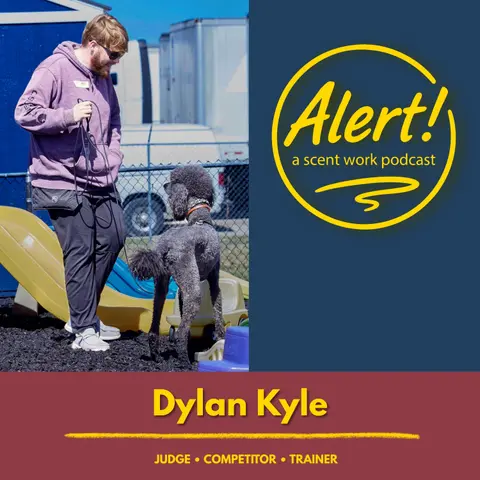



What does it actually take to become an AKC Scent Work judge? Dylan Kyle from Marysville, Ohio and I both got our provisional approvals on the same day. Him for excellent, master, and detective. Me for novice and advanced. We had the conversation so you don’t have to wonder anymore.
Dylan also shared a framework he picked up from Tony Gravley that quieted the noise in his head at detective level. And when I asked him what he loves seeing from a team even when they don’t Q, he gave me three words I’ve been unpacking ever since.
What we talk about:
- What it takes to become an AKC Scent Work judge, from first apprenticing to provisional approval
- Why apprenticing with as many judges as possible builds a better toolbox than doing the minimum
- The search evaluation forms, trial chair sign-offs, and what the provisional process actually looks like in practice
- Why “just because you can doesn’t mean you should” is the advice that stuck with him most
- What Dylan does when a hide isn’t working the way he planned
- Duncan’s 41 detective Qs, what the journey looked like, and why the pressure shifted after the title
- The Tony Gravley detective framework Dylan uses, and why it quieted the noise in his head
- What happens when Dylan gets in his head during a search
- Male competitors and judges in Ohio and why Dylan is a first on two counts for this podcast
- “Be fair to your dog,” what Dylan means by it, and why it stuck with me
- Seven questions with Dylan, including his dog’s favorite reward, the compliment that made him feel great, and a Sheltie moment that made him laugh mid-search
How are you doing?
DylanOh, I am good.I was going to go down to a trial in Florida.I decided, hey, I'll be financially responsible and save money instead.
ScotYou know, you're so right about that.Like, I've had that thought go through my mind as well.Like, I really want to go to this trial, but I think I need to be financially responsible and maybe do a few things around the house for a change.
DylanAnd even some of my students, they're like, oh, well, you enter all these trials, how many of them do you actually go to?I said, look, you got to enter in case you decide you want to go.I said, it's worth it.Just like, Just in case that impulsive thought.Just get your check in the mail.Mail your entry.If you get in, it's meant to be.If you don't, it's not meant to be.And guess what?You can pull at any time.Just make sure you do.I always do it if I need to.A day or two before closing, cancel the Airbnb.Life is great.
ScotYeah.Hey, so is it hard getting into trials in your part of the area?So let me just give some context here.Let's.Let's do the intro first.This is alert scent work.My name is Scott.I'm Murphy and Kiva's dad, and from Ohio.That's who we're talking to this week.Adding a star to the map from the state of Ohio kind of around the Columbus area.I guess Marysville is where you're officially from.Is Dylan Kyle.Welcome.
DylanWell, thank you for having me, Scott.
ScotYeah.So is it hard to get in trials in your part of the world?
DylanYes and no.The local ones in central Ohio.I know for a local.Local club that I judged for, and I used to be part of the committee.Part of the club I've trial chaired for.Yes, that trial filled in secretary or within like, the first 15, like, maybe five, 10 minutes.And there was, like, this big uproar about it.Outside of that, it just kind of depends.I will say most of our stuff fills within the first day or two, typically.
ScotOkay.So you do have to be really proactive.And it sounds like your philosophy is if you think you want to enter it, enter it.And then if you're not going to go, drop before that closing date, and then somebody else is easily going to be able to get in at that point.
DylanThat's my philosophy, at least.Yeah.
ScotAll right.Fair, Fair.I'm curious, what's your origin story?So how did this all start?How did scent work come into your life.
DylanSo scent work came into my life.So my poodle, Duncan Nova.Say dog.First dog I've had as an adult, um, got into some dog training classes.My instructor at the time, who I now co teach with me and her travel all over the place.She got me hooked on rally.I'm like, okay, this is fun.Then I did some obedience, and, okay, this is also kind of fun, just not with this particular dog.And she started doing nose work classes at our local club with her older dog.And I said, ooh, this seems really fun.So I took a couple intro classes.Then life got busy and started doing stuff on my own.Started doing stuff with her.And I said, ooh, this is like my jam with this dog.Like, most fun we've had out of everything.Very motivating, very fun.And then now, kind of here we are, two other dogs later.Really the only thing I do is at work.
ScotSo you got Duncan.Who else you dog dad to?
DylanI have two Shelties.I have Denver and Dory.So we're a big D family, I guess.
ScotSo, like.Like those D names.I love it.All right, so you got into scent work, you did some other stuff, and then, you know, you got into scent working.For whatever reason, it clicked.Why do you think it clicked like that for you and Duncan?
DylanSo for Duncan, you know, I was younger when I was doing rally and obedience.I was probably 19 or 20.I was just.I'd always kind of tense up, get nervous.It would go right down the leash.Um, you know, he was a little dog, touchy.A little people touchy.Just kind of depended on the day.But then I think really my confidence grew with scent work.And when I was a lot more comfortable, he's like, cool.Dad's not being all uptight.Like, this is really fun.So I think me kind of loosening up and becoming more confident with dog sports and training made a really big difference for him.Cause he's like, oh, we don't have to be freaky about everything.Like, life is just very fun and exciting.
ScotIs there anything else about scent work in particular other than maybe you just arrived to it at the right point in your dog sport career that just really captured.I mean, because you became a judge, right?And we're going to talk about that, because I get asked a lot, what's the process to become a judge?Because I just finally became a provisional novice and advanced judge.And we'll talk about your story in a second.But scent work in particular, like, was there something really special about it?
DylanSo the thing I love not to be cliche like everyone else, I love it because any dog and any handler can do it.You know, you could have a dog that's, you know, maybe too environmental for like a rally and obedience or an agility ring.Or you could have a dog that's a little reactive.You know, you can have a person who maybe just wants to hang out in their car and not be bothered.The perk of scent work is like everyone and every dog can do it.So like let's say your dog doesn't like people that much.So you know, you can go exterior, buried container route.That way you're not in a room for interior.You know, in our area there are a lot of old time dog trainers, you know, who are on walkers, wheelchairs, some mobility issues and it's just amazing to watch them just stand there and let their dog work.That's a big thing for me is that it's super level playing field like any dog, any person can do is.
ScotIt's so cool.So let's talk about the process of becoming a judge because while I was doing it, people who knew that I was doing it would come up to me a lot and go like, what do you have to do?So I think that's a common question.I think it would be cool for competitors to know because you know when they might see provisional judge on the premium.What exactly does that mean?Are they getting less than, you know, what, what kind of training do they have?So tell, tell our listeners about the process, what you have to do of.
DylanThe process, your bare minimum, which I do not recommend.I recommend doing more than what you need to do, but we'll save that.So you have to apprentice for every single class with a fully approved judge for all the levels.So you know your novice through Master HD and then all of your odor classes.And detective, that gets you X amount of points.Titling your dog to an overall scent work master get you another X amount of points.You do have to go through the judges seminar, I think within two years of being becoming a judge that counts for most of your credit points.And then you also have hide stewarding which counts towards a smaller amount of points.And then there's also the mentorship with the fully approved judge as well.There's a lot of different avenues to it.
ScotYeah, there are, there's kind of like a choose your own adventure sort of thing.Although.So Dylan, you're talking about the point system.And to clarify, when I did it I had to get 10 points.
DylanPoints yes, I had the same 10 points that you did.
ScotRight.So.And another qualification is you have to have been active in scent work for three years or more when you actually, in order to get approved.So you have to be active in scent work three years or more.You got to get these 10 points judges seminar, like you said, if you take it before you apply, that's like eight points, seven points, something like that.
DylanYes.
ScotYep.And then, and then you have to come up with the rest of your points like you've already outlined.And then there's the apprenticing.And I agree with you 100.Because they only ask you to apprentice, like, if it's novice containers, you only really have to technically do it with one judge once.But it sounds like you did a lot more than that.Tell me what, what that looked like for you.
DylanSo really before I even decided I wanted to become a judge, I was a very active competitor for the local club that I was a member at at the time.I did, I did, I think four, four trials where I was also the trial chair.I think the big thing is just because you can only do it with one, you know, you only have to apprentice and one novice container class.I always kind of would recommend to people looking into becoming a judge, pick multiple judges because you're going to learn something different from every single one of them that will create a very good toolbox for you when you ever decide to bite the bullet.I, um.There's a hundred different ways to do a hundred different things and I find the more people you apprentice with, the better.
ScotAbsolutely.And I, I have the same opinion too.I. I am apprenticed under, I think nine or ten different judges throughout that process.Yeah, we're technically, you know, and around here at least, most of the judges asked that.And I think this is actually what AKC wants you to do, that when you're apprenticing, you need to show up that day you're not showing, and you're basically with that judge for the whole day from beginning to end of day.Was that your experience?
DylanThat was my experience as well.And I had a couple people that really explained it to me and they're like, hey, nothing against you running your dog, but you know, when you're judging, your number one priority is going to be judging if you can run your dog.That's a huge perk.The main reason why a lot of people I apprentice under said, hey, I'd prefer you to not run your dog if you're going to apprentices.Of course, how life works is the 10 minutes you're gone running would be the 10 minutes that something comes up where they could be like, hey, in this situation, you do this.Or it would be, hey, when the dog smashes a box or spills water and buried.Here's what you do.And you kind of missed out on.Literally the most important part of the apprenticing is what do I do when stuff does not work the way I want it to, or things of that nature.
ScotRight.That's a tremendous insight.You're absolutely right.Those are the lessons that you learn that can be really, really important.I think we covered the process to becoming a judge.Well, actually, then what we should say is after you do all these things, then you submit your paperwork to the.The akc.I wanted to circle back and also say the trial chair thing, I think that was a great thing that you did as well, because, you know, it just gives you a broader view of what happens at scent work trials.And I think that's stuff that judges need to know.Was there, Was there anything else that you kind of did?Like before you actually started just considering being a judge?Did you watch a lot of rounds?I did.I was always after I'd run my dog, I was always in there watching rounds, talking to judges.Did you do that as well?
DylanYeah, I did some.Probably not as much as I should have, but I did do that pretty frequently if I was inside stewarding with someone asking questions.Because I really.And I tell.I have a very small group of students, and I always tell them, if you get a chance to work at a trial, you're going to learn so much from watching someone else's dog work versus your own dog?And it gives you the clarification to be able to ask questions like, hey, why would you think that's a good hide?Or, you know, a nicer way of saying it.But it gives you kind of insight also for when you're practicing at home, thinking about airflow conditions of your search area, you know, if it's a busy area, pooling problem, stuff like that, you.
ScotGet all of your requirements done, you send it to the akc, they get back to you, and hopefully they say, yes, you've been approved.And the first step and multiple steps is then you are a provisional judge for novice and advanced levels.And now you got to go out and do the work and do some judges judging stuff, actually do the real thing.But you're under the supervision of a fully licensed judge at these trials.I was looking at your background.Looks like you did a whole Bunch, I think so we should talk about this.I think you need five, right?You need five of five.Five trial chairs, five judges to sign off on your searches.
DylanYes, yes.
ScotSo you need to go out and do trials for different trial chairs.You need to have different supervising judges.You need to have at least five.You did a lot more than that, it looks like.Is that.Is that true?
DylanI.When I first became provisional, I sold my soul.Not in a negative way.It's just I had a lot of people reach out, and I'm saying, yes, yes, yes.Like, I remember last fall, I'm saying yes to everybody, and then I'm uploading it to my calendar.I said, oh, my God.I said, this will be an interesting year.
ScotYeah.Yeah.Huh.So, yeah, you go out and you actually then do some judging.Which did you find that that was so different than apprenticing?Like, it was just worlds different.And how so?
DylanYes and no.I think the hardest part.I remember my first judging assignment.I was so, so, so, so nervous.It is a lot different.You know, you have your judges there.You know, I was very fortunate.My first judging assignment, three of the four judges, I have a very good personal relationship with.So if I had questions or wanted to bounce things off them, they were there, they were available.I could text them, call them.If they weren't judging dogs, you know, they could run over really quick.I think the biggest thing.
ScotSupport system, which really probably made you didn't feel like you're all by yourself on that first trial.
DylanYes.The biggest thing, though, also is like, I.You basically are like, hey, here's your search area.You don't really have that guidance.You're kind of like, hey, I think this is gonna work.This, you know, I'm there Friday night.I'm like, I think this is gonna work.I'm being mindful of, you know, my first assignment was novice containers.Like, okay, you know, your two rows of five.Let's measure things out.Put our soccer dots out.Pick out my container.You know, it's novice, so I'm picking here's my white boxes or here's my mailer boxes, or your four folds.And then it's just thinking through, like, oh, crap, like, I'm in complete control of this.So let's really think what's going to work and what's not going to work, right?
ScotBecause you're going to have to.You're going to have to face the repercussion.It's easy in so many activities, so easy to, you know, watch somebody Else do it.You think you know all the stuff, but then when you actually have to do it, it's a whole different thing.Like, right.All of a sudden, the responsibilities on you, and it's like, w. Wow.There's so many questions I have that I didn't know I was gonna have correct.
DylanEven just setting up containers, I'm like, oh.I'm like, this is a lot more than what I was thinking it would be.Now, granted, I survived, but, like, you know, the perfectionist in me is like, this has to be perfect.Blah, blah, blah.And I'm like, you know what?Let's just set it.Run my demo dog in the morning, see how it goes.Like, get a good night's sleep.Like, get the nervous jitters out.Everything end up ends up being fine.But, you know, your first couple assignments, you're kind of like.It's like walking on eggshells.You're just a little nervous.You don't want to mess things up.You want to put a good name out there for yourself.It does get better with time, I can assure you of that.Like, I'm not nearly as nervous now as I was before.But, you know, there's just a lot of pressure on you as a provisional judge, having people review your search areas.You just kind of want to make sure that everything's up to the particular standard that you think it should be, right?
ScotYeah.So let's talk about that part of it.So as a provisional judge, then you did your search, and then after the search was done, what did you have to do?Because you have to go through some steps.
DylanSo your search evaluation forms.Do not be like me.Put a reminder in your phone and make sure you take pictures of your search area either before or after you do your search.I was really bad about forgetting to do that, and I'd have it basically cleaned up, and I'm like, oh, crap, I forgot to take pictures.So make sure you take your pictures, video, whatever works best for you.And then just.I would always spend maybe five minutes thinking, like, hey, you know, between the first dog and the last dog, how do they work this odor picture?Think through, like, what changed during the search?Was it, you know, air kicked on, air kicked off?Was there push, pull from the door?Did the building warm up?Did the building cool down?If you're doing interiors, did the sun start to come through the windows?Stuff like that, to kind of think about what potentially could have changed the search area?And then you just kind of fill out your search evaluation form from there, right?
ScotSo yeah, every, every search is a provisional judge for those levels.You have to fill out a search evaluation form with either pictures or illustrations of the search area.You have to report on what happened.Don't you have to report how many dogs queued and NQ'd?You have to do that kind of stuff as well?
DylanYes, you do as well.
ScotSo yeah, so you kind of have to self evaluate yourself and then you give that to the judge in the trial chair and they have to sign off on it.Is that right?
DylanSo for your search evaluation form, you just fill them out and you'll submit them with all of your paperwork at the end, and then the trial chair reviews, you get the signature from the trial chair.You hang on to those same thing with the search evaluation forms.The, the judges review, I'm sorry, the judge that you have look at your search area will sign it, they'll leave comments, and then you hang on to all of that paperwork.And then when the time comes, once you have all five of your trial chair reviews and all that stuff, hang on to it, organize it by assignment and, and then you'll just submit all of your stuff at the very, very end once you have all of it completed.
ScotRight.So what I'm trying to say, I guess is, you know, before you even become a provisional judge, you're apprenticing a lot.You've been involved in scent work for at least three years.Hopefully you've been actively involved and you've watched a lot of searches, maybe you've been participating with a club.And then when you become a provisional judge, you set your area under the supervision of a regular judge, then you have to evaluate your area when it's done, and then the judge evaluates and gives you comments and then signs off on that.So that's pretty rigorous.You know, you get a lot of feedback.It seems like your first trial as a judge, was there something that you quickly realized like either.Oh, this was something I hadn't considered being a judge.I need to go find out some information.
DylanMy first couple of assignments.No, not really.Everything was pretty straightforward.I had good areas.There have been a couple, like, you know, I was judging over the weekend and I, you know, had a high go haywire.So I reset my search area and I'm finding the judge that's doing detective.And I said, hey, when you're in between dogs, like, do you have two seconds to chat?So other than that, I mean, yes, we figured that part out.And I'm kind of like, you know, I read my rule Book.I said, hey, I just want clarification.Just make sure I'm understanding this correctly.I mean, other than that, everything's been pretty straightforward.A lot of the questions I've maybe had of, like, can you help me think about the airflow in here in a particular building?Like, I think airflows this way.I just want to make sure I'm thinking the correct way before I think about where I want to put my hide.It's always good.Even when you're approved provisionally or when you're approved for novice in advance and provisional upper level, I would say it never hurts to ask a judge that you trust or have a good working relationship with to come in and be like, hey, this is what I'm thinking.Do you think that this is okay?Do you think this will be too tricky?You know, can you give me some of your insight?And most of them will always say yes, as long as we're not on a time crunch or something crazy.
ScotSo then you, you know, you're the provisional novice and advanced judge.You do your five, you know, trial chairs, your five judges.You have all of your evaluation forms.You submit that, and then you get fully approved to do novice in advanced.And then the next step is you are now provisional to do excellent master and detective.And that's where you're at in the journey right now, if I understand correctly.
DylanYes.Because I think actually you just got approved to be provisional lower level, same day I got approved to be provisional upper level.
ScotAnd that's.That's how I.That's.I saw.I saw that and I'm like, wow, we need to talk to each other because you know, how fortuitous that we both happen to get.And there are some other reasons I want to talk to you as well, which I'll tell you about, because I've seen you around on social media.So about judging, what kind of judging philosophy did you develop through this process of working with so many different judges, not only apprenticing, but then when you were provisional.
DylanSo my philosophy is pretty straightforward to the best of my ability.I want every single dog that comes in there to queue.And if they don't queue, I. I want to make a very good experience to make someone come back.
ScotI like that.Yeah.
DylanFor me, my philosophy with novice is the challenge per se is finding odor in a novel venue.But the hide should not be hard at all.It should be, hey, when the dog comes in, there's odor.Here, pay me, pay me, pay me.You know, I found myself even talking with Others, sometimes you over complicate novice, when really the whole purpose of novice is to be able to find one very easy, very accessible hide.
ScotYeah, I had a piece of advice that really stuck with me, and I actually had this from multiple judges.It's just like, you know, you don't have to make it complicated because it's going to be complicated enough when people come into your search area.And the other thing is, if you're.If you ever think, ooh, this is really sexy hide, you better rethink whether.
DylanOr not you don't do it.
ScotWhich, you know, when you transition to that mindset of a judge, I think it can be really easy to go, well, everybody's seen a chair hide and novice, so I guess I need to try to do something different.Maybe you don't.Right?
DylanBecause the goal is.
ScotYeah, the goal is the job.The job of the dog and the handler is to be able to locate and source odor.So, you know, if we're making it sexy now, maybe we've complicated that picture for them.So that was a really good piece of advice I got.Did you get a really good piece of advice that really stuck with you?
DylanThe signature one from all the people I talked to was, just because you can doesn't mean you should.And I had that same issue over the weekend.I'm like, oh, this hide will be really fun.You know, I ran my demo dog.He's like, cool, there's odor here.I said, this is such a great hide.You know, I don't even remember where it was in a classroom, and I know there was a row of bookcases, and I put it somewhere, and I'm like, oh, this is like a great hide.This is like a very simple odor picture.And I ran probably the first 10 dogs, and, you know, the first couple was their very first trial.Handler's nervous.Dog is nervous.I'm like, okay, I don't think too much of it.You know, I'm like, hey, you know, I'm really sorry.It's over here.If you want to let your.If you want to take your dog to it and feed him.And then a couple good dogs are.And I'm like, oh.I said, yeah, no, I'm going to rerun anybody that in cue.Because I'm like, this hide is just.It's not working the way that it should.It's pooling.It's not available.So that's really the big thing is, like, if you said something and it doesn't work the way you want it to and it's complicated.It may put you behind a little bit.But if you need to rerun your class, rerun the class for the sake of.Especially like novice dogs.That's their first experience, you know, and you notice, ooh, this is funky.I don't like this anymore.Just rerun anybody that in queued before,.
ScotI worked with a couple judges that had to do resets and that.That could be really hard, especially for a provisional judge.Right.It's like, you know, everybody's looking at you going, what's going on?What's happening?But I think at the end of the day, people respect it, right?They.They respect that you made that decision, that this wasn't quite what it needed to be for this level.I'm going to rerun it.Was.Was there.Was there ever a challenge for you in that, or was it just like, absolutely, I'm rerunning this.No question.
DylanI've only had to reset one hide at one class.And everyone was very appreciative of it.I was a little in my feels about it at first because I'm like, oh, God, I don't want to be the provisional.Even though at that time last week I was technically approved for novice advance, I'm like, oh, God, I don't want to be the person holding up the trial, keeping people here late.You know, you just get in your head and you get dramatic, but then you're like, you think about it.I'm like, you know, they pay their 25 for a run and let them rerun it.Let them have that opportunity.You know, it is what it is.It's Saturday.We're gonna be here anyway.You may as well just reset it and make it level appropriate.Let everybody have their chance to try it out again.
ScotYeah.Not only they pay their 25 bucks, for some people, maybe they travel two, three hours.Maybe they paid for a hotel.Right, so.
DylanVery true.
ScotYeah.Yeah.There's all those costs in your area, are there guys.Are there a lot of guys that participate in scent work or even judge like I competed for?Well, first of all, when I go to trials, generally there's not another guy around.Maybe there's a one.Maybe there's a husband.And I competed for two and a half years before I had my first male judge.I mean, that's a long time.What's.What's that situation like around the Ohio area, really?
DylanIn our area, the only male judge is based out of Indiana, and he sometimes comes.So there's not a lot of male judges.Some Clubs will bring in male judges from other areas.And then typically, to your point, really the only.There are a couple male competitors.Not a ton.I would say most of them are the honorary videographer for their wife or their girlfriend running the search.I'm like, here, you go inside and stand.I said, you're the most important person.And they're like, huh?I said, you're taking the video.Come on.But, yeah, there's not a ton of male competitors.Just kind of depends.Kentucky.Yes, there are quite a few male competitors.It just depends on the day and time in Ohio.
ScotOh, that's interesting.So in Kentucky, a lot of guys are doing scent work, at least proportionally.
DylanSo compared elsewhere, you know, there's maybe three or four extra that you don't see at Ohio.But yeah, there's a.There's a couple more.Nothing crazy, but yeah.
ScotSo not only you, my first judge from Ohio, you're my first male judge.So that's you two firsts.
DylanOh, I feel very important.
ScotHow about that, Dylan?Yeah.Let's talk about competing for you in our last little segment here.Your dog Duncan.I believe it's Duncan.Seems to be.How many detective cues?Over 30.Right.
DylanSo total, I think I have 41.41.
ScotWow.And that's how long of a career working together?
DylanMy first detective trial was in 2000.2020.I think it was two in 2025 in May, I went up to Traverse City, Michigan.
ScotWow.So that's pretty fast.That's a pretty fast ascension.
DylanI've been very fortunate.A lot of people, my ear, they're like, wow, you're going really fast.I said, I don't know.I just enter the trial and hope for the best.
ScotThat's a fantastic strategy if it works.I found that that doesn't always work for me, so I'm glad that it works for you.Over all of those, detective se Is, tell me a little bit about that journey, you know, what you've learned, what were some struggles.Does anything come to mind when I say those things, like, kind of quickly, does anything bubble to the surface?
DylanSo I will say the biggest piece of advice I have for detective, and it's easy.Once you have the title and you've competed in it a lot.I was extremely nervous for my first, like, until I got the title, I would get really nervous because, you know, you paid your either 45, 50, $55 a run.You know, you're fighting against time covering an area, things like that.Really, once I got the title, I'm like, the Pressure's off.I'm like, you know, we don't.AKC doesn't count numerical detective titles now.I'm just kind of running it for fun.I said the biggest thing for detective.Do not get in your head something that.Because I did a really good detective or upper level for NACSW training seminar with Tony Gravely.And the thing that made the biggest difference for me is when you call alert.Why are you calling alert?What did you see?Did you see change of speed, change of direction?Did the dog's mouth close?Did you have a quick turn?The dog possibly crabbing?Are they pushing in?Are you noticing a head going under a chair?Things like that.That really bring clarification to you to kind of slightly think about while you're in the search.Like, what am I seeing?Why would I call alert here if I'm in a small room?Am I hearing that?Change of breathing?Stuff like that was very beneficial for me and my dog.But again, those.First, until you get the title, you overthink things.You overcomplicate things.At the end of the day, the dog just let.My big thing is just let the dog work.Cover your area how you see fit.And, you know, if you miss one or two, you miss one or two.But it's a great learning experience.You can always bring something back home with you to work on or mentally manage for your next detective run.
ScotThere's three things I want to tease out of there.First of all, I love that idea of why would I call alert?What evidence have I been provided before this final response that would lead me to believe that I have a high level of certainty, that this is an accurate final response.So, like, we're collecting all that evidence, and you talked very eloquently about the types of evidence that you would collect, you know, that you would be looking for.So that was a game changer for me when I started thinking of it in those terms, like, we're collect.I'm collecting evidence to increase my level of certainty that this final response is actually a legitimate odor final response.And that can be hard under pressure of competition.The other thing that you said was, it gets easier.After you got your.Your title.We got our title, and then we raced to 20 really well.I think we had a 60% completion.And I know there are some dogs out there that bigger than that, but.But I thought that was a pretty good, you know, a pretty good Q rate.And then we did.Then we did seven or eight in a row where we nqed.And I Have no idea how the wheels came off.And now all of a sudden, the pressure comes back because it's like, what's going on?Am I broken?Are we not as good as we used to be?Did you have any ups and downs in your journey?And how did you overcome those?
DylanSo really, my up and down there for a while was the dreaded.You missed one hide.I said, darn it, darn it, darn it.You know, I've been on the road a lot this year.You know, I ran detective Saturday morning last week.I'm like, oh, my dog is just not working, blah, blah, blah.I get in my head, I'm like, okay, whatever.We, you know, last week and I had a complete dry weekend.Didn't get any of my four detective runs.I'm like, you know what?It is what it is, because at the end of the day, the dog also, I always think, I'm like, the dog's allowed to have an off day.You know, when you travel a ton and you go a lot of places, there are a lot of moving parts.You know, if the dog doesn't get a good night's sleep, if they're restless in the hotel because of, I don't know, Friday night at a hotel, God only knows what people are doing.Yeah.And they're like, really, for me, is like, you know, it just kind of is what it.Like, I just always go into it now especially, you know, I've.I'm on my third nose work dog.I'm just like, you're either going to get it or you're not going to get it, but we're going to have a lot of fun.I just really go in with that philosophy only because, like, you know.Yeah, there are so many moving parts in a trial.Trial.You know, the dog maybe doesn't like the slippery flooring all of a sudden, or there's a hide that's really pushing them out of their comfort zone.If they don't like pushing in, maybe it's inaccessible and tight.Things like that.Like, the dog can just get super demotivated pretty quickly.So, like, that's why I'm always like, you know what?Let's just have fun.Yeah, we're not having fun.What's the point, Right?
ScotThe.I. I heard a piece of advice.I was telling Caroline, Caroline Oldham about my struggle, and she just said, it's like the stock market, you know, sometimes it's down, sometimes it's up.And when it's down, you just have to ride it through, because the up will come again.And then when it's up, enter as many trials as you can and just go for it.So that helped make it a little bit easier for me to kind of, you know, think about.Now I think about like, what could we be doing wrong?And sometimes in those searches, like you said, it's just a hide.Maybe the dog didn't have in its owner library or was uncomfortable with and just couldn't do it that day.Right.And that's just is what it is.It doesn't really reflect negatively on you.
DylanOr, you know, the one or two missed.I swear it is always I walked through this area and briefing, I said, oh, this would be a really good spot for a hide.And then mentally I just never go over to that area that's bitten me more than a couple times.
ScotOh, that's a good one.Yeah.I think covering your area is what it really comes down to for us.I think sometimes I don't cover my area quite as well as we should because there's always that balance of, you know, you don't want to over search.
DylanRight, right.
ScotSo, yeah, that's good.I like that.When you said don't get in your head, you gave a couple of examples already.But what does that mean to you?Don't get in your head.What is what happens when you get in your head during a search?
DylanSo I can tell you when I get in my head in my search.There's a couple judges.One of them was just recently on podcast and I will just start mumbling out loud because, you know, in detective, I never really.I have a high count or whatever.I keep counting.The only time I get nervous is when I call alert on that ninth hide.I'm like, oh crap.There's either nine or 10 out here.I'm either going to call finished correctly or I'm going to get an extra one.As of lately with the 10 high detective searches, I always get in my head and just call finish at 9.Because then when I get unconfident, then my dog is like, why are you being like a weirdo?Like work how you normally work.And then I'll just start seeing things that aren't actually there.Or if I get like, really?The big thing is if I tense up, he's like, dude, I don't know what your problem is, but he's like, I'm gonna go search over here and I'll let you know when I need you.You can get your mind together.And I want some cookies.I'm like, okay, great.Sounds good.
ScotThat's awesome.That's a good partner to have.
DylanWow.
ScotThis has been a great conversation.We kind of got to get this thing wrapped up here, though, unfortunately.Can you believe the time has flown like this?
DylanIt's went by very, very fast.
ScotLet's just wrap this up with seven questions.You know what this is about, right?
DylanTo a certain extent, I think I do.
ScotOkay.All right, I'm gonna ask you seven questions, just looking for the first thing that comes to your mind and just looking for a sentence or two answer.If I want you to dig in a little bit more deeply, I'll ask you to.So are you ready for seven questions?
DylanYes, sir.
ScotAll right, you got three dogs.You can pick one or three.What's your dog's favorite reward after a great search?
DylanMy one dog really likes some nudges.Grillers.They're crappy treats, but he really likes them.
ScotNot just grillers.I love it.What's one piece of advice you give to your beginning scent work self?
DylanAlways practice where you know where hides are.
ScotOkay, so you don't believe in practicing blind necessarily?
DylanI never.I very rarely will ever practice blind because then I feel like you're not setting your dog up for success because, you know, when you look at the hide, you can see what it's doing.So if you know you need to move or things like that, that's the kind of stuff that will really, in my opinion, is super beneficial for the dog and your relationship and scent work.
ScotOkay.How do you.How do you battle the urge, though, to even subconsciously maybe give too much away?
DylanI stand and only move when the dog moves.Or if I can, I'll run the dog off leash.
ScotOkay, perfect.What's the best compliment you've ever received at a trial?And this can be as a judge or a competitor?
DylanAs a competitor, I was running detective under a judge that judged at nationals, and he said, wow, your dog has really improved since Nationals, which made me feel great.Judge wise.I always like to hear that I'm nice or your search was fun.I mainly care about the nice part.
ScotI love that you're the first person to say that because it is an experience.Right.We're creating.This is a sport and it's a game, but we're creating experience.So just being nice really helps add to that experience.That's your first priority.
DylanSmile goes a long way.No matter if it's a dog show or just in life, you never know what people are going through outside of the trial.So that five seconds of Being nice to me is the most important thing.
ScotYeah.Probably you find that it sets some nervous people a little bit more calm as well.
DylanYes.
ScotWhat's your dog done in a search that just made you laugh, cracked you up, you couldn't help yourself.
DylanSo my young Sheltie, I was in Michigan running master, buried.She's working, she's working.The judge is like, oh, there's a mimic out there.I said, oh, whatever.I don't care about mimics.Not realizing which dog I have.And there's this life size boxer mimic.And I swear to God, my little shelfie with a dyed pink tail flew up in the air over this mimic and it made me laugh harder than it should have while I was.
ScotThat's fantastic.What's one thing you wish competitors knew about being a judge?
DylanIt's more than just setting hides.
ScotOkay, you can expand on that a little bit.What.What more is it that you want people to know?
DylanSo it's not just us showing up Saturday morning and placing a hide here.It's taking time off work.It's setting up your area on Friday night, sacrificing our time.Not in a selfish way.Sitting in that search area for 10 or 15 minutes thinking, this is what I want to do.Here's my airflow.It's not just us going out and placing a hide.It's us thinking through the entire picture that way your dog is.Can hopefully have the best experience possible.
ScotYeah.I want to add to something that I think people would find interesting is the day before, a lot of times judges will show up.All the judges that'll be doing that trial and some clubs do a pretty good job of saying, here are your search areas.If you want to use them.They already have had this thought out for you.Sometimes you show up at a place and it's a blank slate.And you and all the other judges have to figure out, all right, where are we going to do, you know, novice interiors?What about advanced interiors?What about excellent interiors?We need two rooms.Master interiors.We need three rooms.Are we going to have to use rooms?If we have to use rooms, how are we going to do this in such a way that we're not going to have a lot of blue tape all over the place?Right.There's so much the day before I didn't realize that almost breaks my brain, you know, just for setting up the next day before you can even set out a hide.So I'm glad that you brought that up.That there's just so much more than just Throwing hides out there.When you are a judge, when you're judging, what's one thing you love seeing in a team, even if they don't get the cue?
DylanI love when people are fair to their dog.
ScotOkay, what does that mean?
DylanGiving them space to work, not getting frustrated if the dog is taking too long.Just literally.They're literally just letting the dog, like, work like they would in practice.They're not jerking them around saying, check here, check here.It's.They're literally just being fair to the dog and letting.Realizing that the dog has the nose the dog needs to work.And reinforcing heavy is a big thing for me.I know another person has talked about it before.These people, a lot of people just don't reinforce like they do in practice at a trial.And it's like, okay, it adds 15 seconds onto your time.It is what it is.Be fair to your dog and give them what they need.
ScotI love that.You know, I'm gonna think about that probably for the next couple of weeks.Be fair to your dog.That's such a great way to frame what we need to do as competitors sometimes and asking ourselves, am I being fair to my dog right now?
DylanRight.
ScotNot only in terms of when you're at trial, but like the night before trial.Are you heading right to the hotel and putting them in the crate?Are you trying to get him out to park for, you know, 15, 20 minutes after a long drive?That's being fair to your dog.
DylanRight?
ScotI love that.I'm going to play with that in my brain for a long time.Do you have a signature distractor?I know that you're still pretty new at this, but do you have a distractor that shows up and everybody's like, oh, there's Dylan's.Whatever.
DylanI have just a purple and green leash that I use for everything.I don't use toys.My only.I only use leashes because I always have them with me.So other than that purple, green leash, Other than that, that's about the only signature one.
ScotI like that.And finally, what delights you about this sport or this activity?You know, you've been doing it for a while now, at least three years, if not more.What still delights you about it?
DylanI, as an instructor, as a competitor, as a judge, as someone who trains, I just love watching everything click for the dog and the dog.Just being able to work.It's just amazing to watch a dog find an essential oil on a Q tip and a 2,000 square foot area outside.Or, you know, this busy classroom that God only knows what these kids have touched or not touched.Like, it's just amazing to watch their.Watch them work.
ScotYeah.Yep.100% The love of watching the dog do what the dog does that we just cannot really comprehend.Although we try.Dylan, thank you so much for taking the invitation and being on the podcast.This has been a wonderful conversation.If something from this episode resonates with you, I'd love to hear about it.You can join the conversation at the Alert Scent Work Facebook page.If you found value in this episode or enjoyed it, consider sharing it with a fellow Scent Work competitor.You can also subscribe and find every episode@alertscentwork.com and from Murphy, Kiva and myself, thank you for listening to Alert Scent Work.Dylan, it's been a pleasure getting to know you a little bit better and good luck in the second part of your judge journey.
DylanWell, thank you so much.Good luck on your part of your start at your journey and thank you again for having me.