
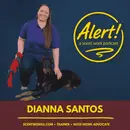


Dianna Santos came to scent work through a dog-aggressive Doberman who needed a reason to be a dog. Zeus couldn't go for walks. He couldn't be around other dogs. His world was shrinking, and so was hers. What happened when he started searching changed him. It also changed how she thinks about this activity: who it's for, what it can do, and why she believes every dog with a nose deserves to play it.
She went on to build Scent Work University and produce over 140 episodes of the All About Scent Work podcast. When I asked her to distill all of those conversations down to some themes that keep coming up, she landed on odor will humble you and focus on the dog. What she said about the first one felt like she'd been following me around with a notebook. The second is a good paradigm for all of us to remember.
We also get into something many competitors wrestle with: how much involvement the handler should have, and what that balance actually looks like in a search.
And if you have a reactive or dog-aggressive dog, Dianna has a lot worth hearing that might help you.
What we talk about:
- The two themes Dianna keeps hearing from the best in the sport and what they mean for the rest of us
- The universal handler journey, why it looks the same for almost everyone, and why understanding it helps you push through the hard parts
- What focus on the dog really means when something is going wrong in a search
- How much involvement should a handler have, and what finding that equilibrium actually looks like
- Zeus, a dog-aggressive Doberman, and what scent work gave him that nothing else could
- The choice point, what it means for any dog to choose the work over whatever else is pulling at them
- What scent work surfaces about your dog during training and how to address it outside of a search so it stops costing you in the ring
- Dogs with challenges, reactive, fearful, dog aggressive, and what perspectives and approaches can actually help
- How closed off a handler's life can become around a difficult dog, and what starts to open up
- Scent work as the activity, not just the sport, and why Dianna will go to her grave defending every dog's right to play it
- Seven questions with Dianna, including what still delights her, the most rewarding thing someone has ever said to her, and the piece of advice that stuck
Find Dianna: scentworku.com All About Scent Work podcast
Alert! Scent Work is a podcast for competitors, the parking lot conversations you'd never get to have at a trial, with the judges and community members you wish you had more time with.
Listen to the podcast and find everything here: https://www.AlertScentWork.com
Follow along: Facebook: https://www.facebook.com/AlertScentWork
Subscribe to the newsletter: https://www.alertscentwork.com/newsletter/
It's so cool hearing your voice in my headphones, and I'm talking to it and it's talking back to me, because I can't tell you how many hours I've logged walking my dogs in the afternoon, especially when I first started out with my Scent Work journey, listening to your podcast.
Dianna:Oh, well, thank you. I'm very delighted that you were enjoying the podcast and that it didn't make you veer off your path while you were walking your dog. No, I didn't.
Scot:Be nice to yourself. By the end of this episode, Dianna, you're going to learn how to be nice to yourself. That's what I decided.
Dianna:Lots of luck with that.
Scot:All right, well, we'll see a little bit at a time now. I mean, actually, I'm being serious. I started scent work in 2023. I was starving for information. I actually was really shocked. Like, the Internet can give you so many things, and it's better now. But, like, good resources weren't easy to find back then, I didn't think. But your podcast I found. And a lot of dog walks with my earbuds in. And the year that I started, I don't know if you remember this, it was a series on training the different elements. So, like, you talked about containers and buried and exterior and interior, and it was just. It was perfect. It was exactly where I was at the time, so it was incredible.
Dianna:Well, perfect. Well, I'm delighted to hear that you enjoyed it and that it reached you. And I completely agree with you. The Internet can sometimes feel like an abyss, but you are doing a wonderful job. I'm very excited about your podcast because I think it's reaching people and talking about the things that they're interested in as far as hearing from these different trial officials. So I think that's awesome what you're doing.
Scot:Well, thank you. I appreciate it. I hope. I can only hope that I have as much impact on somebody as you had on me. And we haven't even gotten a Scent Work University. So then, you know, I realized you have this thing called Scent Work University, and I started buying classes. You know, whenever I'd have a problem, I'd be like, I want to understand odor better. Oh, look, Scent Work University's got, like, six of those. Oh, my dog's false alerting. What can I do about that? Maybe I'll go to Scent Work University. Yep, there's some stuff on that, too. So, you know, it's just. It was such a great resource for me, who had a local coach, but not a lot of other mentors at the time to be able to really, you know, learn from some great people in the world of scent work. So before we get too deep here, this is Alert Scent Work. My name is Scot. I'm Murphy and Keeva's dad. And with me today is the founder and head trainer of Scent Work University and host of the All About Scent Work podcast, Dianna Santos. I usually ask, who are you mom to? Who's in your pack right now?
Dianna:Right now, I have a little smooth fox terrier, and his name is Ozzy, and he is in the room with me, and we'll see how this goes, because he can usually tell when I'm getting ready to wrap up, so he may start squeaking at the end. But he is my little guy who is bringing a lot of light to my life because I just do a lot of working. But he is having so much fun playing the sniffing game right now. His biggest obsession is finding antlers. He thinks finding antlers is the absolute bestest thing ever. Cool.
Scot:Yeah. That's awesome. I love it. I want to circle back to your origin story here in a second, but I do want to focus on something else for. For a second. You've worked with some amazing people in the sport. You know, you talk about how you put on these workshops, and you just get to sit there and soak it in a lot of the times, Right. These webinars and courses.
Dianna:Absolutely.
Scot:Out of all of that and all the episodes you've talked to, can you distill that down into some themes that keep coming up, no matter who you're talking to, that could help all of us improve in this game that we play? Maybe one or two themes.
Dianna:Sure. The biggest one is they always continue to learn that odor. And just the activity overall is going to humble you and welcome that ability to be humbled. Because I think everyone goes through the same type of process where the. The. When we first come in, we're like, oh, this is so awesome. Like, we're amazed that our dogs are able to do any of this. And then we start getting a little bit of a big head. Ah, I totally got this, man. I'm the best. You know, maybe we got a couple Qs, maybe got a couple titles. We're doing great in class, we're killing it. And then we're giving advice to other people and whatever the case may be. And then all of a sudden, the scent work gods say, all right, that's real cute. And then they throw you a complete curveball. And then on top of that your dog then says, oh, well, that was so funny. You thought, you know what? You're. You're not the one who has the nose, but if you want to take this over, you're more than welcome. And then they start, you know, cueing into us, which is a whole other thing. So the biggest theme, I think, is understanding that that journey is normal. And if you can embrace the ability to be humble and truly humble and not fall apart or not become defensive, you will be golden. That what you did in the beginning of your journey is going to look nothing like what you. You're doing towards the end part of your journey. And that's normal, too, which can be very difficult. As human beings. We want to latch on to something like, this is the right way. Like, well, is it really? Because things are changing all the time. So that's the big theme number one.
Scot:I want to jump in because I think there's some. Some things in that theme number one. And we'll get to theme number two that are worth teasing out. First of all, thank you for a new T shirt idea. Odor will humble you. I'm putting that on a T shirt. What an amazing perspective to remember when you start getting a little big for your britches. Like, that's never happened to me, you know.
Dianna:Right.
Scot:Odor will humble you. I love that. The other thing I want to tease out of there is that journey that you described. Oh, my gosh. Have you been following me around for the past three years with a notebook? You described exactly the cycle of everything, and it was just so beautifully done. And I think for us to realize that at any given moment, we can be in different parts of that cycle, equally awesome and equally suck. That can really help us get through, you know, and continue to enjoy this sport. So I love that first answer.
Dianna:Yeah. And I think it's something that I just want everyone to give themselves a little bit of grace to appreciate you. There are going to be times when you are going to be pulling your hair out that you're going to be upset with your training and be even upset with your dog and be upset with yourself and be upset with the gods. Like, oh, the scent work gods. Why, whatever. And that's normal. That really is normal. But what I think someone like Michael McManus is very good, Natalie McManus are very good at pointing this out is if you lean into all of that, you can develop a level of resilience that can help you not just within Scent Work, but also with dog training, also with dog ownership, but just with life that yeah, we don't have all the answers. We never will have all the answers. And that's okay. But seeking more answers is really the whole point. Like again, it's called scent work. We're seeking. We're not just finding, we're seeking. So we can do that more than I think it can really help.
Scot:There's something else there, what you just said. We're seeking. The dog is seeking scent work. We're on this journey of finding and discovery the dog Odor. And also, you know, how to work with us and even us on this, this, this. I'm getting really out there existential right now, but I think you're absolutely right that, that there is so much we can learn from scent work. Some people have never competed before, so they get to learn what it's like to compete. They learn find out what it's like to win and lose. You get to find out. Like for me, I got in and my dog was really, really good. And I'm like, well, at the time I was like, I really owe it to him to continue to do this. Although I was, you know, doing for me, let's be honest, because it made me feel good, right? And then you kind of get over that and then you run into some obstacles and it's been great character building there because I'm the type of person that usually picks up on stuff pretty quickly and I'm not really used to failing. And I started failing, right. And for whatever reason, this relationship I had with my dog, I was like, no, we're not going to quit. We are going to push through this, which is something sometimes I don't do. So. Wow, beautiful.
Dianna:And, but that's great that you recognize it in yourself because I'm sure that's true for lots of people. Like for myself personally, I absolutely am a one time learner type of person. If something goes wrong, I have learned that and I'm not going to do it again. And you cannot make me do it again. And that's not the best way of going about things because there may have been a reason why that didn't work that time, but you absolutely could have just changed a few things and you could have tried again. So having that level of resilience, of being able to go into a situation where things don't go 100% and with scent work trials in particular, you could have done everything right. Your dog could have done everything right. The trial officials and the trial staff did everything right. Everyone had everything 100% and Mother Nature and Odor said not Today, Satan. And so everyone is not going to qualify or a bunch of people aren't going to qualify. And you can sit there and you can take in that information one of two ways. You can say, that's it, everyone is against me and you can take your ball and you can go home, or you can really try to just objectively look at it and say, all right, I think that me and my dog are actually good. I don't have anything to really blow up in my training, but I do have something that I can deal with as far as how I'm coping with this situation. What is the emotion that I'm feeling? Don't try to like smash it down, own it and feel it like you did, like you were recognizing in yourself and said, you know what? I want to try something a little bit different. And that doesn't make you a bad person. That's the whole thing that is my love hate relationship with competition, is that it pulls in all these things as far as emotions and ego, that a lot of times people can kind of lean into in a way that is really bothersome to me. But a shortcoming of mine is not seeing it to the other side of that, that these can be situations that people can put themselves into. So they can have a different reaction, but they may have to experience it first and then they can get to the other side. And that's awesome. And again, nothing that we do exists inside vacuums. So if we can have that experience at a trial where again, we're kind of tethered with our dog and that experience and they can kind of keep us a little bit more grounded because we're so concerned for the dog and for the relationship and everything else, then maybe that can bleed over to other parts of our life too, where we may have other kinds of situations where we're like, oh, this is kind of icky, but that's okay. I can get through the other side because I'm not going to die. Like, that's a great thing. That's a wonderful thing for you to be able to experience and for you to get to the other side for. So while I know that anyone who's listened to me for any period of time, like, oh, she's so against trialing, that's not entirely true. It's definitely something I have a love hate relationship for. But the more that I think about it, I think it's just a journey that I'm on to get to a different place where I can experience it for what it is instead of all the emotional baggage that I've attached to. To it. So I don't want anyone to think like, oh, well, that's Santos Lady. She's just some up on some pedestal, and we're just below her groveling. Nope, that's not it. Santos lady is absolutely still very much on her journey. She's learning many, many things, and I can learn from anyone at any time, and I'm open to doing so. So I think that's a really important thing for everyone to figure out, is that, yes, there are some people who are extraordinarily experienced. They're so talented. They. They are still learning to.
Scot:Yeah. What was your second thing, your second theme that kind of. Kind of keep coming up no matter who you're talking to?
Dianna:Focus on the dog. Absolutely. Focus on the dog. Because sometimes what happens is we are so concerned about outcome. We're so worried about that dang hide that we kind of lose the dog in the sauce. So the theme that I've noticed throughout the years is how all the instructors just keep trying to remind everyone, like, hey, can we get back to that awe point when you're just sitting there with your jaw on the floor going, I can't believe my dog just did that. That was amazing. How do they do that? What is the magic? Trying to really bottle that up a little bit more and so that we can remind ourselves what that's like, because that can then inform us of the decisions that we're making within our training with what we're doing, with our own handling, what we can do as handlers to ensure that we have the skill sets that are necessary to meet our dogs where they are and also to appreciate that our dogs are indeed incredible. They're so very talented at what they do, but they also want to please us. So where something's going south in a search, as an example, let's say that our dog is fringing or our dog is offering false alerts or our dog is looking at us or whatever. They're offering aggressive alerts, any kind of thing. The idea that our dog is just, you know, randomly deciding to do this, that there isn't a reason behind it, is not true. So if we put the focus back on the dog, like, okay, well, why don't we ask ourselves some questions? Why is our dog doing this? Our dogs have incredible sense of smell. We're playing an activity that makes 100% sense to them. Normally speaking, before we start adding on all this confusing human rules that come along with the game that we want to play. So where was the breakdown? What was the confusion point? And how can we put the focus back on them so that we can kind of tease out what's happening and we can come up with a solution which very well may mean that we need to as people better understand what was I asking? What was my expectation? How did that break down? Maybe I was asking for pink polka dots, but my dog thought I was asking for elephants. Well, those are not the same, not even close. How can I get that more on one single line? And that's something I hear time and time and time again with all the different presentations, is trying to remind everyone, let's put the focus back on the dog, try to see through their perspective and keep reminding ourselves our dogs are doing what they've been trained to do. So if a dog is doing something at some point in their learning, some point in the opportunity that we gave them to put information together, we provided them with pictures and this is what they thought we wanted them to see. And it can be drastically different than what we thought, but that's what they perceive. So that's the biggest second theme that I've encountered over the years is let's just put the focus back on the dog and the tease things up from there.
Scot:I've been thinking a lot lately about the role of the human in the sport, right? Because everybody keeps saying scent work is a team sport and there's a lot of debate and I'm going to push that aside for a second. You know, you let the dog do everything versus, you know, the, you know, and I never interact and the dog just does the dog's job. Or what is the role of the human? Right. I'm, I'm starting to come more towards. It is a team sport. I have my job, my dog has their job. And I think you just really summed up, if you can think in terms of the dog, you. It's also a game of communication. Like all these pieces are coming together right now in this conversation for me and it's not doing what you quite want. Well, as the human, as the person who is trying to communicate to the dog what we want to do in this game with human made rules. Well, maybe I screwed up somewhere, so how can I do a better job of making sure I communicate?
Dianna:Absolutely. And that's harder said than done. I mean, truly. And also the thing that you're talking about as far as the interplay of, is it totally the dog? Is it the person? Is there some kind of 50, 50, is it 80, 20, what is it that's also part of your journey, too, is typically speaking when people first get started, it's like 99% the dog. And like, oh, this is great.
Scot:Here comes Diana with her notebook. Like, she's followed me again. I a feeling. Let's see. Let's see how accurate you are this time. Go ahead. It's 99% of the dog when we first start. Okay.
Dianna:Yes. So you're basically releasing the dog. Dog is going to go search, and you're just sitting there, you know, awestruck, like, oh, this is amazing. The dog can just do this all. And maybe I'll deliver a cookie at some point. And then you realize, okay, well, now I also have to be able to get some own skills, because now I'm interested in trialing. That means I have to. I have to actually call alert, and I don't know where the hide is. Ooh. So now I actually need to be able to read my dog, and that's a whole other can of worms. Maybe I need to learn how to handle a leash. Maybe I need to understand how to cover my search area. Maybe I need to know what we've covered. What we haven't covered was that interest. Was that dog odor? Oh, my God. Was that a distractor? Like, all these fun things? So now we're starting to swing a little bit more. Whereas before, when we first started, like, oh, this is so great. This is so much easier than that obedience, agility stuff. I get to just stand back. My dog finds stuff, and I deliver a cookie. This is the best. And now all of a sudden, it's like, oh, my goodness, I'm drowning in all these things that I have to do. So then we want to build up the dog. So it's this big neon sign here. Human, it's here, please call this. And so it goes a little bit too far the other way. Because we're so uncomfortable with our own ability to do these things. We want desperately to be right. We don't want the person, whether it be our instructor, our friend, or a judge, to say no, because no is death. So to build up the dog. So they're neon sign stuff. So it tends to go a little bit too far in the other direction, where now we're micromanaging. That feels kind of gross. Maybe it works for a little bit, and then all of a sudden it doesn't. And then we hear about, oh, no, we should be doing more with the dogs. And we swing the pendulum the other way. And then we're trying to follow and jog behind Our dog be like, I'm going to follow every move that you make and I'm not going to bother you at all. And please be brilliant. I am the weak link. I am the weak link. And then the dog's like, I don't know where you are. Like, we're supposed to be doing this together. Think about a pack hunt. Like we're trying to get the prey. Come on.
Scot:Yeah, think about that.
Dianna:Then you're trying to find that equilibrium.
Scot:Yes.
Dianna:So it's. It's a journey. It's really, really hard and it's. It's a different journey for everyone. And also what that teamwork looks like from dog and handler team number one to dog and handler team number two, also, depending on where they are in their journey, is going to look entirely different. And none of them are wrong. They're just not. If you and your dog feel like this is in sync for this moment in time, you're great. In my book, by all means. It may not be the way that I do things with my dog. It may not have been the ways that I did things with my dog before or in the future, but that doesn't matter. And the other problem is for all those people out there who have multiple dogs. Bless you. Because you need to develop your own unique approach for dog number one, dog number two, dog number three, and that's also going to change. The issue, I think, that people run into is, again, that whole emotion thing ties into it. Am I a bad person if I do something? Am I a bad dog owner? Am I doing bad things to my dog if I do or don't do something? And I can sit here and honestly say that's probably not the case, but yes, you may make decisions that I wouldn't make necessarily for my dog, but that doesn't make you bad. If it works for you and your dog, by all means. But also experiment, because that's the communication and the dialogue you're having with your dog and you're trying to figure out how you can have that communication with them under pressure, particularly if you're doing this at trial or a class so that you can tackle this thing together. And that doesn't mean that you have to look exactly like somebody else. If anything, you shouldn't. If anything, you should figure out what works for you and that it is a give and take and it's going to be changing again. I know this is not the answer anyone wants, but it's going to be changing and shifting and morphing and developing throughout your whole Journey.
Scot:Question on your origin story. So from what I understand, you started your career working with reactive, fearful, aggressive dogs. You know, kind of the ones that people had given up on. How does that tie into your scent work origin story? And I want you to think of this in terms of, you know, there was one point in Diana's life where there wasn't scent work, and now all of a sudden, there's scent work.
Dianna:What.
Scot:What was that Introduction?
Dianna:Sure. So it all started when I adopted my first Doberman, and he was Zeus, and he was not dog reactive. He was dog aggressive. He wanted to eat other dogs.
Scot:That's even worse.
Dianna:Yes. So I was not a professional dog trainer at the time. I was just a person who adopted a dog after not having any dogs for a very long period of time. So my husband and I were very excited about this adoption. And then as we were, like, walking him around the neighborhood, like you would do, he actually wouldn't do anything, but he would look at other dogs in a way that would make the hair stand up on the back of my neck. I'm like, that's not a normal reaction. Having had a background in horses, I knew to trust what my body was telling me. So I reached out to a couple of trainers, and they went, oh, yeah, this is bad. So I started working with them. And we were doing behavior modification, following all the protocols. But because he was a very large and quite frankly, dangerous dog, his life was very limited. So I was trying to work with the trainers to figure out, well, how can we provide him some kind of enrichment? Because I can't take him for walks because it's just too dangerous, and I can't take him for hikes and things like that. It's just, again, too dangerous. So what can we do? And we were doing some brainstorming, and one of the trainers I was working with at the time was like, you should check out this whole nosework thing. It may be something that you want to give a. Give a go. So I just fell into it and was like, oh, well, yeah, this sounds like fun. We hide things around the house, and maybe he'll have fun with that. And at the very same time, the trainer that I was working with was at a training facility where they were also offering nosework classes. And she said, we can make sure it's super safe. No one's going to get hurt. We can see if this is going to work. And that's how it all began was I was just trying to find a outlet for this dog. You know, we had Zeus's closet at the group class, where quite literally, we put his crate into a broom closet and closed the door and put like three pens around it. And I would stand in front of it feeling, no one can come here, right? But he was amazing in his searches. And it opened up my. My eyes like, this is incredible. His quality of life just blossomed. Because this was his thing to do. I could now safely take him out of the house. I could go to this designated activity at this training facility with lots and lots and lots of controls in place. He could be a dog. And it was safe. And it was good for him. It was good for me. It helped me with my behavior modification because I was able to read him more. It opened up more channels for communication. And I was so smitten with it. And I saw it improve. As far as his behavior modification outcomes, as far as his level of explosions or anything else, if he did happen to be outside or something like that, that I was like, I really think I want to do this. So that was how the whole, let me give this whole dog training thing a try, how that all started off. And it was because I got really keyed into this whole nosework thing that it was so incredibly impactful for him. And my brain immediately went to, well, couldn't this help help so many dogs who have behavioral issues? So that was how we got started.
Scot:So from what I understand, and I also had another guest on who had a very similar story, Judith Guthrie. A couple. Couple episodes ago, she had a dog that wasn't reactive, it was aggressive. And, you know, we talked about that Buddha a little bit. And, you know, nose work wasn't the only thing you were doing right, to adjust his behavior. She. She made that very clear. It was just one of the things.
Dianna:Absolutely, yes. No, it's just one thing. On top of many modalities, behavior modification that we were doing.
Scot:I am curious though. Why do you think scent work complemented that behavior work so well? You alluded to, you know, you're better able to read him. Were there other reasons that you think that that really complemented behavior work?
Dianna:I think the ability for him to actually make decisions, to problem solve and to be trusted to do so, as opposed to being managed 24 7. So where we can set up a search in a safe space, primarily at home, and he can then be trusted. You are going to go and do these things without me micromanaging every square inch of your existence and then being able to take that into other environments like the training facility. Again, super micromanaged. As far as making sure everything was safe. But he could tackle a search even though there are other dogs staged outside inside their vehicles. There are other dogs in other parts of the facility, which is with very closed, blocked off doors, but that's still happening around. And he can say, yeah, there's dogs going around, no problem. I'm going to focus on this. That's a choice point for the dog. That's the dog saying, I'm able to key into this amazing innate instinct that I have of hunting and I can do that. Even though for his case there are all these opportunities for me to issue out death. But I'm going to choose to hunt instead for this tiny little tin that has birch in it. Sure, that sounds like a good idea for me. And he did great.
Scot:Do you think that that little choice point of him being at a facility, even though, you know you had a lot of safety measures in place, he didn't have to be micromanaged. He kind of proved to himself like, I don't always have to do this. Is that what was going on, do you think, or.
Dianna:I think that absolutely is. Part of it is. I think it's important for people to recognize that if you have a dog with any kind of behavior issue, you as a person are taking on kind of a residue of that. So you're developing in your own psyche an expectation of what's going to be happening and you're trying to guard yourself from that, if that makes any sense. So if my expectation was okay, if we hear a dog or we see a dog, however far away, I'm going to tense up, hold my breath, get exorcist head and try to look for exits, which again is not exactly the ideal thing that you're supposed to be doing. You're supposed to be doing other things, but that's just an innate reaction that you have. Whereas with this, we could be in that training room again, very super safe, but he could hear the dogs. And what do you know, he's not stiffening up, he's not getting really tall, he's not closing his mouth and going, hmm, who do I want to hurt today? Like, it's none of that.
Scot:And you're not, you're not tensing up at all either too, because you've started to develop this relationship that this is a thing he can do on his own and I don't have to, you know, be as concerned, at least. Exactly. It really ties back into this idea of awe you brought up earlier. So I'm just kind of curious, like When a handler who's ever seen their dog as a problem gets an opportunity to see them doing scent work like you did, and then all of a sudden see them as brilliant, what does that do to the relationship? Do you remember going through that?
Dianna:Oh, yes, absolutely. So for myself, I was so in the weeds of trying to help him and knowing that if I couldn't help him, then he was going to go to the vet, and that was going to be the end of that. So it was a whole lot of pressure I was putting on myself. And seeing him perform in this way where he could tackle these puzzles, do so way under threshold, that he was nowhere near his threshold, and he was happy and he was competent, that highlighted to me that this is what having a dog is supposed to be all about, is that I'm watching him be a dog and he's doing this with me. It's not just about all this other stuff that was very scary. It's about this right here. So that I was able to take deeper levels of appreciation for him, that it wasn't just Zeus the aggressive dog. It was Zeus the really super stunningly beautiful, handsome Doberman, who would clear perimeter, would then work the center, and then would go to this hide and that hide, and then he would go back to the other one, and he would look at me and be like, did you want to maybe pay me sometime today? Like, oh, yes. I'm so sorry. I was just so enthralled with you, I forgot what we were doing. Like, so that shift is amazing. And I think it could be so therapeutic for people who are dealing with dogs with any kind of issues, because there's so much that the person goes through that they don't even know. They don't even appreciate how closed off their lives can become. Well, I can't go there because then I can't bring my dog. And if I can't bring my dog, then I'm worried that they're at home and what are they gonna be doing? It's just easier for me not to go out or. Well, I can't play that noise on the television because that's gonna set the dog off. I'm just not gonna bother watching tv. Like, those sound extreme. Those are things my clients were doing where they were quite literally creating prisons for themselves inside their own homes. And they were just a basket case because they were trying to help the dog. And by having an activity like this again, in concert with. With really serious behavior modification training, we can try to unpeel the layers of that Onion to help the person so that the person can see. Yes, your dog is maybe not the fido that you had romanticized when you were a child, but they are brilliant who they are, and there are so many things about them that are absolutely incredible. And you also are incredible because you're here wanting to help them. And this is something you both can do together. You can do it safely, and it will bolster the communication you have with each other. So if you do get into a situation where maybe your dog becomes afraid that they don't have to panic, that they can just say, hey, Mama, Papa. I'm a little worried about that, and you're going to hear it and you're going to see it so that you can do something, whereas before you did something like that, you may have missed that signal or they may have had to scream it to you instead of whisper. So this is why I'm so incredibly passionate about scent work, not just the sport, and the sport is great. I care about the activity and I want every single dog in the planet to be playing the activity because I think it's so impactful for them. But quite honestly, I think it makes us better dog people.
Scot:There are some people that I have come across who have had similar stories. Their dog, you know, might be reactive, they might be fearful, they might not have a lot of confidence. They come to a scent work trial, maybe that first trial, maybe it's confidence. Right. And. And the dog is constantly just looking around what's going on, not able to do the game. And a couple times later, you'll see them, and they're actually, you know, kind of really searching. And you can see that. You can see that improvement for somebody who has a dog with challenges. And I'm gonna lump them all together, which probably isn't very good, but let's try it and see. See what happens. Whether that's confidence, reactivity, fearfulness, whatever. And they are participating in scent work and they're trying, but they're really struggling. Do you have any advice for those handlers on. On what they could do to maybe make it a little bit better for them and their dog and more enjoyable?
Dianna:Sure. So the first thing is try to really distill what it is that you're hoping to get out of this and know that not every answer is going to be the same. So let's say, as an example, we're trying to work on confidence. We can absolutely do that by working on scent work and just realizing that confidence in that context is the dog deciding, making a Choice point. Okay, I'm being asked by my person to go into this space and go find a hide. But eye dog need to assess whether or not I'm going to die in here. So if I assess that I'm not going to die, that I can put in a little bit of try. That is what you're looking for. You're looking for the try. They don't even necessarily have to get to the hide. So let's say as an example, you have a dog who is concerned about maybe putting their feet on things where maybe you're trying to get them to use the environment to get closer to their hides. As an example, maybe they're just not sure of where their feet are. There are lots of dogs who don't have very good proprioception. They don't like back end. Back end what? Like, I don't know, I have back feet. So there's all kinds of things as far as that's concerned. But you could design an exercise depending on the type of high that you wanted to set, even what it is you're asking them to hunt for. Which is why I really try to champion for. Why don't we start with primary first? Things like food and toys that we know really mean a lot to the dog. And you're simply asking a question. Hey, here's a treat here as an example. Do you think you can get that? If the dog says, I don't know, I don't think so, I think I might die. Okay, no problem. We're going to go out, we're going to make a big, you know, no big deal, no problem. I'm going to come may make an adjustment. Either I'm going to make a bigger space, I'm going to make more entry points, I'm going to lower the platforms, I'm asking them to use whatever the case may be and they're going to ask again and then goes, oh, well, that's a little bit different. How about if I just try to put my foot on here? Great. Maybe they don't have to get that treat. Maybe I can just reward them there. Then we're going to release pressure and go somewhere else and incrementally go from there. Now, if you're like Santos lady, that's all fine and dandy. I'm trying to build up confidence in my dog and confidence compete. Great. I would still be recommending the same kind of things and just being mindful about, again, the kinds of questions that you're asking of if you want your dog to go into a novel location, like at a trial. What do you think are some of the things that they're going to be encountering there? Different sites, different smells, different textures, different social pressure. As far as pressure from you, the pressure of the actual space. How big is it? How small is it? How many people are going to be in there? What are those people going to be doing? Are they going to be still? Are they going to be moving? Are they going to be making noise? All that stuff matters. And that's absolutely tiny little elements that we can parse out in various different types of training exercises to present a picture to the dog where, again, the key point is they are letting you know what they can do, and you're basically trying to manipulate all of that. So the answer is always, I think I can do that. And then allowing them to try it again, be like, I can do that. Did you know that I could do that? And you're like, yes, I knew that you could do it the whole, whole time. Like, I'm amazing. I'm like, you are amazing. You're incredible. They're like, I want to do it again. Guess what? We're going to do it tomorrow. And so I was like, oh, no, but I want to do it. Like, nope, nope, we're going to try it again tomorrow. We're going to. We're going to sleep on that. And they're like, oh, my God. But I want to do it right now. I'm so brave. Like, you are so brave. Like, that's. That's the kind of thing that makes scent work for me so incredibly exciting, is that there are so many tiny little things that I can play with and I can parse out. And the dog is always telling me me where as an example, my dober boy Valor was amazing. He was. He could do anything under the sun, but he showed me. He's like, I'm a little worried about putting my head underneath, like, a tight table, like, because maybe it'll fall on me. Maybe I can't fit. I don't know. I'm like, that's a wonderful thing that you told me. Thank you so much. So I took it completely out of scent work. And I would just sit while I was working, and I would toss treats into really tight spaces for him to chase while I was working, working. And he thought that was a whole lot of fun. We're going to put treats, toss treats behind doors that are closed up against the wall. We're going to toss treats underneath the dining room table. We're going to Toss treats into this chair and that chair. And I did that for, I don't know, a month or something. And completely not within scent work. Then I set up a hide and he was able to do it like it was nothing. He's like, oh my God, I'm going to the tight space. This is so much fun. Like that's the key of. I like to view scent work as a way for the dog to communicate to me stuff that I didn't know know. And then I can either apply that within a set or training session, but more often than not completely separate from it and then I can weave all that stuff back in.
Scot:I brilliant. How you say, I'm just going to ask my dog questions. Hey, do you feel comfortable doing this? Oh, you don't? Okay, well, cool. Maybe we'll lessen the stakes a little bit. You feel comfortable doing this? I love that framing. So if, you know, a dog is scared of novel environments, maybe there's, you know, a family member's house you go to that is kind of novel, but it's not where they live, right? Maybe that's where you go and you, you try a couple of hides cuz they're a little bit more comfortable there, but not entirely. And if it works, great and if not, then you go, all right, well how do we make it familiar and maybe just a little less familiar? Like that, that incremental training. I've heard that a lot since I've started scent work. That incremental training idea of you're just taking these little baby steps, you're just asking your dog to do little baby step things, whether it's getting comfortable with squirrels or whether it's going under a tight table or, you know, whatever. So, so that was really insightful. Thank you.
Dianna:Well, and I love the way that you said that. And I'll just pull upon that one tiny little thing of novel environments Again, as humans, we always think big, right? We go from step A to step Z. So for novel, you may have been practicing at home in like your living room, maybe your bedroom, maybe your kitchen. You can go practice inside your garage. Has your dog has a done a search inside of the garage. What about your laundry room? Let's think about outside. You probably have done your backyard, maybe done your front yard. Do you have a side yard? Do you have another part on your block on your walk that you could do a search in? Like it's. We just need to open the aperture of what we are considering of these things and there are so many opportunities for us to do again, I'm all for field trip searches. I think field trip searches are amazing. But we can do that incremental training that you're talking about that we can make sure that there's a lot of familiarity first. Then when we go to the new place, we're doing our boxes as an example. Oh, my God, I see the box. We're doing the talk. That's what I want my dog to think. I don't want my dog going, oh, my God, where are we?
Scot:Yeah, I've heard that, like boxes or power boxes, a lot of people use those power boxes. And if you take that to the novel environment, sometimes that can help because at least there's some familiarity. They understand what that means and you get those little baby steps. So if you're. If your baby steps aren't working, take. Take even more Babier steps.
Dianna:Exactly. And again, love the process. Like, that's. That's my big thing I try to get across people is that I don't want anyone to say, like, oh, this is taking so long. Like, please make sure that you are, first of all, video everything, jot everything down and revel in that time that you have, because I can guarantee you, you are so going to want that time back at some point. And I don't want anyone to just be rushing ahead because, like, oh, but I want to get this goal. Like, I can guarantee you whatever goal it is, doesn't matter. I want you to get there, there. But maybe take your time getting there because that journey is the important part.
Scot:You've been very vocal that you think that this sport is for every dog. Who were you thinking about when you say that? What do you mean?
Dianna:I just want everyone to realize that quite literally, if your dog has a nose, it works. They can play this. And for my purposes is that I want somewhere to be seen from activity down to sport. I don't want to be seen the other way around. So every single dog should be playing the activity. And however that is. Like my little guy is hunting for food, he's hunting for toys, he's hunting for antlers. That is scent work. My valor was competing. He was finding Birch, Anise, Clove. He was hunting. He was competing in akc, uscss and NACSW. That is the sport. So I want every single dog to be playing the activity of scent work, whatever flavor that is. And then some of those dogs may do really well within the sport. What I want to make certain that we're shying away from is trying to make this anything where you have to pass some kind of metric. Well, you know, you didn't search this fast or oh, well, you weren't this zesty or whatever. That is a hill I will absolutely die on. Like absolutely not. This is something for every single dog. Will every single dog do well at an in person trial? Maybe not. But that doesn't mean they shouldn't be doing the activity. So my big thing is that I want every single dog playing the activity. Activity. Some dogs and teams will do well doing things at trial, whether it be in person or maybe they would do well with competition, but maybe not in person. That there are virtual options. Highly recommend you guys check that stuff out as well. But that's really what I mean is I don't want this to become a. Well, you know, you need to make sure that you have a fill in the blank, whatever descriptor that you want this type of dog and this type of handler. Otherwise you can't play. Absolutely not. As long as Santos is alive and kicking second, that ain't gonna be it.
Scot:I gotta tell you. So like most of my listeners are gonna be, you know, the scent sport listeners. Right. So where they're competing already. And I gotta tell you that playing the activity thing is so powerful because just recently I started getting down. Like, I'm like, oh, I'm kind of getting tired of trialing and sitting around all day and blah, blah, blah. And, and, and for some reason I got in my head that the only way I could do this thing is if I went to trials.
Dianna:And.
Scot:And then I had this epiphany like, no, no, we do this for fun. So why can't I get some people that I know at trials? And maybe I don't go to a trial out of town. That's a five hour drive. Maybe I just go, hey, we're getting together at the park for a couple hours and want to do the activity. Like that was freeing for me. So I'm really glad you're such a proponent of playing the activity is the important part.
Dianna:Absolutely. And I love the fact that you're doing that big gold star for you and your little group for doing that, because that's what we should be doing more of. Again, it's not that trials are bad. I think they could be wonderful as far as actual tests. Tests to see. Okay, well, where are we? What? How are things going? And it could also be wonderful social and everything else. But what you just described is what to me set or truly is whether you're doing it on your own, whether you're doing with a group of friends. It is the activity that is the absolute wonderful thing that we should be protecting as much as possible and we should be celebrating.
Scot:Yeah. And sometimes it's easy for us to conflate that with the event or the trial.
Dianna:Right.
Scot:With we make those two equal. And they certainly are not. And, and I will say one of the things I do love about scent work is much like you, I think it's for every dog in every team. And it took me a while to come to this too. You're going to have some competitive teams and that's great. And you're going to have some people that show up and it's just a fun day to do something with their dog and hang out with some people they know that's great too. And, you know, whatever the level that you want to play the game however you want to play the game, I really admire anybody that's there playing it their own way. And I think that's super, super cool.
Dianna:Absolutely. Couldn't agree more.
Scot:By the way, what's your favorite dog to see? Do scent work at a trial? I, I'm a sucker for the little dogs like the Chihuahuas or the wiener dogs or, or the little terriers that are just, you know, like, I don't know, five, six pounds. And when they go out there and you just see they have heart for it and they just can't wait to search. I love that. I think that's so much cooler than the Australian shepherds or the, or the, you know, the Border Collies. And I have an Aussie, so. But what's your favorite. What's your favorite dog to watch play? The. Do you have any?
Dianna:I don't have one that pops out to the front of my mind as far as, like, oh, like that's a given. But I will say that I will become always emotional when I see senior dogs, dogs who are blind, dogs who are deaf, dogs who are in carts or dogs that I know have had any kind of challenge and you can just tell like when someone is walking up to a line, like they're trying to help their dog through. That is stuff that I, I'm not an overly cry kind of person, but I will get a little teary eyed and be like, oh, look at them. Like, yes, that is the thing that just absolutely pulls upon my heartstrings. Obviously. Go Dobermans. I love a good dober sniffer. Oh, I love it so very much. But yeah, the dogs who at first glance, at first brush and be like, oh, that poor Dog, they're not gonna be able to and they kill it. Particularly the blind dogs. The blind dogs are just incredible to watch search. And I love when they find a hide and they do the looking up into the sk by like, I found it, I found it. I just, I could. I could watch that all day long. So, yeah, I love it. Yeah. The dogs that the people kind of like brush off, those are the dogs I actually love to watch.
Scot:That was a solid, solid answer. And I agree. 100. As soon as you said, I'm like, yeah, that should have been my answer. It was a good answer. All right, time for seven questions. That's where I'm going to ask seven questions. I just looking for a sentence or two. Whatever comes to your mind. If I want you to expand, I'll ask you to expand. You ready?
Dianna:Sure.
Scot:All right, question number one. What still delights you about this sport or this activity?
Dianna:The fact that it's growing so much and the dogs are having fun.
Scot:What's the most rewarding thing somebody said to you about either the podcast, scent work, university and your training life? Anything you've built that they have a.
Dianna:Better relationship with their dog? Thanks to the things that I've put together.
Scot:Piece of advice that stuck with you, what is it?
Dianna:Be kinder to yourself, the same way you would be kind to your dog.
Scot:What do you want this sport to look like in 10 years?
Dianna:More inclusive Again, trying to focus more on the activity and some more creative searches. That's not just trying to put everyone inside one box, but really expanding out maybe a little bit more in the games.
Scot:Okay, like, what kind of creative searches could there be, do you think?
Dianna:I think thinking about all those different elements we were talking about before, as far as we're able to see all these different things the dogs are telling. Telling us about. Use a dog as kind of a guide. Like, could we have different types of things as far as virtual vertical mazes as an example, or thinking more 3D as far as our searches, doing things. USCSS has done a fantastic job with this, with their games. Really trying to isolate what the handler is doing, what the dog is doing, seeing what kind of things we can pull upon as far as those skill sets, really being creative about it and not just simply saying, well, maybe we can have them tackle rubble piles. Like, well, now my little dog in a cart can't do that. So now I'm sad. So I want something that's inclusive but also really creative at the same time.
Scot:Where do you see the greatest opportunity for scent work?
Dianna:To grow really leaning into the benefits of scent work for pet people and then getting them involved in the activity, giving their dogs an outlet. And then a good percentage of them will then also come into the sport realm.
Scot:What's the most surprising thing you've learned from building all of those?
Dianna:This. Just how much interest there is and that there is no quenching that desire for more.
Scot:What's your dog's favorite reward? And that could be, you know, any of your dogs that you had after a great search.
Dianna:Oh, our parties. So the parties are customized for all my dogs and they are, they are ridiculous. So I'm really known for my parties. I'm really loud, obnoxious, I'm yipping and skipping, skipping and jumping and doing all kinds of craziness. When I'm doing all this stuff, I'm tossing treats at them. We're playing tug. All kinds of ridiculousness. So that's the thing that my dogs really look forward to the most. How ridiculous can the Santos lady be?
Scot:I love it. All right. Does your dog have a search quirk that makes you laugh?
Dianna:Yes. So when he's, particularly when he's hunting for his toys, he will do a pause before he pounces onto it. So I absolutely love that for my little guy. He'll just freak out, ease, and then he'll go pounce like a little fox. So that's smooth fox terrier. I guess it makes sense.
Scot:Dianna, this has been such a privilege to be able to talk to you. Somebody who really influenced me early on in my scent work career gave me access to so much knowledge and information. And one of the things that I do love that you do about Scent Work University is, you know, there, there's kind of a lack of lower priced resources for somebody that wants to learn. It seems like if you want to learn, you got to do some in person seminars or you have to travel and have a trainer, you know, and that could be a lot of. But you have these nice little bite sized pieces at Scent Work University that somebody can get if they're just more of the casual person and they can go learn a little something and feel a little more confident, have a little bit more fun with their dog. So thanks for building that. That's really incredible.
Dianna:Well, thank you. I really appreciate, again, everything that you're doing is awesome, truly. And I love the fact that you're building up all this interest and also having all these conversations with these professionals who are working so very hard and putting on these trials. They're trying so hard to make sure that they're. The tests are nice and fair and hearing all the feedback from them is incredible. So I'm very, very thankful that you've taken this all on and that you are so passionate about scent work, and I'm thankful that you allowed me to be a part of your journey. So thank you. You're awesome. Possum bots. Wow.
Scot:I should have. I should have made it more about me earlier on in the show. I really enjoyed hearing all that. Thank you. Dianna, if somebody wants to find you, where can they go? This is the easiest question of the whole conversation.
Dianna:So if you want to learn a little bit more about university, you can go to scentworku.com that's S C-E-N-T W-O-R-K-U.com and you can see everything that we offer there. You're also more than welcome to contact me at Dianna. That's D I A n n a@scentworku.com I'm always happy to help however I can. If there's a particular resource you're interested in, you just let me know. I am extraordinarily fortunate to have contacts with so many very talented professionals all throughout the whole world of scent work who would love to put a resource together for you. So if you're like, oh, I really wish that you guys would talk about this, quite honestly, reach out to me and I'll have that made for you within a couple of months.
Scot:All right. One of the things I regret I didn't mention, I'm going to give a quick tag at the end. Cyber Scent Work, you co founded that in 2021, which is perfect for people that maybe don't want to go to a traditional trial. So take a look at Cyber Scent Work, as well as one of the resources that Diana offers. If you like this episode and think somebody else out there might like, like it, please be sure to share it. You can follow and subscribe at alertscentwork.com we also have a Facebook page. It's facebook.com/AlertScentWork. Dianna, thank you so much for being on the podcast. It's been a pleasure.
Dianna:Thank you so much for having me and thank you again for everything that you do.