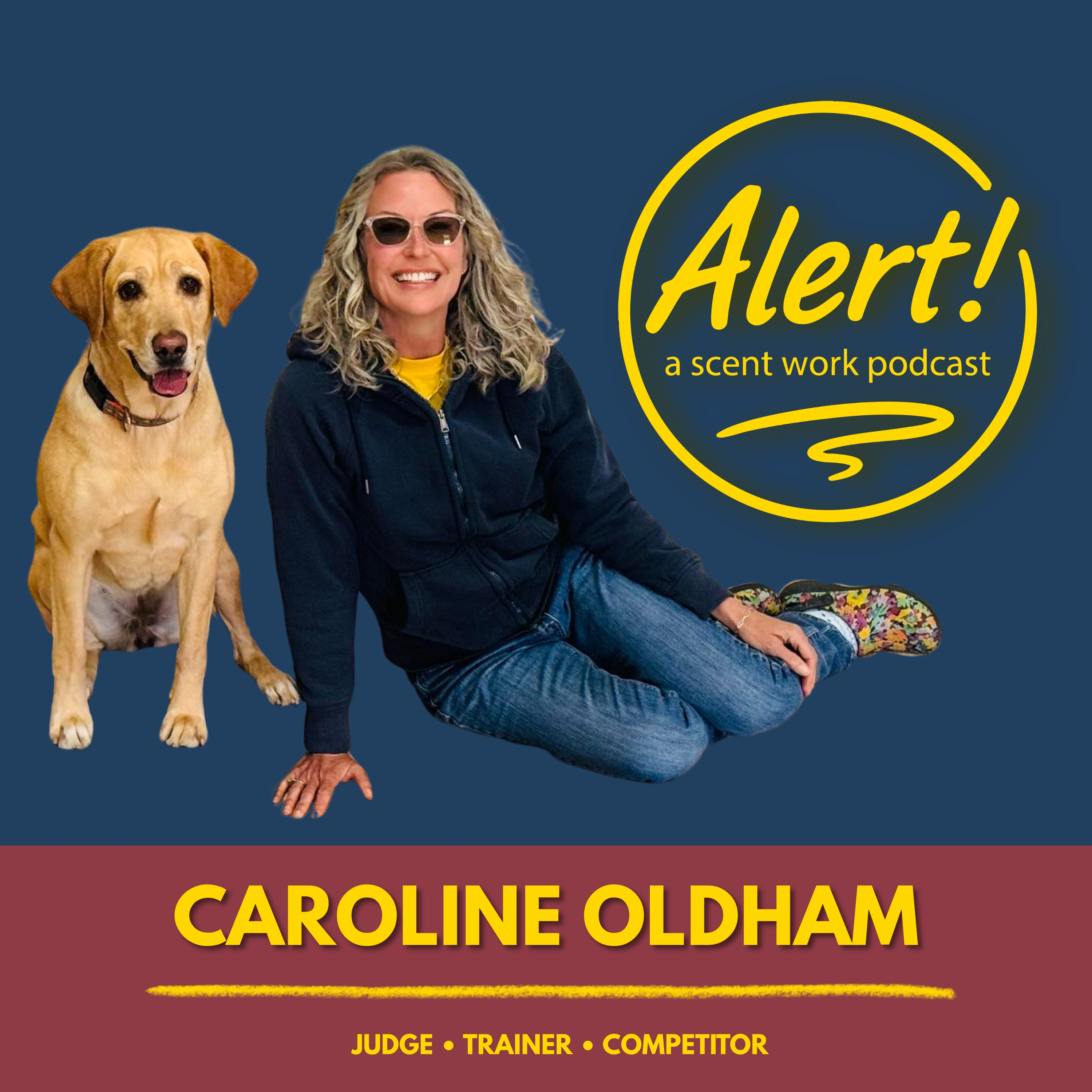


If the journey with your dog in this sport is the priority, success can fall into place for any team. And Caroline Oldham puts a lot of effort into focusing on the journey. And doing so helps both the dog and handler achieve their goals.
She also talks about her crate-to-crate ritual and why she does it, what your dog's breed group tells you about how they search, building handler grit, and a start line tip she thinks will make a difference for most teams.
What We Talk About
- Caroline's pack, Timber the Welsh Springer, Kate the Malinois who made her a planner, and Rebarre the yellow lab she planned a year before she got her
- What training a Malinois teaches you that no other breed will
- Breed groups and what they tell you about how your dog searches
- The dog is always learning whether or not you're teaching, and what Caroline did with that idea the first hour she had Rebarre
- Your dog is perceiving odor, not just smelling it, and why that reframe changes how you handle
- The toy basket mistake and why all good things should come from you
- Clarity, no gray days, black and white rules that hold even when you don't feel like training
- The one treat that is only for the discovery of odor
- Crate to crate, what the ritual looks like from the hotel to the search area to the car ride home
- What success looked like with the first dog and what it looks like now
- Two stories about what it looks like to drive home from a trial and call it a success even when you don't do as well as you wanted
- Handler grit and what it takes to keep your rituals in place when everything is falling apart
- The self-care coach on her training team and why the handler is half the partnership
- Seven questions with Caroline, including her signature distractor, the start line tip she thinks will make a difference for most teams, and what her dog would say about her in one word
Links and Resources
Find Caroline:
Facebook: Caroline Oldham
Facebook group: Scent Work Texas
Southern DFW Scent Training seminars: ckoldham@att.net
Alert! Scent Work is a podcast for competitors, the parking lot conversations you'd never get to have at a trial, with the judges and community members you wish you had more time with.
Listen to the podcast and find everything here: https://www.AlertScentWork.com
Follow along: Facebook: https://www.facebook.com/AlertScentWork
Subscribe to the newsletter: https://www.alertscentwork.com/newsletter/
On your Facebook page one time you said, if you're trying to convince you to do anything, there's four words to say. Do you remember what those four words are?
Caroline:I don't. How old was that?
Scot:There will be coffee.
Caroline:You're right. I love it.
Scot:And if you're trying to get Caroline to do anything, the first choice is the hot blonde from seven Breweries. Sugar free heavy cream, extra shot. But if you don't have a seven brew nearby, just get the quad with stevia and a splash of hot heavy cream. Do we get that order right?
Caroline:How do you know that? Yes, That's it.
Scot:Yep. I did a little reading about you. You know, I like to know what my guests are all about. So you said yes so quickly that I didn't even have to offer coffee. So if we ever connect again in real life, I will buy you a coffee for this.
Caroline:A caffeinated life is a happy life.
Scot:Yes. No kidding. Right, let me do the intro. This is Alert Scent Work. I'm Scot Murphy and Keeva's dad and today Caroline Oldham is on the podcast who are you Dog mom to give us your pack.
Caroline:So right now, my current pack, the oldest member is Timber, who is a Welsh springer spaniel. And I got her mainly as a breeding prospect, but also suspension. Sports is my life. I fully expected her to go into sports, which she did. And she was the first Welshy to achieve any UKC nosework titles and AKC nosework titles. She was also the very first Welshy to achieve UKC doc titles. So I turned a little breed ring dog into a sport dog and she really exceeded my expectations. I have a CDX on her and obedience and we made it up to the excellent level in the AKC and she has a shed hunt title and she's just a great little dog. But more than anything, she's a wonderful little snuggly companion and she's beautiful.
Scot:That's awesome. Who else is in that crew?
Caroline:So I also have Kate. Kate is a 9 year old Belgian Malinois and I got her from Karen Shivers, who wrote the AKC rulebook. UKC rulebook and was one of my early mentors in the sport. And she was my very first detective dog and probably the dog I have learned the most from because Malinois are not for the faint of heart. What I did learn from her about the breed is you can't go in without having a plan. Every training session with a Malinois has to be put out on paper first, executed without the dog and then the Dog added. Because if you train it wrong and you reinforce wrong, you're stuck with wrong for the rest of that dog's life. Wow.
Scot:Really? They just grab all the time.
Caroline:It goes right into the hard drive.
Scot:Oh, geez.
Caroline:Yes. And so it made me a very thoughtful trainer. A trainer who plans. I never was able to do anything half hearted or halfway with her. Everything had to be intentional. And she really sold me on the marker system and the timing of a marker system and what it means to have a re. A meaningful reward to a dog. So where she might have been my toughest dog to train, she was also, she taught me more than any other dog has in the past about just the basics of what you need to do to make a happy dog and a dog who will respond appropriately during training. And then my current competition dog is Rebarre. And she came out of Katalyst K9 in Connecticut. And Katalyst K9 provides scent detection dogs all over the place for agencies, all types of dogs. But when yellow females come along, sports people like me get moved up the list as a, a candidate to become an owner. An owner for that kind of dog. And you know, I hear some ugly talk sometimes like, well, she got that dog from a sport detect or scent detection kennel. But they, what they don't realize is they don't come trained. They just come with a lot of gas in the tank with a powerful motor. Yes, yes. And she has. She. I planned for her a year before I got her. And I had so many just goals and dreams and, and pictures of what our life would look like together. And she has far, far exceeded any of those visions I had for us together. She's. I know a lot of people say, you know, in your life you only have one heart dog, but she is quickly becoming my second heart dog. And I would not trade her for anything. Every single day, even if it is just a chore day, is special with her. She's just amazing. Yes.
Scot:Yeah. I want to circle back to your Malinois. You also train a lot. Are there other dogs like Malinois that you just have to get it right the first time? Other breeds that you've noticed?
Caroline:Well, I think a lot of times you do need to be thoughtful. You need to pre plan. And a lot of people don't want to invest that step. But a lot of people come to me just to troubleshoot problems. They receive their foundation somewhere else or they were able to compete to a certain degree and then something has stopped them, a problem, and so they get sent to me. Or people come to me for help. And the number one thing I see is they don't understand the breed category, like the group category of the dog that they own. Like, is it a herding breed, is it a hunting breed, is it a guardian breed, is it a companion breed? And I think that is a step a lot of people don't really research. They, they maybe buy on looks or maybe someone else had a successful dog in that category, you know, and dogs do vary within breeds and within litters for sure. But I think it's really important to understand the group your dog came from and to understand how that dog may look in our sport. Like the herding breeds, the little shelties that I train, and I have three of them in class right now, they circle their handlers constantly and, and if you just step back and watch or you video, you realize that they are actually corralling or herding their handler to odor.
Scot:Oh, they're trying to herd their handler to source is what you're saying.
Caroline:Exactly. Really? And so understanding that or understanding why a guardian breed can't move away at a far distance from the handler to discover odor on its own, or why a guardian breed needs to feel safe in the environment. So they may blast into a search area at a high speed and stop. And then they're going to look all the way around, 360 and they're going to decide, are we safe here? And if the answer is yes, then we proceed. And people see that my dog won't search. No, your dog hasn't started searching yet. Your dog needs to feel safe first. And so just realizing these things about different breeds, super important within the hunting group, is your dog, is your dog's nose going to drop and track or is your dog going to lift and air scent the whole time? And so a lot of people don't even consider these things when they're looking for a sport prospect or training. The beginning a support journey with the pet dog that they have. And so I, I try to enlighten them on what, what group did your dog come out of? Okay, now let's get, let's realize some things about that group and we can solve problems way quicker or it may not even be a problem. It just needs to be a realization on the handler's part.
Scot:Right. Just something that, that this is my teammate. This is what my teammate does. I just need to accept it and then we can get to work after. Just like working with people, you know, all people have their own little quirks, right? Sometimes somebody. Yeah, sometimes somebody needs a Little bit of chatting before they can get to work. So you just, you know, you chat that co worker up and then they're good to go. We could do a whole episode on just this. And I'd love to, but I've got so many other questions that I want to hit. So that. That was a great lead in little tidbit for people. Think about the breed you have. If you don't understand that breed, find somebody who can help you, like Caroline. So at one point, there was no scent work in your life. Could you remember that?
Caroline:I do.
Scot:A long time ago.
Caroline:Yeah.
Scot:Yeah. I mean, you've been around this sport for a long time. One of the thing I loved about this podcast is getting an appreciation for the history of this sport, which I had none when I first started and the organizations that led up to where we are today and the people who were involved from almost day one. And you're one of those people.
Caroline:Well, in Texas, I am, for sure. You know, we were behind the west coast a little because you guys had NACSW before we did. Way before we did. All we really had early was United Nose Work, and that was UKC before UKC. So United Nose Work was also written by my Malinois breeder, Karen Shivers. And. But before that, we had nothing. And I had my very first competition dog. Her name was Hershey, and she was a chocolate lab, a pet dog from a backyard breeder. Nothing special, but she was very special. She was just one of those dogs who understood how to bring a green handler along. And it was an amazing 12 years. Amazing. And so my first foray into competition, two years after I started training dogs, just pet dog training, was in obedience, and I loved it. And someone said, you know, you can go to competitions for this. And I was like. And so I joined a local club and I started competing immediately. And I got a utility dog on that title. And she wasn't even four years old yet, so she was exceptional. I absolutely was not. But. But we did that together and we did it really fast. Now I've paid dues since then, and I know exactly what it takes to get that title on a dog. So this dog, she finished her utility title. So she was retired and young and bored, and I didn't know what to do. So a man came down from Alaska and he was teaching something called nose work. And it was basically throwing kibble into boxes and deciding which box had the kibble in it. And I mean, I knew zero, but my dog was like, hold my beer. And. And she. She took to that I. I could not put any problems in front of her that she couldn't understand immediately. And it. It was amazing. And so I was like, okay, we've already outgrown this. We need to do something else. And so we had a few people locally who were working with United nose work and trying to figure out what did training look like for this, what. What do we do? And all we really had to learn from was professionals. And a lot of those people owned agency dogs. And so agency dogs spent their days in kennels all day long, and the stimulation they got was to come out and work. And. And so that is very, very different than what we're faced with now with pet dogs. Mm. So it was very easy to drill those dogs and, you know, put the same scenario in front of them again and again and again. And my dog could do that stuff and thrived in that environment. But now that AKC has a program in place, I've had to adjust to every single breed, every single drive within the breed, and dogs who live in the lap of luxury. And how are we going to make these dogs hunt?
Scot:Right. I mean, that is. That is a real challenge, I think, for us competitors. We go out and we like, oh, I wish our dog was more like a detection dog, but you have to realize that's their first primary job, our job, dog's job as a pet. So I love that you said that, because that can help you give your dog a little bit more grace and realize, you know, correct work with them in a little bit of a different way.
Caroline:There are some hacks for that that I've discovered over the years. One I just discussed with a lady yesterday. I'm trying to involve my classes very. On a very deep level in reward events. And my. My mentor for that. He has no idea that he's my mentor, but he is, is Michael Ellis. And I think Michael Ellis absolutely hung the moon. His. His depth of knowledge, his understanding of canines, being able to read, canines, being able to think like a dog. I think he is unsurpassed. He's amazing. And I have watched a ton of content, listened to a ton of content, and passed on a ton of content that has helped so many people. But the number one mistake I think people make is a toy basket. They have a toy basket in the house, and that toy basket is. Is accessible all day long, every day for dog to get. Dogs to go get balls, shoes, tugs, stuffies, and all of this. Out of all day, they have access to this. But in my house, you don't play with a toy unless it comes out of my pocket.
Scot:Yeah. And I would imagine unless you've earned it.
Caroline:Well, I want my dog. I want my dog to think I am the most interesting thing on the planet. That way there's no extracurricular sniffing during a search. Know where's the rabbit been? Where's the squirrel been? Where are the birds? Other dogs pee, they. I think that this is the number one change you can make to where all good things come from. You especially play that will make a difference in your handling, in your performance.
Scot:Treats as well. If you don't have a, a motivated dog with toys, just I, I think what I'm getting out of you is so I, I hear that need to come from you as the handler. 100 And the dog has to earn that doing whatever it is you want the dog to do, whether it's, you know, tricks or obedience or scent work.
Caroline:True. But I think it's more if you think like a dog. Dogs are very opportunistic. That's how they've survived is what role can they fulfill for us. And in turn, they were workers for us. And we have forgotten that. The dogs do still have a job, but most of their jobs now are ornamental or comfort, which I'm not knocking either one of those because those are valuable. But if you want a dog to work, you have to treat the dog like an employee who earns a paycheck.
Scot:Okay. All right. You got to earn your things. I love that.
Caroline:Yes. And you know, every single day I start my day by stuffing my pockets full of high value treats. And they know it's on me from, from the morning till the end of the day. And you know, toys, they're on me. And, and so they come to me for that stimulation. And what it, what the good part about that for me is there's no lazy days like these dogs are like, let's do something, let's do something, let's do something. And I can't say, well, today I don't feel like it. And even if I don't feel like it by the time I'm done training, I feel like it. So, you know, it's, it, it's symbiotic. It works both ways. It can turn a bad day for me into a great day with a short, a short search or a short rally course or anything like that, because they demand that of me. But I've created that in them. You got to start from the beginning with that, I think.
Scot:Yeah. So I very rarely feed my Dogs from the bowl.
Caroline:Right.
Scot:Everything. And, and, and, and I did that out of necessity because I have two Australian shepherds and I needed to burn mental energy. Right. So.
Caroline:Right.
Scot:We would do those sniffing food puzzle toys, or we do. I mean, even if it's a simple game of I take their toys, I dump them out on the floor and they have to go pick them up and put them in the box like they have to earn their food. And hearing what you're just saying, like that has been foundational for why maybe they do well in scent work. Because I have laid down that expectation that they have to earn that and that, that if they do what I want them to do, I provide them with these great things.
Caroline:Right. It. And you're just creating work ethic. And so the last competition dog Rebarre, the yellow lab, I. I pre planned, like I said, for a year what our. What our experience would look like together. And I especially put a lot of thought into what the full first 24 hours would look like of ownership and what the first hour of ownership would look like with her. And so when my husband and I flew to Connecticut to pick her up and we stayed at the hotel that was actually hooked on to the Hartford airport. And so our breeder brought the dog to the hotel. We didn't even have to get a car. So I signed the final contract, I talked with the breeder, I grabbed the dog and I headed up to the hotel room where I had pre staged a little bitty tug, a little bitty ball, a scent tin, and a little bitty Frisbee. And as soon as I got her in the room, I dropped to the floor and we played and we played. And I have videos that I. I will die if I ever lose them. They are so precious to me. Of the first. What the first 30 minutes look like. And I wanted to establish with her, this is a preview of your life, girl. This is what you and I are together. This is. This is us. I'm building this partnership and team the first minute that we're together. And I let my husband do, you know, the training into the airplane bag. Here's the pee pad. But for all those kind of things that took more structure. He did that while I was nothing but the. The player and the teammate and the companion and the source of everything good.
Scot:Everything good and fun.
Caroline:Yeah, that was her first impression of me.
Scot:Yeah. And then. Yeah. And then you talk about this reward sequence. So you continue that. That relationship through the reward sequence. Right.
Caroline:She never has seen me in a different light than that. And I'll tell you what formed that thought of how I should introduce myself to her is one of the coaches we have at Southern dfw. His name is David Bull, and he is a retired assistant fire marshal for Ellis County. And I helped train his arson dog. And the reason he chose me is because his arson dog was a retired agility dog. And we were the very first team to ever certify a border collie for arson work. And it is one of the proudest moments I've ever had is getting that done with him. But he's. He's older than me and a million times wiser than me. And one thing he said. He said, caroline, the dog is learning whether or not you're teaching.
Scot:Yeah.
Caroline:I was like, wow. And. And. And so I took that thought into what my first hour with Rebarre was going to be like.
Scot:That's pretty profound. The dog is learning. So, like, when you allow them to do something you don't want them to.
Caroline:Do, they're still learning.
Scot:They're learning. Right. And you might not even realize it at the time.
Caroline:100%, Yeah. 100%, Yes.
Scot:Yeah. So we have to watch those. Those moments.
Caroline:Right. So, you know, my training philosophy is clarity is super important. Like, if you have a rule that leads to reward or consequence, good or bad, when you're tired, that rule still has to be in place. And when you're not feeling it today, I don't want to train dogs. That rule still has to be in place. And when I say rule, I don't mean, like, a bad rule. I mean any rule that you have, like, this equals food. This equals toys. This equals a walk. This equals work. Whatever that rule may be, you can't have gray days. Your days all need to be black and white with your dog if you want a partner you can depend on under competition circumstances.
Scot:Yeah, you gave us a ton of great stuff there. But I want to know, what is it about nose work, scent work that you just love, that you just fell in love with? Is it watching the dog do these amazing things? Is it. Is it the relationship between you and the dog? What is it?
Caroline:So let's go deeper than that.
Scot:Okay.
Caroline:Layers deeper than that. I think it has made me a student of dogs. And what I mean by that is not just structurally, what does the olfactory system do, but when a dog is hunting, what do the ears do? What do the eyes do? How does the nose look? How is the coat moving? Because the coat even moves, too. And one little piece of information I picked up From Tony Gravley, who I greatly respect, is that odor has a frequency, meaning that odor vibrates. Everything in our environment has a frequency, but odor also has a frequency. And whiskers are super important to picking up frequency.
Scot:Oh, no. Really?
Caroline:Yeah. Yeah. And coat. The coat on the dog is super important to picking up frequency. So your dog, when it's in a search, it's not just using its nose. And so if you, if you change the wording to your dog is perceiving odor, it changes the way you handle the dog.
Scot:So you just love watching dogs perceive odor.
Caroline:Perceive odor. Like, like, take. Take all the information we talked about earlier about different breeds, different breeds, but they're all one species. How does all. How do all these different breeds within this species perceive odor? And how do they work? And so the last time I looked, thanks to Kristi Murdock's We Smell Better, I had judged 210 AKC trials. And that's just AKC. That's not the other venues that I or organizations I judge for. And then I judge. I coach about 35 dogs a week, and that's almost every week. I take a couple weeks off a year that's watching a ton of dogs experience os. And that's the only reason I'm saying it is because I have observed so much dog behavior and the respect that I have gained for the species is just so profound.
Scot:I want to take that a step further. One of your core philosophies is if the journey with your dog in this sport is a priority, success can fall into place for any team.
Caroline:Correct.
Scot:Expand on what that means a little bit more. And I think it's probably related to what you just communicated to me.
Caroline:It is a little bit. But the key word in that sentence is success. So success, as I have matured within this sport has changed for me. So success used to mean train really hard and get the blue ribbon. And I could do that. I could do that consistent, consistently. And then it turned into train really hard. And then your dog dies. When you have $600 worth of entries out on it and you just entered your very first detective trial.
Scot:Yeah.
Caroline:And the dog is gone. And the dog that has taught you everything is gone. And you're just left with a leash. You're left with nothing. And the next dog that comes up, success changes a little bit. And the next dog that comes up, it changes more. And then with this dog now Rebarre. Success looks totally different. Success looks like, am I a dependable partner for her? Am I. Do I have rituals in place in my Training and rituals in place, trial day that she can depend on that make me appear dependable to where all she has to be concerned with is the hunt. She doesn't have to be concerned with my emotional state or whether or not I brought the right treats, or whether or not the leash made it into the car, or whether or not she's going to get her coconut water before and after the search. I've created this ritual loop. I call it crate to crate. So from leaving the crate to the search area back to the crate is full of ritual. And then the trial weekend is always full of ritual. And it's not a really popular choice. But I'm not the kind of girl that you'll find out late with other handlers like, and my dog is sitting in a hotel room or in the car, right? That's not me. So I have all these rituals in place. One of them includes if we're traveling and when we hit town, we check into our hotel room, and then we will. We will be hiking somewhere. We'll be on a trail somewhere. And that is both of our connection time, decompression time, and a chance for her to just be a dog without me asking anything of her. But at the same time, I. My assignment during that time is studying dog. Studying dog language and studying my dog's language. How does she interact when I'm not asking anything of her in the environment? Because that is. Those are tools you need when you are working. And so nothing is wasted. No time is ever wasted. And it is a ritual that means everything to her. Another ritual that I have is after every search, I don't care what the outcome was in the search. It could have been a disaster. I will be bringing out a toy, and we are playing all the way back to the car. And that is not a reward for what just happened in the search area. It is me investing in the next search because her opinion of the sport is the engine that is going to drive the vehicle.
Scot:So much to unpack there. First of all, I want to say that just recently, I've done this for three years now. Just recently, I have started thinking a little bit more holistically about the ritual of, like, my house to trial site, from trial site to my house and what that looks like. And I've been incorporating some more of those things. I love that you said you go on a hike, right? Because I've started to try to, like, if I can stop 45 minutes outside of the place where the hotel is, right. I try to find a park and yes. And we do something together. You know, like it can be really easy to throw your dog in the car and make that six hour drive and not really think much about it and show up at the hotel and you're tired and you feed your dog and you just want to decompress and watch tv. But that's not being a great teammate, which is something else I think a lot about, like how I'm the support staff. Right. So you got to do some other things to help your dog be ready for the next day. So I love that you said that. And I'm going to try to expand my door to door.
Caroline:Right.
Scot:Ritual a little bit.
Caroline:So one of the hardest things to overcome for handlers is there's no excuses. Like, there might be a three day trial where I don't do this that much anymore, but I might be judging all three days, which means all the prep work before the execution of the trial, plus prepping for the next day. And maybe I ran my dog five or six times each day. So I come out of there at almost 60 years old, tired.
Scot:Right.
Caroline:We go hiking.
Scot:Right. Because that's the ritual. That's what you owe your. Your dog.
Caroline:Yes. If I want her to be at her best mentally and have her spirit invested in this, there is no I'm tired. That's how serious I am about it. And I can be tired when we're done.
Scot:The other thing that you mentioned in that is I think there's a lot of debate and I struggle with this myself. Like, if we did not have a successful search, if it's a disaster, as you said, going back to the car, what do you do? Right.
Caroline:Right.
Scot:Because on one hand, I don't want to communicate like, that was awesome. Because it kind of wasn't. Now I will say, if it was something I did, then absolutely, he gets treated, he gets rewarded. But I love that you said that, that playing in your mind is an investment in the next search.
Caroline:Right. So if you go back to clarity. So clarity in your training, clarity in your trialing. So I have one food that I use for successful discovery of odor. Okay. That food is not used for standing in line, quietly getting in your crate, any other behavior. That food is for the discovery, successful discovery of odor. So she knows if that did not happen, that we did not complete the mission. Okay. She knows that. And then when we leave the search area, it's not doom and gloomy. It is, we need to go train some more. We need to set up that scenario we just failed at. We need to dissect that and figure out why. But I do not put that on the dog. She does not deserve it. And I really don't put it on myself anymore either. Instead, it is, oh, my gosh, I need to be a detective here, and I need to dissect this and improve my training. So it's almost exciting when I fail because I get to go figure out how to fix it. And then when people come to me, I may have a partial answer for them. I can tell you one of the biggest disappointments where I was really tested in that moment is this time last year, I traveled from Texas to Colorado for an elite trial for NACSW. And you don't have to be perfect anymore. It's in elite, you just have to meet a point minimum for the day. And if you find a decent amount of hides, it's really pretty attainable to meet that point minimum. Unless your dog pees in a search area, it is. It is an event you almost cannot recover from points wise. And that happened to us because I overhydrated, because in Texas you don't need as much water as you do in Colorado. And so I was really pushing fluids on her and she peed in a search area where I had only found, I think there were like, I don't know, eight or nine hides out there. And so you're penalized for the ones you don't find, you're penalized for the ones you have found. And then you get a penalization for eliminating in the ring. And I could not recover from it. And I knew when it happened, it happened early in the day, too. So I had all those searches still to go. And when we left that search area, that was a tough moment for me. But it was not her fault and it was not my fault. It just happened.
Scot:Yeah.
Caroline:And I had to get her ball out and play and play and play all the way back to the car. And we did not make our point minimum that day. And so I drove to Colorado. Some people would say for nothing, but that's not true. I drove to Colorado with my best girl to play the game that we absolutely adore and become grittier and more resilient and wiser. When people come to me and say, this happened to me, what should I do.
Scot:Again? A million things I want to unpack in there. You just give me too much in such few sentences. I want to reflect back to the clarity because I think that food thing, food is only for successful hides. You had a specific way you worded it. Word that again. For me, that specific treat is for what? The successful sourcing of odor.
Caroline:Discovery of odor.
Scot:Yeah. Discovery of odor. Yeah. I love that because I finally kind of came to the idea that scent work is about communication. And you're a communication major. That's what your training is.
Caroline:Right.
Scot:And so am I. And it when it dawned on me that scent work is about communication, like, that changes everything for me. How I think in trial, how I think in training. I was just out this morning proofing against food, and with that idea of this is a game about communication, how do I communicate with clarity to my dog that that food is not what's important. Right, right. And what you just said, I love having that special treat because that communicates with clarity that you are not successful in this part of it, but then that allows you to have that rest of that, you know, investment in the Next search that's 100%.
Caroline:It's, the dog knows this part'. But now we get to play. And again, it's investing in her opinion of the sport.
Scot:Yeah. Yep.
Caroline:I can tell through observation when a dog does not want to do this, and it's usually the handler is in front of the dog approaching the start line instead of vice versa. And I'm like, girl, if I could just sit with you 30 minutes, I could get that dog out in front of you, I promise. You know, but it's just they think a lot of people, handlers are handler thought driven, not dog thought driven. And you've got to flip that to make this game work in your favor.
Scot:The other thing that I want to pull out that you said is you have referred to the journey with your dog is the sport, and the priority is the priority of the sport, and then expanded on that with develop and treasure the journey that is training and competing with a dog. And I think that that philosophy really came out with your NACSW trip to Colorado. The way you process that on the back end, it wasn't a failure. It was actually a success. It was. It was. We went through this thing together and we became grittier for it and we are going to get better because of it. And we learned lessons along the way that's going to help us achieve those goals in the future. And I want to circle back to when you mentioned, you know, when you had entry fees out there and your dog died.
Caroline:Right.
Scot:I. I have a feeling that that was probably one of the foundational parts of, like, if it's all about the goal, sometimes goals can leave us really empty. We achieve that goal and we're like, all right, well, that wasn't, you know, it's more about that journey. It's more about the struggle and the journey and the successes along the way. I love that paradigm.
Caroline:I think building handler grit is, has become a huge priority for me. Here's a, here's another really, really good example. So we decided to enter AKC Master Nationals. And that trip for me was a two week trip, not a four day trip. So I, I have headed out from Texas. I went to a hunt trial in Oklahoma, and we got our very first junior handler leg for hunt that we went on to the Lab Nationals at Purina farms. And in three days, I competed 19 times. And then from there, I headed to Ohio where we had two days off. And then we started Master Nationals. Now, the game plan was my husband Eddie was going to stay home with the other dogs, the chickens, the house, everything else. And on the last day of the Lab Nationals, fly into Missouri and road trip with me to Ohio. So I had already checked in his flight. I had a little surprise for him in the hotel. I bought, I'd bought him a Labrador hat. It was laid out for him. I am ready to see him the next day and I get a phone call from ICU that he has a blood clot.
Scot:Oh, no.
Caroline:And I am 12 hours away from home by car. And along that time, I have a torn ACL in my knee, a torn meniscus and a torn patella tendon, and Rebarre has a torn ccl. So all that is in our suitcase with us. Then I get to Master Nationals and I have. Eddie says, go. You're this far away. You've prepped this long. My brother is here. He's taking care of Eddie. So I go the first day we're in first place. And I was like, oh, my gosh, I can't believe we did that. I knew we did well because the searches felt really good. But first place, I could not believe it. Next day, same highest scoring lab. I'm like, oh, my gosh, I can't believe we're doing this. And then overnight, before the last night, I had a pain in my neck and my arm. And I woke up with no feeling from my neck to my middle finger on my leash handling arm. And I'm like, really? What else?
Scot:Yeah, no kidding, right?
Caroline:What else? And it was just a lot. It was a lot. And I was homesick and I was in pain and, and I was worried, but I had been training for this for six months. And when I say training, special training sessions, a Lot of mental work, a mental coach, a lot of work. And I was like, we're staying and we're finishing this and I don't care what. And then I texted David Bull, who I mentioned earlier, and he's like, keep your rituals in place. You've got. You have got your best girl there with you. Keep your rituals in place. And I did. And we ended up in the top 25. Miraculously. Under all that pressure, though, when I drove home. So it's a two day drive home. That's a lot of alone time in the car.
Scot:It's a lot of time to think about it.
Caroline:It is. And what I brought back from, from Ohio was we completely kicked ass for two days. Unequivocally kicked ass. And the amount of pride I had for our performance the first two days and then making it through the last day without caving and keeping my rituals in place and playing poker to where my dog didn't know anything was wrong with me.
Scot:Me. That was the accomplishment.
Caroline:Oh, yeah.
Scot:That was the journey. That was a journey.
Caroline:You know, what is important, what is important is that I got to go do my very first hunt trial, my very first breed specialty, my very first master Nationals with this awesome dog that I cherish so much. Who cares how it all ended up?
Scot:You are doing something that's hard for so many of us to do and something that I'm trying to get better at. And a lot of my friends and I in scent work will talk about this and it could be easy to go. Finished 25th after being first two days in a row. This was a failure, right? Like, I don't know. If you go through the process where you have to arrive at the successful stuff, sometimes it takes work and fixing that muscle that allows you to start having, you know, recognizing the great things that happened as opposed to going right to the negative things. How do you do that?
Caroline:Well, you have to define success. So I'm not a spring chicken anymore, and I'll be 59 this year. And success looks way different than it did a few years ago. Success is, are you proud of your training? Are you proud of how you help others? Are you.
Scot:How.
Caroline:Are you proud of how. Of the product you put out when you judge?
Scot:Yeah.
Caroline:Are you proud? Do you have regret in your relationship with your dog? And. And I feel like if you dissect those different areas and you put in the mental and heart effort into those areas, that's success. It's not measured by two searches in one day. That's not the measurement. And besides that Scot, I mean, I'm a spiritual person. I believe everything happens for a reason. That happened exactly like it was supposed to happen for me. And the people who ended up on the podium were supposed to be there that day. That happened for them in their journey. And I cannot argue with what is meant to be. It's not my business to.
Scot:These measures of success we talk about. As a conversationalist, a podcaster, I don't like to call myself an interviewer because I really try to have a conversation with my guests. Right. I don't try to go down a list of questions, right.
Caroline:That's that I have feels like, yeah,.
Scot:That said, I had a list of questions, right. But the journey you took me on did not allow me to get to a lot of those questions. And I can go, well, then I failed. But I didn't. We got so much better than I could have gotten with my questions. But still, I have so many questions I want to answer. And we're at the point where we have to do the wrap up.
Caroline:That is okay.
Scot:I do want to ask one thing though, because I think this ties in with everything you've talked about. I was fascinated to find out that on your training team you have a self care coach for the human part, for the Right. Tell me a little bit about that because that I don't think anybody else probably is doing in the United States. I could be wrong. But tell me about your self care coach and why that happened and what that person does for the humans.
Caroline:So it started out with. So the demographic in our sport is older, you know, our age and older. There are some youngsters. I wish there were a lot more involved because there are most energetic volunteers. But I kept hearing about falls and trips and people being injured and the self care coach is also a yoga instructor. And I said, you know, what can we do to show these handlers how important it is to take care of yourself, to be the best, best you can for the dog? Because if you fall at a trial, that's a major event that will affect your dog. And you know, people are like, they make comments about how I don't skip workouts and I don't usually. And the only reason I work out is because if you don't have muscles, you're not going to be able to handle Rebarre. The end, the end. And I do that for our partnership. And so what we're trying to get across is if you don't take care of you, you're falling down on half the job. You can have all this training in place and if you're not eating the best you can, taking some supplements, moving in ways that support your handling, sleeping well, drinking lots of hydration, water, you know, that is a big piece of the team and people are like, oh well you're, you know, you're putting too much into this. How much money are you spending on training and trialing all of us? Take yourself seriously. Take your the part of the team that is you seriously. You know, don't feed your dog the expensive raw diet while you're stuffing a snickers in your mouth. That's not. Both ends need care.
Scot:As a self care coach. So you went a completely different direction than I thought it was going to be. I thought it was going to be mental self care you talked about.
Caroline:Most of it is physical. What we also, we do work on the mental a lot. I try. It's hard because my teams are really good but I try to stay ahead of them in competition. So I can say this is going to feel like this, this is what a clear search feels like. This is what you're going to feel like when you fail. So when it comes to them, they don't think, they feel weird or strange or experiencing something no one else has felt. And a great example this week is a lady who's going to do her first NW3 coming up. And she's concerned about clear searches. And I go, listen girl, you got this. I go, just watch everybody else's face who comes out of the search after you. And if they look shell shocked, you were right,.
Scot:Caroline. We could have another 16 conversations. Things to talk about was not a problem with us today. I think so.
Caroline:It never is.
Scot:Yeah, I, I love your dedication to, to your team, how you think about your role. The standards you set for yourself are inspiring, if not a little intimidating for myself because they're so incredibly high. But you have started to make me think a little bit more. Like how can I just make myself 1% better?
Caroline:Right? It doesn't happen all in one day. Just right. Do something every six months.
Scot:Yeah. All right, we gotta wrap this up. Segment called seven questions. I'm gonna ask you seven questions. It's gonna be a challenge because you are a lot like me. I'm just looking for a sentence or two on these first thing that comes to your mind.
Caroline:Seven hours.
Scot:Yeah, I, I will ask for follow up if I, if I, if I want a little bit more. So here we go.
Caroline:Okay.
Scot:What is your dog's favorite reward after a great search?
Caroline:Tennis ball.
Scot:Tennis ball.
Caroline:Yes.
Scot:All Right. What do you wish competitors knew about being a judge?
Caroline:That there's a lot more work besides the work that you see. And when you criticize us, it hurts and it feels really unfair.
Scot:Piece of advice that stuck with you. You gave us so much during this episode. I don't know if you can give us another one.
Caroline:I will default always. I will default. Back to my good friend David Bull when he said, the dog is always learning whether or not you're teaching.
Scot:Do you have a signature distractor as a judge? If I show up in one of your rounds, I'm like, oh, well, Caroline's here. I see that distractor.
Caroline:Yes. And it's so awesome. And so it is. So when I travel by plane, everything's got to fit in a backpack. And so all my distractors are little. And this is a actual size turtle with a little head that sticks up. And I will put him at the start line. And I get more reaction from dogs for. For that 2 inch turtle than I do anything else I put out.
Scot:I think you judged a UKC here in Salt Lake. I think I saw that distractor and I remember you put it out at the start line and I'm like, that's ridiculous. Nobody care about that. And the very first dog.
Caroline:Yes.
Scot:Like, almost jumped of its fur when it saw it and was obsessed with it for about 10 seconds.
Caroline:So correct. Yes, this is true.
Scot:It's so funny. If your dog could describe you in one word as a handler, what would that word be?
Caroline:Overly enthusiastic.
Scot:Your answer is so overly enthusiastic. Oh, it's hyphenated, I guess. So it's one word. All right.
Caroline:Yes.
Scot:As a judge. Finish the sentence. As a judge, I love it when. Whether or not a team gets the Q when this happens.
Caroline:Oh, absolutely. When I see play happening as they're exiting the search and the dog has no idea of how that outcome actually happened.
Scot:What still delights you about the sport of scent work?
Caroline:Learning how complex dogs are.
Scot:Yeah, that's a good one. Yeah. Is there a rule, and I know you're. You're UKC, AKC, a couple of other organizations. Is there a rule that you think every competitor should know? Because it's gonna help em. You can pick the organization you want.
Caroline:Oh, yes, I do. So it's not a rule. It's a handling technique. So when I show people this, it immediately changes success level.
Scot:Okay.
Caroline:So you don't have to square up to the start line. So if you have a threshold object, whether that be in containers or buried, the first box, like, let's say to your left or right or an object in an organic search, like say it's interiors and it's a desk and you angle your dog at the start line to where that object is the first thing in that dog's field of vision, not the whole entire search area. And you go to that first, it leads to more success. Especially if that object is hot.
Scot:That is awesome.
Caroline:It is. It is. It is a really small change that leads to big, big outcomes. And I think the fur, the further back from that start line, either cones or tape on the ground you can get on that angle, the better off.
Scot:You're going to be as a judge. If you had to choose a music distractor. A music distractor. What's the playlist going to be?
Caroline:Oh, it's absolutely going to start with the song Backup Plan for sure.
Scot:What's the song Backup Plan? Who sings that?
Caroline:It is Luke Combs and Bailey Zimmerman song. So listen to it after this. Listen to it after this. And it was also my theme song. So the mental coach I had for Scent Work Master Nationals had me create a playlist and my, I listened to my playlist all the way on the road on that trip and that was one of the songs on, on the playlist for sure.
Scot:I love it. What a great way to end this episode. Let's find out where we can get in touch with you. You know, I, I know that you have is Scent Work Texas your Facebook page or you're involved with it?
Caroline:So I'm the co admin on that. Valerie Grant out of Lubbock is also an administrator on that page. And that page is not just for Texans. It's grown way bigger than that. But the one thing that we try to instill is that it's safe place, it's a positive place. It's not a place to get on there and complain because we got plenty of places to do that. What we want to do is have opportunity, support. You can sell supplies on there. You can talk about competitions and practices that are coming up or just ask questions without attack answers.
Scot:Yeah, I love it. Yeah, it's, it's a great, it's a great community. So Scent Work Texas, even if you're not in Texas, it's going to be a great community for you. Where else can we find you if somebody wants to learn more?
Caroline:So also my personal Facebook page, I absolutely adore following teams that I've judged or done seminars for. A great example is when I went back to Colorado a couple weeks ago and it had been about three years or so that I judged for longs peak and those teams had come so far and I just wanted to cry at how much better they were. And I just, I love getting to jump inside of a journey for just two or three minutes and then getting to follow that journey later on. It means so much to me. So you can find me on my personal Facebook page. Of course there's a lot of chicken content and a lot of date night content, but plenty of dog content too.
Scot:And then where do you train? What's the name of your training?
Caroline:So my business is Southern DFW Scent Training and it's a private page for a class only. But if I have come to your area and you have persistent participated in one of my seminars, I do allow access for that. But it's, you know, I don't want to give away content for people because people are paying for content there. And so it's kind of a private page. But I'm also available. I do seminars all over the place.
Scot:And if somebody is interested in getting a hold of you for seminars or they want to train with you in the Dallas Fort Worth area, how would they contact you?
Caroline:They can email me. That's ckoldham@att.net anything else you want to.
Scot:Say before we say goodbye?
Caroline:Thank you so much for having me. I can talk about this like I said earlier, for 20 hours.
Scot:Yeah. Did you have fun?
Caroline:Yes, I had a great time. Thank you so much for the opportunity.
Scot:If you love this conversation and something stuck out for you, you can go to our Facebook page, alertscentwork.com that's where we like to discuss what happened on the podcast. Try to have also much like Scent Work Texas, a community that's supportive, talks about lifestyle aspects of it and then also it's a place to talk about the different guests and the shows. So check that out. If you're not a subscriber, consider doing so. You can do so@alertscentwork.com and you can also find past episodes there as well. Thanks for listening to Alert Scent Work.