Why I'll Always Let My Dog Sniff Distractors
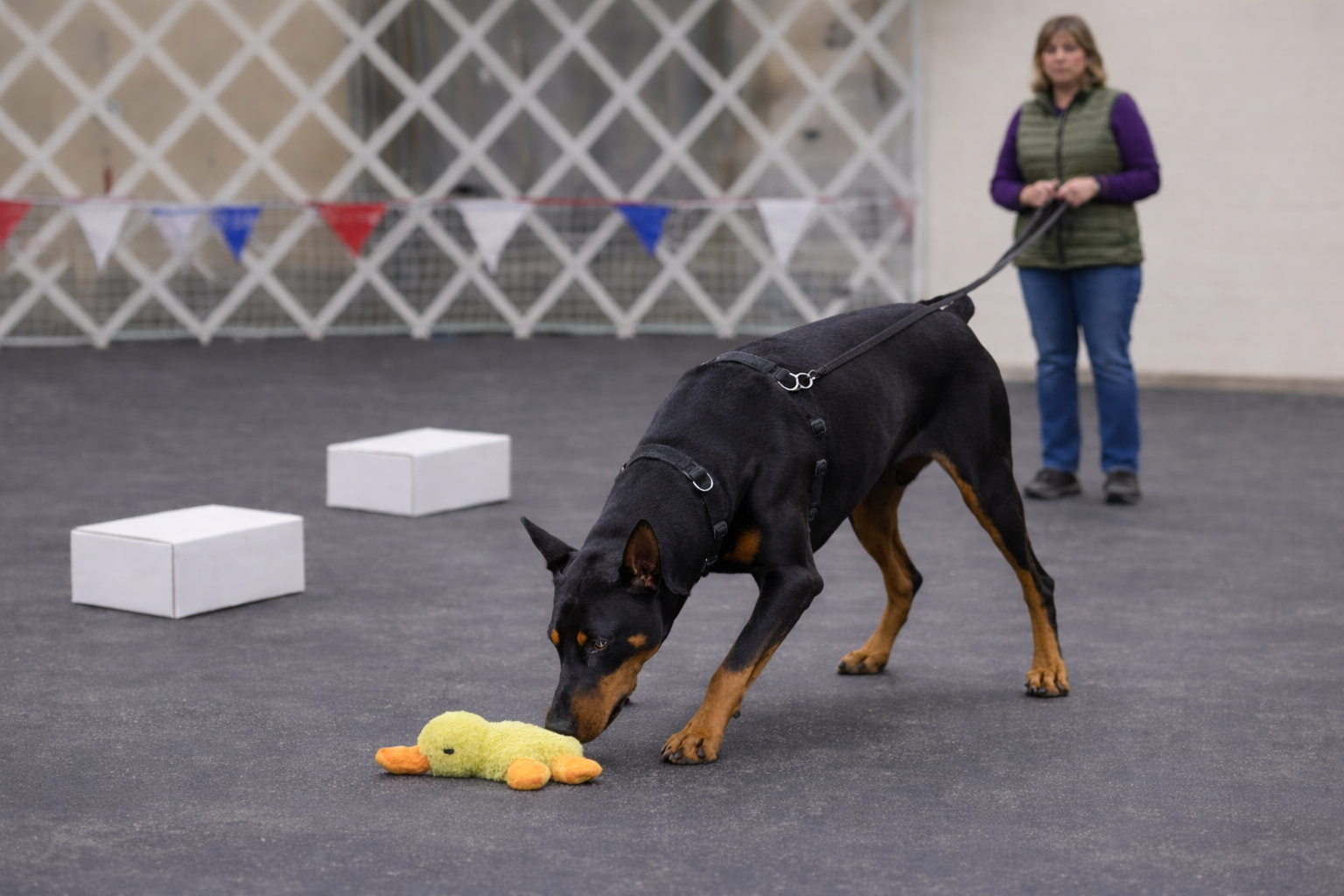
You see your dog heading toward a distractor. You tense up. You preemptively pull them off before they can get over there. Why? Because it's a distraction. We are here to find odor. We are not here to play with the stuffed duck.
I get it. I've been there. But after doing this for a while, I have a different philosophy.
The Comment That Got Me Thinking
After a buried element search with my youngest dog, Keeva, a fellow competitor — one who was also apprenticing to become a judge — walked over after the search and said, "Good job letting her sniff that distractor." We chatted for a bit. I probably mentioned that I've learned distractors sometimes have useful odor information. Then he said something that stuck with me: a lot of people pull their dogs off distractors, but his dogs get to sniff whatever they want.
I was already letting my dogs sniff distractors before this happened, but the way he said it made a lot of sense to me. They should get to sniff whatever they want. Our dogs don't know that the object was intentionally placed there by a judge for a game that we invented. To them, it's just another thing in the room. Sure, maybe a more interesting thing than some of the other things, but still just a thing. A ball. A dog dish. A squeaky toy. So when he heads over to check it out, he's doing exactly what he does with everything else in the search area. He's being a dog.
And that's what I want. I want my dog to feel free to sniff whatever he wants in the search area. All of it. Because that freedom is what makes a confident searcher. Plus, that thing he's sniffing? It might actually matter.
Your Dog Might Not Even Be Distracted
I think about something Aleks Woodroofe said on the podcast: "Assume that the dog is working more often than assume that they are distracted." When we default to that assumption as they trot toward a distractor, we can start to trust that they might know something we don't.
I've watched it happen in containers. A dog will make a beeline straight to the distractor in the middle of the circle, work it, and then drag their handler right to the hide. I'm pretty sure the handler had no idea; they probably thought their dog was just heading to the distractor because it was a distractor. But that dog knew exactly what they were doing.
I've seen many scenarios like this where a distractor is positioned near a hide, or in a way that puts a dog on a useful odor line. A dog investigating that distractor might not be fooling around; they might be working a hide. Pulling them off might be pulling off the information they need to solve the puzzle.
Here's Another Reason to Let Your Dog Sniff the Distractor
Some judges use distractors for more than to distract your dog. Sometimes judges use them to guide teams into areas they want covered or to position them near hides to get them to the right neighborhood. And sometimes they're used to steer teams away from areas where odor is pooling in ways that aren't appropriate for the level.
Your dog sniffing that distractor might be responding to intentional information built into the search design. Letting them work it isn't a mistake. It might be exactly right.
What Can Happen When You Pull Your Dog Off a Distractor
Keeping your dog from a distractor with useful information is one thing. But there's another cost that's harder to measure. I watched a search with a dog that was exceptional at following odor. They were working so beautifully, showing the edges of plumes, reading what odor was doing in the room. Their nose led them toward a distractor. I knew the distraction had a line to source on it because I'd watched previous dogs use it to find the hide. But their handler corrected them off it about a foot away.
What happened next was hard to watch. The dog shut down. For the rest of the search, they wouldn't work. They just fell into a heel with their handler. After, the handler commented, "I don't know, she just doesn't seem to be into it."
I'm positive the handler didn't mean to do what they did. They saw their dog heading toward a distractor and did what a lot of us do. But there was a miscommunication that changed everything. The dog was working. The handler interrupted. And the message the dog took from that might have been that what you were doing was wrong. Or simply, we're done. It wasn't what the handler intended. But it's what happened.
Be Fair to Yourself and Your Dog
For some teams, certain distractors genuinely can cause problems. If your Doberman has a notorious relationship with tennis balls, I understand the anxiety. But give them a chance before you intervene. Let them actually show you they're going to grab it before you assume they will.
The rules are more forgiving than you might think. If your dog sniffs a distractor and returns to work within about five seconds on a verbal cue, no penalty. Even if they pick it up and you have to ask them to drop it, still no fault. The worst realistic outcome is a fault, and in my experience, judges tend to be understanding. Excusal is reserved for a dog that has completely checked out and cannot be brought back. I have never seen that happen.
Sometimes it's Useful, Sometimes it's a Day-Old Chicken Nugget
Look, I'm not going to pretend every distractor sniff is a profound moment. Sometimes Murphy locks onto something twenty feet away, changes direction, slows down, and I think, "he's got something." Then, we turn the corner, and now he's sourcing a Tupperware with a day-old chicken nugget in it. Frustrating? A little. Funny? Also yes. But he dismissed it and got back to work. That's all I can ask.
Your dog doesn't know it's a distractor. They're just doing what you brought them there to do. And they're gonna check out things that interest them. So when your dog heads toward that stuffed duck, take a breath. Let them work it. It might lead them straight to the hide. Or, it might be nothing, and they get back to work after a couple of seconds of checking it out. And sometimes it leads to a well needed laugh.
That's why I'll always let my dog sniff distractors.
Best Video Camera for Recording Scent Work