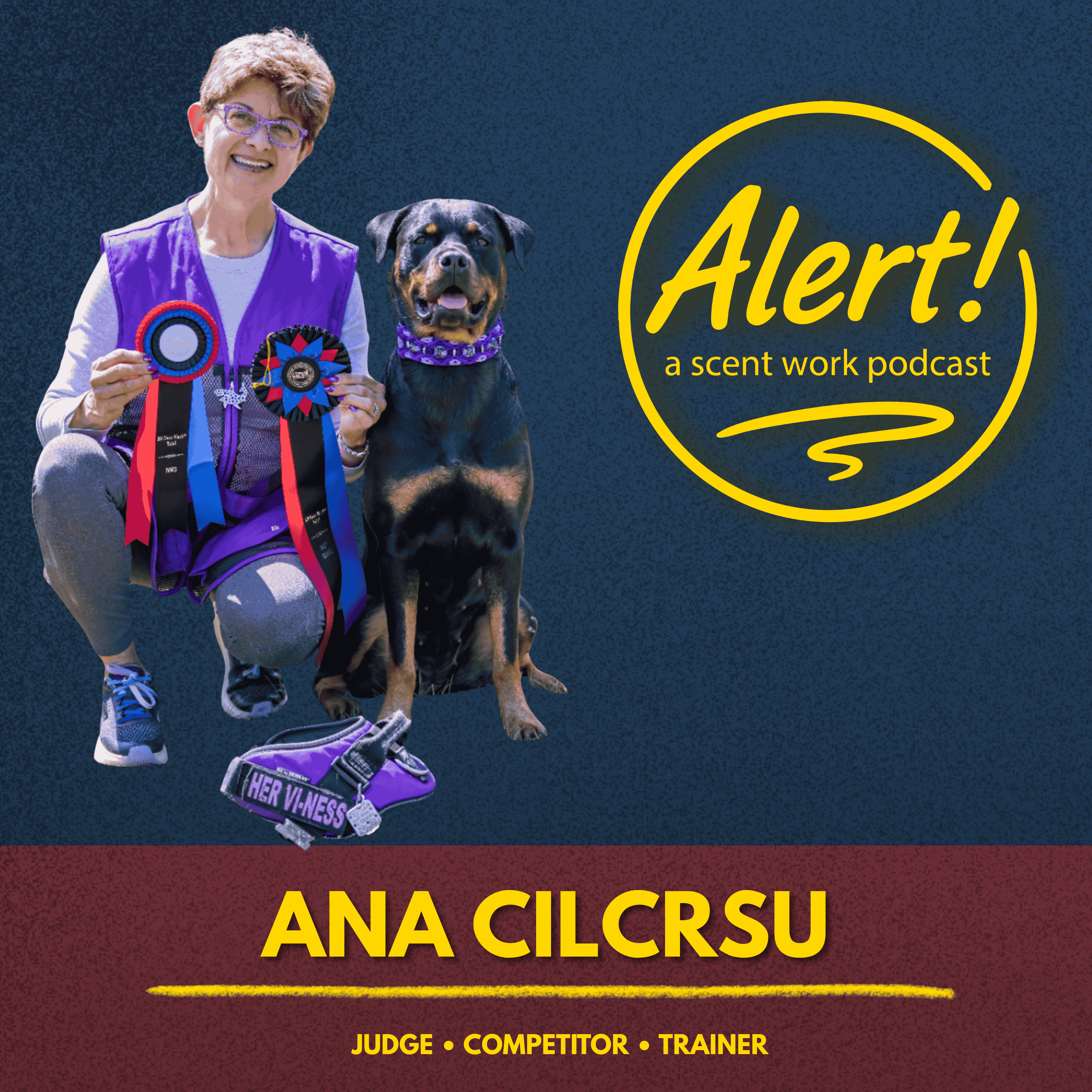


Many competitors have seen Ana's AKC trial debrief videos — breaking down hide placement, odor movement, and what teams were experiencing in the search area. In this episode, the judge, trainer, and competitor talks about the lessons she has learned from years of watching teams search.
Before scent work, Ana had a career in medicine and medical education. She views judging as education — through the hides she sets, the briefings she gives, and the debriefs she shares publicly after every trial. In my observation, that medical background shows up in how she approaches the sport — doctors are always learning, digesting new material, and teaching it to others at the same time. You can see that in how deeply Ana understands odor theory and how dogs work.
And if you've ever wondered what the dogs would say about us in the parking lot after a trial — Ana has some thoughts on that too.
What we talk about:
- Ana's origin story — this is a familiar story about how scent work wasn't even the thing until it was the thing
- The recurring themes she sees across her debriefs — what handlers consistently struggle with and what the best teams do differently
- Close proximity hides and convergence — why handlers miss them and what to do about it
- Why handlers over-handle under pressure — and what the dog thinks about it
- The twenty-plus picnic table search — what Ana was testing and why competitors over-focused on the objects instead of the odor
- How dogs perceive a search area versus how handlers perceive it — and why that difference matters
- Ana's distractor philosophy — why she uses food distractors, what she tests with them, and why gummy bears tripped up more dogs than bacon
- Why the boundaries define where hides are placed but not where odor goes — and how to help your dog collect information outside the search area
- Retiring Axel from competition — and why making that call was the right thing for their team
- Seven questions with Ana — what she loves to see teams celebrate, her signature distractor, the best compliment she ever received, and what Axel and VI would say about her as a handler
Find Ana: YouTube: Ana Cilursu for her AKC trial debrief videos:
Training: Rots-n-Nots Nosework
Staten Island Companion Dog Training Club — nose work instructor
Alert! Scent Work is a podcast for competitors — the parking lot conversations you'd never get to have at a trial, with the judges and community members you wish you had more time with.
Listen to the podcast and find everything here:
https://www.AlertScentWork.com
Follow along: Facebook: https://www.facebook.com/AlertScentWork
Subscribe to the newsletter: https://www.alertscentwork.com/newsletter/ #ScentWork
I remember when I first saw your AKC debriefs. When I watched them, I was like, this is how it's done. It was like I was there — you would tell me where the hides were, you would tell me how odor was moving, you would tell me how the dogs worked it. For the most part, you told me the problems that competitors might have had, and you were done. In under three or four minutes. It was perfect.
Ana:Thank you. Yeah, it's a nice summary, and it gives people an option in terms of the different levels, what other judges are setting. But it's also a brief glimpse into how odor behaves. And for people that actually ran the search, they might remember parts of the search and how they ran it based on my comments. And if they have video of their searches, they can go back and watch their video and then compare how their dogs worked to what I describe in the debrief.
Scot:And that's perfect. When I saw them, it was an early point in my scent work career where you introduced me to some cool concepts. It wasn't lecture or teaching, but I didn't realize — oh, this is how odor's moving. That wasn't something that had even dawned on me. So I'm like, oh, I want to learn more about that. I love that.
Ana:That's great.
Scot:And then there's your diamond tip pointer, which is your trademark. I don't know if you know that or not.
Ana:Yes. Blue or purple. Those are my colors, because those are the dog's colors. Some days I'm blue, some days I'm purple.
Scot:And I think you might have the best nails in scent work judging too. You have just perfect nails and great manicures.
Ana:Thanks. That's the extent of the bling you're going to see — my pen, my nails, and my glasses. My glasses always have some kind of weird frame. Just to be a little different.
Scot:All right, let's do the intro and then get into this conversation. This is Alert Scent Work. I'm Scot, Murphy and Keeva's dad. And with me today is Ana Cilurso, who is mom to Axel and Vi.
Ana:Vi.
Ana:It's Vi. Short for Violet, which she is not.
Scot:She's not a shrinking violet.
Ana:She is definitely not a shrinking violet.
Scot:And from New Jersey. I'm really excited to have you on because your debriefs earned my respect. I just thought they were so good. And it's a great opportunity — I have not had a guest on my podcast yet that's been outside of my little western bubble here around Utah, Idaho, Nevada, California. So I'm really excited to hear how things are done over there.
Ana:Thank you for having me. I'm very proud to be the person to kick off your East Coast tour.
Scot:All right, so I want to know — in your debriefs, you sometimes say things like, a lot of dogs struggled here, or handlers tend to overthink this part. Out of all the debriefs you've done, are there some recurring themes that you tend to see over and over again in either dogs or handlers that we could learn from so we could handle better or train better?
Ana:It depends on the level. In the lower levels, sometimes what I see is that handlers may not recognize the behaviors their dogs are offering, or they may second guess themselves in terms of what they're seeing, and that can create a challenge. Every search in every element is based on the skill sets for those levels. So if I'm setting a detective search, for example, I have a set of skills that I anticipate the exhibitors and the dogs will be able to process. And sometimes some of those skill sets, they come up a little short in terms of how the handler solved the puzzle. A good example at the higher levels are the close proximity hides. Because of the amount of odor that we use, we get a lot of convergence. We get dogs picking up one scent cone and then getting hijacked over to another scent cone. And sometimes the handlers make an assumption that all of that behavior was from one hide, and they don't process the possibility of another hide being that close. Some of it is because maybe the dogs haven't had an opportunity to practice that in training. Similar to that would be a double threshold, which I set in master. Sometimes dogs and handlers struggle with inaccessible hides, especially if the dogs are used to giving a specific response when they are at the hide. And if the teams don't have a lot of experience working the inaccessible hide, that can be a challenge too. But again, these are all things that are presented to the teams based on the level they are entered in. If I have an excellent search to set up, part of those skill sets includes elevated hides up to four feet, and it can include an inaccessible hide. I think teams should be prepared when they go into a different level of competition — they should start looking at what those differences are. What makes an excellent level search different from an advanced search? What makes a master search different from an excellent search? That's the way I think about it when I set my hides and look at the search area.
Scot:That's perfect. And just for listeners that don't know this, this is outlined in the judges guidelines which is available to anybody. I highly recommend that you read it because it outlines very clearly — novice, advanced, excellent, master, and detective — what's being tested, what's going to be required of the dog at that level. And then you get a judge like Ana who's going to test you on that. So that's a great resource if you haven't checked it out. I want to go back to the idea of two hides close together. I'm glad you brought that up because that's something I just finally started thinking I need to tackle. We find one hide and get so excited to move off to the next one. In advanced, the hides were never close to each other. In excellent, they're rarely close. But in detective, they can be really close. Something I've found useful — I'm still working on getting my dog to start searching from that area again after I reward from a close hide, but that's not always reliable. So if I've found a hide in one area, I hang out there a little longer, give the dog a chance to work. If we find another one, we hang out even longer in case it's a triangle and there are three around. Are there other strategies you've seen that help people solve that particular puzzle?
Ana:I think one of the things is to give the dog some space when working those hides. If you have hides behaving like close proximity hides — either because of a lot of convergence or because of the way the hides are set — you'll see the dog almost do a double take or start to waffle when they get stuck in the middle of those two scent cones. Sometimes handlers make an assumption as to which direction the dog is going to go, and that may not be where the dog is headed, but the dog defers to the handler. A lot of times that has something to do with how close the handler is. Some dogs, if you're too close, you put pressure on them and they may actually move away. For those types of hides, it's a combination of practicing, having the experience to allow the dog to work in close proximity to a found hide, and seeing whether the dog is going to give you odor behavior or respond to what's left of that scent cone. The dog finds a hide, and then if you present that same area, the dog goes — yeah, this is all from that hide, we're moving on — as opposed to — wait a minute, there's another hide here. Sometimes those behaviors get missed for various reasons. There's a lot of pressure in detective, you have a larger area to cover, there's a time constraint. Some people feel they need to work through a space and move on. So I think giving the dog space, entertaining the possibility that the dog's response to odor could be from a second scent cone, and then helping the dog finish that puzzle or accepting that the dog may want to leave the area if there's nothing left there. Because the reverse is also true — sometimes I see handlers keep the dog in a space for a long time because they see odor seeking behavior and interpret it as odor behavior from a hide. It's knowing when to fish and when to cut bait, so to speak.
Scot:I also love that you said sometimes handlers work a little too close. I think we're all guilty of that. I try to work further away from my dog, and then I see video and I'm like, you're still not working further away from your dog. Working at a distance allows you to do a couple of things — it allows you to observe your dog a little better, so you can see those subtle double steps or a dog making a decision, which could indicate there might be two hides being decided between. And it gives them room to work the plume without you in the way.
Ana:Correct.
Scot:Are there other handler things you see consistently that you think if we got a handle on, we'd all be a little bit better?
Ana:Sometimes you get the sense that the handler isn't trusting what the dog is telling them — they second guess things. I think that's just a lack of experience in reading subtleties in dog behavior. From where I'm standing, on the outside of those cones, not holding the leash, I can see the dog's attempt to communicate and the handler's inability to interpret that communication at that moment. And that sometimes creates hiccups. Then you see the handler start to over handle — the leash starts to get looped in their hands, the tone of their voice changes, they start talking. Search here, search here. Show me. Are you sure? A lot of that is just nerves. The handlers feel the time pressure and the performance pressure. I get it. Anyone who competes knows what that's like when you've got people watching you. So handlers tend to over handle when they get stressed. And then you can see the dog go — who are you, and what did you do with my mom? This is not how we normally do things. But I sympathize and I'm very empathetic because I know exactly how that feels. Those of us that compete and then are given the privilege of watching other people — I hate to say judging because I'm not really judging in the strictest sense of the word. I'm evaluating a performance based on predetermined criteria of which I was not a part. So I'm not really judging. Inside, I'm cheering everybody on. I find myself silently saying call, finish, call, finish — or go back, go back, go back. I'm sending telepathic messages without even meaning to, because I can see what the handlers are struggling with. And I can see when everything goes really well. There are always going to be hiccups.
Scot:I love what you just said. I'm going to take that to my own competing — just trying to be aware when I'm starting to get stressed out and whether I'm doing things that could impact my teammate. And it's so funny because I hear so many people in the parking lot going, oh, my dog just wasn't himself today, was doing weird things. Like, the dog's thinking the same thing of you sometimes.
Ana:I totally think so. I think if the dogs had a chance to hang out in the parking lot, the things they would say would be pretty surprising. That would be a pretty good cartoon. Somebody should do that.
Scot:It would. Can you, off the top of your head, think of a couple things those dogs might be talking about?
Ana:I told her where it was two minutes ago. If she wasn't in my way, I would have been able to get to the hide. If she had just moved. And then she stood right in front of it.
Scot:All right, I want to jump into your scent work origin story, because I find these fascinating. How did scent work first find you?
Ana:I got involved with scent work in 2015. At the time, my dog Zoe was very actively involved in obedience, rally, herding, and barn hunt, and she suffered a cruciate tear. I went through the whole woe is me — there goes our career, there goes our performance work. How am I going to keep this dog quiet in a cage for eight weeks while she recovers from TPLO surgery? Through conversations on Facebook, someone said, why don't you try nosework? It'll give her something to do and it'll be good mentally. And it'll probably help you too, from the two of you going crazy, not being able to do anything. We were constantly on the go — constantly going places, doing things, training, competing. We were doing really well in herding, which is something I had never done before. So that's how I got started. I took an online course with Fenzi Dog Sports Academy. Stacy Barnett was teaching an Intro to Nosework, and we never looked back. Since Zoe was still recovering from surgery, she took to it like she was born to do it, and I had no clue what I was doing. So we learned a lot together. I've been doing it ever since, and it just took over.
Scot:This is a very familiar story — somebody was doing some other dog sport, dog gets hurt, they find scent work and become obsessed with it. Which you kind of are, because not only do you compete, you judge, and you also train dogs. So what sucked you all the way in? You're in deep.
Ana:Very, very deep. Part of it was developing a passion for learning how to communicate with a dog who's doing something that comes naturally, but also learning all the nuances that go into the sport. Teaching a dog to find birch is just one piece of it. I was fascinated by the changes in behavior, the subtleties, how arousal impacts the dog's ability to perform, how arousal impacts my ability as a handler to perform. I really became enthralled with the more complicated scent puzzles and how to teach scent theory to a dog — how to present the dog with puzzles and hide placements that would impact their learning and help them grow as individuals in the sport. And then taking that and transferring based on what I knew, based on the philosophy of my training. I started watching other people, watching other videos. When I started the training assistant program through Fenzi Online, I worked very closely with Stacy Barnett. I'm her teaching assistant for her Facebook study groups. I've been watching hundreds of videos since 2018.
Scot:What an awesome learning experience for you too.
Ana:An incredibly awesome learning experience. And then when scent work started, I started to volunteer before I even started to compete. Volunteering is a great way to learn every aspect of a trial. Even if you don't get to watch everything, you still learn a lot. I started to see some recurring themes in how handlers worked and began thinking about that in a little bit more detail. Are there people training with the same philosophy? You tend to see that over time if you watch enough. I became fascinated with it, was helping people with their videos online, and then decided — I really want to become a judge.
Scot:What did you want to get out of judging?
Ana:The judging is the educational piece, which is huge for me. I come from an academic background. I taught for many, many years. As a judge, I have the opportunity to educate people about scent work — through the hides I set, through my briefings, through my support of the exhibitors, through talking to the volunteers and taking time to explain things to them. As judges, we're educators. We're really educating the public about this sport because we encourage people to come watch. We're educating the handlers, and indirectly we're educating the dogs because we're setting puzzles for them to solve together with their handlers. The academic piece in me and the opportunity to watch so many people and so many videos made me want to become a judge.
Scot:That's very cool.
Ana:And that's how it all happened.
Scot:I want to talk about your judging philosophy and search design. I was watching some of your debrief videos last night, and I'm very fortunate — you've got a lot of material out there. There was one where, I don't know if you remember this, the twenty plus picnic table search. There were like twenty picnic tables, and the hide wasn't on any of them. There was a single hide and not one on a table.
Ana:Was that in the rain? Yes, that was in the rain. That was Salisbury — the Salisbury Kennel Club in Maryland.
Scot:It might have been one of your first debriefs. What was your thought process? What were you trying to do?
Ana:Here's the education piece. A lot of times handlers come in with preconceived notions — we all do as competitors. If you see a classroom full of desks, or a pavilion full of picnic tables, or an auditorium full of seating, the natural fear is, oh my God, how am I going to check all those tables? And people may assume — there are thirty picnic tables, there has to be a hide on one of them. Part of the challenge at that level is to allow the dog to work odor, to give the dog the freedom to move around, to recognize when the dog is working odor and when they're clearing space because there's nothing there. And to realize the hide could be anywhere. Not necessarily on a table. We actually had a pretty good Q rate that day. But what you're testing at that level is — can the handler free themselves from preconceived notions? And not over handle because they've become hyper focused on objects. As handlers, we tend to become focused on objects. People come into a room and while I'm describing in my briefing how the door is going to open, there's sun coming through the windows, there's a high ceiling, there's the HVAC — all these things that are going to heavily impact how you search that room — in the background I can hear, oh my God, there's so many desks, look at all the stuffed animals. I'm trying to create an environment. And this is where the debriefs are very helpful — when I do my debrief, I talk about the sun coming through the window, the HVAC, how the door opening and closing impacted how odor moved. I'm not hyper focused on the objects. But a lot of competitors are. Dogs don't necessarily search that way. Most of the time the dogs are working air and working space. And the lesson from that picnic table search was — don't worry so much about the objects. Watch your dog. Let your dog take you into odor. Your dog will tell you where the hides are.
Scot:There is so much to unpack from that story. The first thing is that in that particular instance, the hide was pretty close to the start — not towards the back of the search area. And you also identified how airflow was moving. This story illustrates how we see all the things — oh, there's so many things to search — as opposed to asking what might impact odor, what might impact what my dog is perceiving, which isn't with their eyes, it's with their nose. The HVAC system, for example — everybody is focused on the desks but not paying attention to what airflow is doing in that room. It took me a long time to start learning that, and I still make those mistakes.
Ana:I think we all do. As a judge, I'm always thinking about airflow. I test the airflow — I have my little cirrus wind indicator, and I'm checking where the airflow is at six inches, eight inches, twelve inches off the ground, at my height. How is it changing? Because that impacts how we set hides, and it impacts how the dogs are going to perceive odor movement. Outdoors it's a lot less predictable. Indoors you have a little more stability as long as the HVAC doesn't kick in halfway through your search. It's all part of understanding the dog's world — how they perceive things on air currents. I can't tell you how many times I've seen a dog stop, lift their head, cast their head. Just collecting information in the air. And sometimes the handlers recognize it, and sometimes the handlers are like, let's go, let's keep searching. And the dogs — that's where one of those little cartoons would be — will you just give me a second? I'm collecting information here.
Scot:That's right. I'm trying to solve this mystery. I need to gather some clues. Just give me a tick.
Ana:And the other thing I tend to see more in the lower levels — people who are still learning and in the early phases of their journeys — is that they tend to be very worried about the dog going out of bounds. Some people seem to perceive the boundary as some invisible wall they're not going to be able to cross. I can't tell you how many times the dog has gone ten or fifteen feet out of bounds to collect information. It happens — the dogs do it all the time. I find myself reminding newer competitors — the boundaries are there to define the search area, and there is no hide outside of those boundaries. But you can come and go as you please.
Scot:Yes.
Ana:And you'd be surprised — some of the more novice people, especially if they've not competed in other venues, are actually afraid to cross over the cone.
Scot:Because they're afraid Ana's going to come and bop them on the nose with her diamond tip pointer.
Ana:Some people are just concerned they might be making a mistake.
Scot:Yeah, you're right.
Ana:I try to tell them in the briefing — the boundaries are there, there's no hide on the other side of those yellow cones. I promise you, there's no hide over there. That doesn't mean there's no odor over there — it just means there's no hide. If your dog wants to go over there, you can come and go without any penalty. Some people think they're going to get a fault if they cross over the boundary. As an instructor and coach, my job is to make sure my students understand the variability of a search area, that they're comfortable going out of bounds, and not pulling their dog back. Give the dog a few seconds. Let the dog tell you why they crossed over that line. Are they going out there because they're working odor, or because somebody left half a cheese sandwich nearby? You need to be able to know the difference. As a competitor, I've had judges tell me I'm out of bounds. And I just say thank you. I tell my students — if a judge tells you you're out of bounds, just say thank you.
Scot:Right.
Ana:I think judges want to be helpful. We all want to see everyone succeed. We may say you're out of bounds — maybe they didn't realize it, maybe they didn't hear it in the briefing, maybe they didn't see the cone. Judges are doing it because they want to be helpful. So just say thank you and keep searching.
Scot:That's great advice. The thing that really resonates with me from this whole section is that humans see with our eyes. We see cones and barriers and lots of objects in a room. That's not how the dog perceives the world at all. We need to start trying to picture how the dog perceives the world so we can better understand what they're doing and why. Odor goes everywhere. I remember one search — just a cluttered, cluttered space — and I'm like, oh my gosh, how am I going to navigate this? And my dog did it no problem, because odor was readily available and he could go right to it. The objects didn't make a bit of difference to him. That was really a turning point for me in understanding how he sees it and how I see it are two different things. I want to talk to you about distractors. Another thing I learned is you use a lot of food distractors — cranberry trail mix, Lucky Charms, chicken jerky. You even had a Kong taped under a chair one time. That's a little different than what I've seen, because sometimes I talk to judges who are like, I hate distractors. But you don't. You seem to have a very distinct distractor philosophy. What is that philosophy?
Ana:The distractors I use — primarily food in my container searches — are there because one of the things I'm testing at that level is the dog's ability to discriminate between non-target odor and target odor. And does the handler recognize the difference, and has the team trained for it? I train with a ton of distractors with my dogs in containers. Every time I do a container search, there's something in a container. Sometimes there's something in every container. And I do the same thing with my students — even at the novice level, when there's technically no distractor in a container, every one of my containers has something in it. Not food, not a toy, but things like an open tube of toothpaste, a sponge, a Brillo pad, a fabric softener sheet. I just toss things in containers because I want the dogs to learn how to discriminate between non-target odor and target odor. And I want the handlers to see what that looks like. They always know in training where the distractors are, because I don't want them to make a mistake — I want them to be able to learn. I like using food primarily for that same reason. I'll tape it under a chair or put it in a drawer. The Kong was a little Chihuahua-sized Kong, but there it was under the chair. I usually bring distractors with me — the cereal, the peanuts, the Chex mix, the trail mix. I have containers specifically designed for them. And sometimes it's just what I can grab for breakfast or leftover lunch. I'll see a pizza crust and think, can I have a little piece of that? I use little screw-on lid tins that have holes in them.
Scot:Out of those distractors, were there any that you threw out there thinking this is just like anything else, but it really tripped up the dogs? I was at one trial and everybody was talking about the walnuts a judge put in a container. So many dogs hit on the walnuts. If you'd have asked me, I'd have said chicken jerky maybe, walnuts probably not. Have you ever discovered anything like that — something that trips people up that you didn't expect would?
Ana:I didn't expect the fruit gummies — the little bears. I had those, and I also had applewood smoked bacon and popcorn. If you had asked me, I would have said the bacon and the popcorn are going to take everybody out. It was the gummies.
Scot:That's so funny. Why do you think that is? Any educated guesses?
Ana:I think it was the novelty. The dogs have smelled bacon, the dogs have eaten popcorn. I don't know too many dogs that get gummy bears. The novelty just threw the dogs for a loop — wow, this is really interesting. And some of the handlers interpreted that as target odor. Most people thought the popcorn and the bacon would be more interesting. And the dogs were like, yeah, popcorn — but these gummies smell really good.
Scot:As we start to wrap up, I want to talk to you as a competitor. Bring me up to speed. Is Axel still competing? I was reading about quite a few detective Qs. Have you gotten your title with Axel?
Ana:No. Axel is retired. We had one detective leg and we finished our NACSW Elite One. Axel tends to get anxious sometimes — he has some arousal issues, and that was hindering our performance as a team. I was finding that I was micromanaging, and I started to see that he wasn't having fun the way he did in the past. So I made the decision to retire him from competition. I've used him several times as my demo dog, which he absolutely loves. The more people to fuss over him, the better. He's extremely happy when he trains. There's no pressure on him, there's no pressure on me. We did enter quite a few detective trials and came close in several of them, totally bombed out in a couple of others — which is fine. We got a leg, and I was very happy with the leg. And then it became clear that it just wasn't the same amount of fun. He enjoys being with me, but I think he enjoys much more being able to search when he wants, sleep in when he wants. When he's up to training, we train. But it was the right decision for us. It's not an easy decision to make when you realize the best thing for your team is to just play and not trial. And it was the right decision for us.
Scot:I'm feeling a lot of empathy right now, because that would be a hard decision. Obviously you love the game, and at one point Axel loved the game. It can be really easy to just soldier on through. That's amazing that you made that call.
Ana:We ended our career on a high note — we ended with our Elite One. It was important for us as a team to finish what we started. But it also became very clear that we ended it at the right time.
Ana:And now all my competitive energy is on Vi.
Scot:Where's Vi at right now?
Ana:She's like — let's go. Are we going training? What are we doing? How many hides did you put out? Come on. Did you only put out four hides? Really? Come on, Mom. What do you mean there's only two hides? Let's go. What are we waiting for?
Scot:Do we need more odor? Are we out of odor? What's going on? Let me help you.
Ana:I absolutely love her energy. She is so much fun. She's really a great dog to play with. I really have a lot of fun with her.
Scot:This has been such a fun conversation and I have so many other questions. Maybe we can do a round two sometime. Are you up for a round two?
Ana:I would love to. There's so much I'd love to continue talking about.
Scot:I want to learn more about you as a competitor — what's your mental checklist before you release your dog at the start line? And I'm highly intrigued that you run Rottweilers. You don't see a lot of Rotties doing scent work, and I'm really curious what they're like as scent dogs. Do they have any quirks you have to work around? But we'll have to save that for another day. Does that sound good?
Ana:That sounds great. I would love to continue the conversation.
Scot:All right, we're going to wrap up this episode with something called Seven Questions. It's a quick fire round. Are you ready for this?
Ana:As Vi would say — yeah, yeah, yeah, sign me up. Let's go. What are we waiting for?
Scot:That's more like it. All right, Seven Questions. Number one — when you're judging, beyond seeing teams get the qualification, you love it when...
Ana:They celebrate the actual moments together. Not always when they succeed, but when they still celebrate the moment that they share. That means a lot to me.
Scot:What does that look like to you as a judge when you see them celebrating the moment?
Ana:I see the tenderness in the handler. I see the unspoken relationship — you don't have to hear them say anything. Sometimes they just look at each other, or the handler reaches out and pets the dog, or the dog leans in. It's just a moment of their relationship that really overpowers anything technical that they may have done or may not have done. That says everything about nosework right there. It's that snapshot of the relationship. That's beautiful.
Scot:What's your dog's favorite reward after a great search? Get specific.
Ana:For Axel, it is without a doubt his ball. His ball is linked to the word "finish." He will work until I say finish, and the minute I say it, he wants the ball. That is the most powerful reinforcer for him. For Vi, it's food. It doesn't matter what it is, as long as there's plenty of it. At the end of the search, she knows when she gets back to the car she's going to get her treats — salmon and rice, cooked turkey, steak, something like that. She knows she has to wait for the gear to come off. She jumps in her crate, and then she gets her jackpot.
Scot:What's one thing you wish more competitors understood about being a judge?
Ana:That we are sincerely rooting for them. Everything we do, we do with them in mind.
Scot:Do you have a signature distractor — one that just always goes with you and people know, that's Ana's distractor right there?
Ana:My applewood smoked bacon. Always have it with me.
Scot:What's a scent work rule that if competitors kept in mind when they were searching, would instantly help them? Something out of the rule book — what's one rule that could really make a difference?
Ana:Breathe. You have to breathe. You can hold your breath for three minutes, but you don't have to.
Scot:What's a piece of advice that really stuck with you in your own journey?
Ana:Breathe. Honestly, that was probably the most important thing. Someone was watching a video of mine and critiquing it. I was all about the technical stuff — what did I miss, what should I have done. And the first thing the person reviewing the video said to me was, did you know you're not breathing?
Scot:And dogs know that. That's that instance where they're like, what is wrong with you? Who are you?
Ana:Breathe. Take that breath.
Scot:What's the best compliment you've ever gotten at a trial — as a judge or as a competitor?
Ana:That I made a difference. I had a competitor come up to me at a trial. She didn't expand on it. She just said, I just want you to know that you have made a huge difference in my life. And that just floored me. She gave me a hug and that was it. That meant the world to me.
Scot:If Axel or Vi could talk, what would they say about you as a handler?
Ana:Axel would say thank you, I think, for just letting him play the game. We had a lot of fun — thank you for making it a game. Vi would say — you're doing well, you're doing better. You still have some catching up to do, but I'll wait for you.
Scot:Last question — who is another judge I should have on this podcast so they can have as much fun as you had?
Ana:There are several people I have incredible respect for and I know competitors do too. One is Lori Kobayashi. She's amazing, extremely popular with competitors. I love showing under her. She just brings this great energy. There's also Michele Gray, who is so kind to the competitors and so supportive. I've competed under her, and just everyone she comes in contact with automatically relaxes and feels really good in her company. As a judge, that's such a huge positive. Those would be two people who would do your podcast a great service on the East Coast.
Scot:I love it. And you're so right — the judge is responsible for so many things. Setting the hides, figuring out the puzzles, making sure all the rules are met. But also, more importantly, creating an environment where the competitor and the dog can thrive. Things like kindness and other soft skills — we can forget about those. I love that you said that.
Ana:That's true.
Scot:Someday I hope to make it out there and run under you. Maybe I can get you out to Salt Lake to judge. Would you ever travel?
Ana:It would be my pleasure. I haven't had the opportunity yet, but I'm certainly open to it. I love to travel.
Scot:All right, let's wrap this up. You post your AKC scent work debriefs to your YouTube channel under your name. You also share those on the AKC Judges Debriefs group on Facebook. You're connected with Staten Island Companion Dog Training Club.
Ana:Yes, I'm their nosework instructor.
Scot:And your training business — you also do virtual work — is Rotts-n-Notts Nosework. You can find that at rotts-n-notts nosework.com or Facebook at Rotts-n-Notts. Is there any place I left out?
Ana:No, that's a great way for people to reach me. We're doing a lot this year — trialing, I'm hosting trials for NACSW, and my judging assignments, seminars, and workshops are all posted on my website so people can see those.
Scot:I knew this was going to be a great conversation just because I had a chance to sample what you do in your debriefs, and it exceeded my expectations. Ana, thank you so much for sharing your insight and everything you bring to the sport.
Ana:It was absolutely my pleasure.
Scot:If you like this episode, share it with a friend — I don't know who wouldn't like Ana. You can also subscribe and follow wherever you podcast, or check out our Facebook page, Alert Scent Work. Thank you very much for listening. And next time you go out there, just remember — it's about the experience with your dog, like Ana said. Ana, it was so much fun. I hope you have a great night.
Ana:Thank you. You as well. It was a wonderful experience.