Aleks Woodrofe | The Most Critical Handler Skill, The Value of Volunteering, and Setting Hides with Purpose
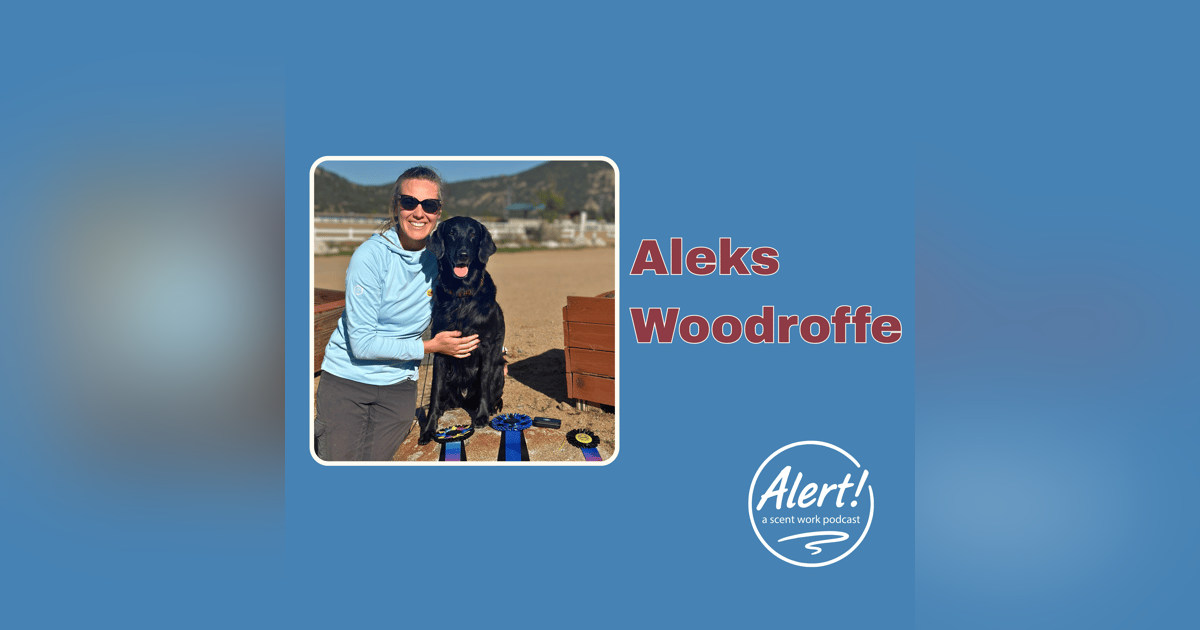


Scent work wasn’t part of the plan. It started with Sam, anxious in agility but able to find his place in nose work. Then Rosie, her flat coat, lit up the moment she started searching, and her joy made the game contagious. Finally, Tana, the dog who was supposed to do agility but didn’t love it, found her stride in scent work and pulled Aleks all the way in.
That was the start of an obsession with scent work. Competing, learning everything she could, teaching, and judging all followed.
Aleks shares what she believes is the single most important skill for scent work teams and why it changes everything. She talks about the difference between waiting for confirmation and watching for the odor picture, and how she sets searches with intention. From her “chair at every level” example to the master searches she plans in detail, nothing is just slapping hides out there.
Are you nervous at all? No. I'm gonna confess I am.
Aleks:You're doing good.
Scot:Actually, the first time I showed under you, I was nervous. I was intimidated.
Aleks:No, no.
Scot:I was because your knowledge about odor theory and being a great judge and a great competitor really preceded you.
Aleks:Aw, thanks.
Scot:So my name's Scot Singpiel. I'm Murphy's dad. I'm a scent work competitor, and today on Alert! A Scent Work Podcast is Aleks Woodroofe, Tana and Georges' mom. Is that right?
Aleks:Those are my two.
Scot:She's a scent work judge, competitor, and trainer, American Kennel Club (AKC), Australian Shepherd Club of America (ASCA), and National Association of Canine Scent Work (NACSW), president of the Copper State Scent Work Club. You can also hear her on the K9 Scent Fix Podcast, and she does so much more too. But I want to know. That first time I showed under you, I was nervous, and then I showed under you not too long ago. The first time it was an advanced run. The last time it was detective runs, and I was a lot more relaxed because I've come to learn how cool you are. You have this approachable, curious, passionate energy about scent work that is really inspiring. I do not feel any judginess at all, any of that sort of stuff. Plus you are engaged in it in so many ways. Where did your passion for this sport come from?
Aleks:Oh, isn't that a weird question?
Scot:How is that a weird question?
Aleks:I don't know. Why do we do the things we do, you know? So I don't think it's normally a linear passion for most people coming into this sport. I think it's because we don't have, or it is kind of a newer sport, any role models or examples other than maybe professional detection dogs, which I think before maybe five years ago really were not even on TV. You would just every once in a while see on Cops that there is a dog that shows up for a little bit and then it disappears.
So I think having - I grew up in Canada on a horse farm, so I grew up listening to my mom coach dressage-level horses and teams. That was in my head of what a relationship with animals was. They were always a teammate, and we were trying to get the best performance possible as a team. You cannot just tell them to do something.
When I moved down to Arizona, I did agility. I had a softer flat coat and a reactive dog. When my reactive dog showed up to be a little bit more anxious than possible to do agility very well, I started nose work. It was something to do because people told me I should. I started online because there was not really anything available here. Once in a while there was an in-person class in town, but that was it.
So I started online, and with Sam, she liked it. She was okay. She figured it out. We were learning together. But my flat coat at the time was like, "this is bomb. This is great. I love this." When I started seeing her having so much fun, it created more joy and enthusiasm for it for myself. I ended up getting her Odor Recognition Test (ORT) for both of them, and I did my NW1 with Rosie. Still no in-person teaching up here. There was one instructor that was giving classes every once in a while, and I never really was able to get over there because I was doing agility pretty much full time.
I got my NW1 and I thought, I could have done so much better in some of these classes. I started looking at what we did and where we ended up. I think I was eighth overall or something. I thought, I could do this. This is fun. I was just getting a puppy at the time, and that was Tana. Tana learned from day one. She was supposed to be my agility dog, but we very quickly slipped into nose work as being her sport, my sport.
She did not love agility. She was trained for agility. She did really well, but she did not love it. So we did something that really connected with her, and she dragged me along. I learned a ton. She learned a ton, and it gave me the confidence, because she was good at it, to go seek out information elsewhere, seminars and places like that, that I would not ever think about traveling to.
If you asked me when I was doing agility, would you travel to do dog sports, I would say no way. Why would I travel, spend money for a hotel? Then when I had a dog that was actually pretty good at the sport, I felt like I could go somewhere and feel like I achieved something and meet new friends and have that confidence. She just dragged me along. And whole new world. Holy crap, a whole new world.
Scot:Your story resonates with me. I was reflecting on my story. I started in 2023, and it started when I realized my dog needed some intellectual stimulation and I stumbled across scent work. He was just good at it, and it became very addicting and I did not want to let him down.
I do not ever want to say, "what if I would have learned more or worked at this harder." I think that is how I got sucked in. Then the community part that you talk about is another huge part for me. I love the friendly competition. I love talking about the theory with people, and I love hanging out with people. I think we have similar stories there as to why we are so passionate about it.
Aleks:The community is interesting for scent work, and I think it is a little bit different because we do not really watch each other compete. We can connect on such a different non-judgy level. I find a lot of other sports, you watch each other and then you feel like they do better and you feel envious or jealous. Those are emotions that we have. That can flavor how you interact with other people.
Versus when you do not really get to watch each other work, all you have is that relationship in the parking lot and the friends that we make and the conversations that you have because you happen to park next to somebody. I think it creates a different game. It creates a different kind of relationship within the community than some other sports. Which is good. I think it is not a bad thing. I think it is a very good thing.
Scot:I do watch a lot of other competitors. Early on, I am going to say something that makes me sound like a horrible person, but hopefully I will redeem myself by the end of my sentence. I was that judgy person. I would think, "they are not that good, or whatever."
As I started moving through this and getting more experience, one of the things I love about scent work is the fact that it is so broad and you can do it for the reasons you want to do it. When I started learning those stories of people in the parking lot: my dog was reactive and I could not take them out in public at all, and scent work provided my dog with confidence, and now we can come to these strange locations and they can perform well. That amazes me and it puts everybody into context.
We are all at a different point in our journey, and we all invest different amounts of time, and it means different things to us. That really got me over that judgy thing. Now I celebrate everybody that crosses that start line when it comes to competing.
You are very successful with your dog Tana. Your students also do well. I have seen some posts where they do well. I want to pull from some of your knowledge here. Do you have any advice? What is something that you could tell us that has helped both you and your students improve?
Aleks:A big one is learning to read the dog. When I do seminars, that is the number one topic that keeps getting asked. Can we add just read the dog, read the dog better? That is always the number one thing. It is true because the more that we can read the dog, meaning we can recognize changes of behavior that are associated with odor, the target odor we are trying to find, the easier it is to understand what is happening.
If you understand what is happening and you know that they are working, you are more likely to support them versus trying to take over. I think that is the number one thing, getting better at reading your dog.
So then how do you do that? Watching videos is a big one. Being able to piece it apart, know where the hides are, watch when the dog changes direction, speed, their head, and start associating and drawing that on a picture to try and figure out what that odor picture might look like and how your dog is communicating that to you. Then we can start becoming more honest with our handling, to be able to follow the direction and face the odor and to let them lead us to that location.
Scot:Reading your dog is so critically important. As a novice, that was not even something I realized had to happen. It was all about telling your dog to find it and then getting that final response.
A lot of us as beginners will belabor that final response because we cannot read our dog. We want them to tell us everything. I was talking to one of the guests on this podcast, Hallie McMullen, she is another judge, and she gave some great advice, which was, when you are a novice, start that process of watching and observing what your dog does, which can be really hard because you are nervous about being a novice, you are nervous about doing the search.
I thought, if I could go back and take that piece of advice, that would be pretty valuable. So you agree reading the dog is a crucial skill.
Aleks:If I can watch with the purpose of trying to understand odor pictures versus watching my dog for confirmation of where the hide is. The difference in that is, if I am really taking in the information, I am trying to see where they change direction. Can I put cones in those locations after they search one hide, and then where are they dropping, where are they speeding up, where are those beelines where they go straight into a source?
If I can start watching for those locations, I do not care about the hide, which is hard as a novice person to be told. The hide does not matter. Your dog can find the hide. Your job is to watch the rest of it. That is hard. But that is where all the information is.
Versus if I am just waiting for confirmation, I am going to stand near the chair where the hide is, wait for my dog to get over it, wait for their nose to go underneath, and then I am going to reward my dog. I am just waiting for the confirmation. They find it. It is a different observation. What are you doing out there? Are you just waiting or are you watching?
Scot:A valuable part of my learning experience was observing other teams. After I run, go back in and watch other dogs. You can start to see those things.
Do you find a lot of people watch? I feel like I am one of the few. First, you can volunteer. You can time. You can be a judge’s steward, that sort of stuff. Sometimes if you are a gate steward, you can peek around the corner and see what is going on, or you can just watch. A lot of people do not take advantage of that though, I feel. Is it a little different in Arizona where you are?
Aleks:No. I have found that throughout, that not very many people will watch. Detective seems to pull in people to watch, especially if you have run before. But in general, there is not a lot of spectating, which is unfortunate because that is where information is.
I do find that people start watching, even when they are watching like that for confirmation. "Oh, that is what they look like on the hide." Okay. Versus really watching the rest of the odor information, which gets to be cool. But I think you need somebody with knowledge interpreting, especially if you are a newer person. What are you seeing?
If you are watching and you do not really know why the dog changes direction, especially because the handlers are over-handling and things like that, you might miss out on some good information. That is where judge’s steward or timer are great volunteer positions because you are stuck with your judge. Your judge is developing a relationship with you, but they cannot keep their mouth shut, so they are going to whisper to somebody and that somebody is normally the volunteer.
Scot:That is so funny. That is what I said too. That is what I have told my wife before. If I go in and sit with a judge, I know if I sit there quietly and respectfully, eventually they are going to start talking to me.
Aleks:They cannot keep their mouth shut. It does not matter what venue. National Association of Canine Scent Work (NACSW) does allow spectators. You do have to sign your waiver. But same thing, if you stick around with the same judge all day, you will start to get to know them. We cannot keep our mouth shut because we have to tell somebody, did you see that turn, or why are they pulling their dog off?
I find myself, when I am judging, my mouth might be behind a clipboard, but I am going, "call it, call it, call it, no, you are pushing your dog off, just wait, just wait." That kind of feedback, if you are hearing that as a volunteer or a spectator because you are allowed to stand near the judge, depends on how the search is set up, you might be getting a lot of great information on how you might handle a search and where that odor information is going.
Scot:When you are setting up a search, how would you describe your approach when you are setting those hides across levels?
Aleks:Across levels. Something that, because I am becoming a NACSW certified official, which means setting hides for NACSW trials, and at AKC I set hides for AKC and ASCA, the Australian Shepherd Club of America. In all these situations, you want to be setting for the level. What skills are you setting? I should have a purpose, like what am I putting out there as hide placement?
I am thinking about the environment itself. What kind of pressures is the environment going to place on my odor information and the hides? How available are they? And then the specific hide set itself. Am I putting it where the dog can have a really nice, clean hit, so the dog finds the hide and knows exactly where they should be to find that alert behavior?
Where to start that. If I place, for example, a simple metal foldable chair, I think everybody can envision something like that. Very easy. So I have multiple levels that I can set on that one single chair. If I want a novice, so let us just do an AKC novice hide in a search area, my hide would be probably front corner, whether it is left or right might depend on the airflow.
That hide is going to be in a corner, so it is contained in that corner. It is going to be up underneath. Hopefully it is not just flat metal underneath. Maybe it has a little lip or something, and I can set my hide in there so a dog cannot get their teeth on it and pull it off. That hide becomes very clear on where the dog can alert from that location.
Now if I take that exact same chair and I want it for advanced level, so this is the next level up, hide placements are not significantly different. But if I wanted to add a little bit of challenge, maybe it is on the side of the chair near a bracket or maybe the very center of the front of the chair, so it asks for a little more sourcing but is still available to the dog. As the dog comes to the chair, the odor information is sitting there and they can grab that information.
Now what if we do excellent level? Taking aside anything else I can do with other hides, if we are just talking about that one hide, I can put it on the back of the seat of the chair. Now I am asking for it to be deeper. Can the dog recognize where that odor is coming from and alert correctly saying it is under the seat of this chair?
Especially if it is up against a wall, that becomes a little more difficult. I probably will want more than one side of that chair available to the dog so that they are able to come around it and understand that odor picture and not just get lost in pooling odor behind it.
So that same little chair. Then what if I want to make it difficult for masters or detective? I could put it on the back of the chair, where your back rests when you sit on a chair, and I can place that against a wall, and those hides can be near impossible. I want to make sure that they are able to track it back. Because now it is above the dog's nose level, it creates a different picture.
So we can have the same metal chair with varying levels. Depending on where we place it, how available it is, how much air flows around it, how much it is in the dog's normal path, because you do not want to set a hide so out of their natural path and odor is not available, then it becomes a hide that is not found.
In AKC that does not work. You have a zero Q right then. All hides need to be findable in AKC versus some other venues. In NACSW elite, if a hide disappears, there is a little wiggle room within how the rules are written for those hide placements. Versus AKC, a zero hide placement is pretty brutal.
Especially, I judged out in California and some of those are the biggest trials that we have had in the country. If I have a search, I think I had forty six dogs this past weekend for masters only on Saturday. If I have a hide that disappeared, that is six hours of judging where I feel terrible all day long. That is not fun.
So you need to make sure you can create a challenge that is fun to work with odor available that is level appropriate. It is not just disappeared hides and you get luck that it shows up.
Scot:I never thought of that. At a trial where maybe you have six or seven dogs at the master level, if you do not have something that is accessible, that is one thing. You feel badly about it. But forty or fifty dogs, that is a day of miserable and you cannot change it.
Aleks:You could rerun if you caught it early. If you are three dogs in and you realize this is not working. That is where you really have to trust a demo dog. The demo dog runs and they show you this is hard.
This weekend, total, I had two hides that were above nose level. They were not crazy hide placements. One was on the back of a bench on the top, but it had a nice picture for the odor to move around. But same level, about twenty feet away along a wall, was in a hinge. When the demo dog was working it, he was showing me a lot of converging odor above his head.
I could have left it. It is a master level problem. The dog probably would solve it, but it was not the challenge I wanted for that weekend and it was not a challenge I wanted to trust for six hours, seven hours of judging. So I ended up adjusting both hides to make a cleaner problem so that they could work it out. My Q rate was still quite high.
That was what I was going for this weekend. It became much easier for the dogs to work out. I know if it is going to sit there for an hour or two before the dog works it, it is going to become a different problem. But also, if it is going to sit for six hours, my sun has moved, my breezes might change. I want to set for the worst case scenario. What is this going to look like if they are both high now for the demo dog to work? What happens in six hours and I get a little sun hitting that wall? Is it just going to rise completely and disappear?
So I set my hides where I wanted them, and I was very happy with the search. I think it worked very well. There were nice blank areas for them to work through. It was a nice master search.
Scot:Thank you so much for describing that process. I think sometimes we as competitors can think that you are just slapping hides out there, you are just putting hides out in the room for us to find. But I think you illustrate how much thought goes into it and how much thought you put into it from a competitor's point of view. You are trying to create something for the competitors that is enjoyable but challenging. How do you balance that?
Aleks:I do not think that as a competitor it needs to be easy to be fun. You just need to have odor available to be able to work. I think people feel slighted or unjust when their dog shows no changes of behavior for a hide in the space, or they hit really hard because of odor information on a different location than where the hide was placed.
That becomes where we as competitors feel like it was not fair. Sometimes that is preventable because of the hide placement. Maybe we had to think about where that odor might be channeling. Maybe it is shooting across to a location because of the conditions in the space, and a slight adjustment of moving a chair five feet or three feet might have avoided that whole situation.
Little things like that. That is learned through experience, setting those hides, experiencing them, writing down your learning moments. For the first two years of judging, every single hide I wrote down what I might have done better. Every search, how could I adjust that one. Every time I have a search that I do not love, I am always analyzing every single hide, what could I have done better.
I had a detective search right before Christmas. It is too bad because the search was really cool, and everybody who searched it when they knew where the hides were said, I could have done that. But I think before Christmas everybody was a little mentally fatigued.
They had done, it was the setup of the trial, six detectives. So this was the very last of six detective searches over a weekend. Or it was Wednesday and Saturday, Sunday. By the time they got to mine, nobody had a brain. The dogs were working well and the handlers were not seeing it. They were not picking it up. The dogs were working really nicely.
So I looked at every hide. What could I have done differently? I want to make tiny changes here and there. But significantly the search was a fun search. The search was a cool one. It was not that any hide was not available, it was just that it was kind of bad luck of the situation. It should not be like that, that I would have a zero pass rate, but it was what happened that weekend.
Scot:It is something completely out of your control. Sometimes that happens. You get those, and let me tell you, as you know, as a competitor, the parking lot chatter. When we see a round that has zero Qs, it can be easy to blame the judge.
Aleks:For sure, yeah.
Scot:But that is not always the case. A lot of times it could be. I mean, you have to get more details. I remember I was at a search and we had a zero Q rate, and I thought it was because of a particular hide that we did not find, but that was not it. The first room was blank. For whatever reason, very few people made it through that first blank room. If there is no odor, how could that be the judge's fault?
Aleks:Right. Yeah. It is just making that choice.
Scot:We learned quickly that just because you see a no Q does not mean that there was something wrong with the hide, which is easy to default to in the parking lot.
Aleks:So there is an AKC Judges Debrief Facebook page. That is where I put that detective search, because it was almost like the people there were telling me you should post this, you should put it on there. It is a fun search. Other people should see it. We would love to hear their responses.
So I posted on there, and it is one of those things you sheepishly do. It was not a great Q rate. It was interesting; a lot of people said, I wish I had searched that one, that looks like fun. That helps me as a judge know that it was what I thought it was. I am not just in my head thinking something.
That Facebook group might be good if you have some listeners that have not seen that and want to see what to maybe expect for some judges. Not all judges post on there. There are only a few of us that do, realistically for the broad spectrum of AKC judges out there. But you can see what you might expect at different levels. A lot of it has been upper levels, but there are some lower level things that get posted too.
Scot:A little bit earlier when you were talking about your approach to setting hides, you mentioned what skills are you testing. Give me a laundry list of different skills that you think people should be aware of. I found, again, when I first started, this concept did not even come to me. Finding odor was the skill.
Not knowing that there is a whole invisible world of other skills that go beyond just finding odor, that go into handler skills and understanding odor skills and dog skills and all of it. So just give us a list because I think that could open people's minds as to what they should be paying attention to.
Aleks:Sure. I think when it comes down to it, what skills are being tested, it really is in the rules or guidelines. NACSW has in their rule book what skills are officially being tested. AKC has a judges’ guideline that is available on their website, and that spells it out. They do have some very clear different things that are in there.
Some examples might be in the novice, it is can the dog identify odor, location, and communicate to the handler. That is it. That is all that is being tested. It is nothing fancy. It is not converging odor. It is nothing really. It is determining odor in a new space, a novel environment. That is pretty much it.
When we go to advanced, it is being able to do that twice, moving from one hide to another, but not necessarily interaction between one hide and another. That is not being tested in advanced. They do ask us to limit convergence and have none if possible. So that is advanced.
When you get into excellent, now we are talking about testing a little bit of converging odor skills, inaccessible skills, which typically at the excellent level are going to be introduction to that concept. You might have a hide in a drawer or a cabinet, but typically it is clear where that location should be, or maybe a stack of chairs, a single stack of chairs.
When we start moving up to the master level, we are going to be playing with elevation more. You have a little bit of elevation at excellent level. It is four feet, which is elevated for the majority of dogs and is considered inaccessible, but that height does not get pushed typically until we get to masters.
When we get to masters, it is a hide five feet off the ground. We also have convergence as a tested thing. You could have all three hides converging with each other, meaning their odor plumes are going to be overlapping, whether that is at a hide or away from the hide. You also have inaccessible. It can be deep inaccessible, meaning it is not available from the surface. They have to go around and work a surface or an object.
We also have testing handler skills. Can you leash-handle load? Can you manage complex environments? Can you read when your dog is done? That is tested when you have an unknown number of hides, like excellent interiors where you have one or two hides in your first space. You do have to call finish when you believe your dog is done, if you have only found one, if you found two. We call finish.
In the master level, that gets tested more in all elements. Then when we get to detective, we are pushing all those skills. There are no height limitations. There are no convergence limitations. All the hides need to be adjustable, meaning I need to have clear yes zones for each one, meaning if the dog finds one hide, I say yes. It is not possibly also a yes for a different hide for a different dog or the same dog if they came back working a hide from a different direction. Those hides need to be set with that distinction that my yes zone needs to be clear enough that I am saying yes for a specific hide.
So when we are talking about the skills being tested, it is covering blank spaces, covering areas that are not productive. We are covering a lot of pooling odor. There is a lot of odor in AKC, and it gets caught in different places and reading that. We also have distractions at each level and purposeful distractions that are placed out there.
I do find some judges will put them out, and that is the skill being tested. They want to put a hide and four feet away a ball. The closest that a distractor can be placed to a hide is twelve inches, which is not that far. If it is on a container, that container is not hot, but four feet away is still very close if you have a high-level distraction next to a hide. Some judges like to test that. Some judges do not think it is worth it or worth their time. Others are in the middle. I think I am in the middle.
Scot:It is obvious that you care about the competitors. You want to give them the best experience possible. You stress out when you do not do that. I think sometimes competitors can think, the judges are out to get us, but I have found that not to be the case almost ever.
Was there a time that a search that you set went so sideways that it became unforgettable, and how did you work around that?
Aleks:Recently I had, during a detective search, something I totally did not expect. The way that the room worked and looked, it was a library. It was not anything weird. I had three hides that were lightly converging into one single point. Once one dog false alerted in this pile of books, it was the bottom shelf of a bookshelf on the edge of the search area, I had all these other dogs hitting there.
Now it could be that some human took the book home and had essential oils in their home, and maybe there was something extra, but it did not show up until the last third of the day, the last ten dogs of the thirty dogs. I do not know. It was one of those weird situations. What am I going to do different? I do not know. It was not there for the demo dog. It did not show up for all the first dogs.
When I started really watching the odor pictures of how the dogs worked each hide and how wide they were starting to get towards that location where they were, and there are no hides near that space. I think the closest hide to that was probably thirty, forty feet away. It was how it was moving. I think maybe even the movement of the dogs through the space created some of that.
Scot:Wow.
Aleks:It was very strange. I am going to remember that one for a long time. Maybe if I am around books and if I am around things that are going home with unknown people, I might be a little more thoughtful and throw my dog on it more. That is the purpose of a demo dog, to tell you that kind of information.
Scot:It could have also been, what is that effect called when one dog falses on something, they leave those feel-good pheromones behind and then other dogs.
Aleks:I find typically there is a little bit of trapping odor that usually will create that, or contamination, in addition to the cortisol levels.
Scot:Alright, we are going to wrap this up with a segment I call seven questions. I am going to ask you seven questions. Just off the top of your head, whatever comes to mind, answer in a real quick one-sentence answer. If I follow up, then you can expand on them.
Cool. Number one. When judging, beyond seeing competitors successful, I love it when -
Aleks:I get the thank you afterwards, if they had that fun, joyful search.
Scot:Let your judge know that you appreciated it.
Aleks:Even with a smile, that is enough.
Scot:What do you think competitors say about your searches?
Aleks:That they are tough but fun.
Scot:What is your dogs’ favorite reward after a great search? You personally.
Aleks:Which one? If it is Tana, definitely food. If it is Georges, he loves his toy, and a toy could be a water bottle.
Scot:Easily amused.
Aleks:Yes, easily. Chew a leash. It is all good.
Scot:What is one thing you wish competitors knew about being a judge?
Aleks:That we are trying to cheer you on in our heads the whole time. We are making your calls for you. We are telling you to do it.
Scot:If a competitor has a bad day or you have a bad day as a competitor, how do you process that? How do you get through that?
Aleks:Appreciate your dog. They are doing it for us, and we all have bad days. It is okay to have a bad day.
Scot:What is one thing judging has taught you about competing?
Aleks:To have more patience and pay attention to the small changes of behavior, especially at upper level competition.
Scot:Give us one piece of advice that you would give to your beginner self in scent work. What would that be?
Aleks:Assume that the dog is working more often than assume that they are distracted.
Scot:Aleks, I want to hear, if I was competing under you and I called alert incorrectly, I want to hear, as you would say it in the round, what you would say to me.
Aleks:No, I am sorry.
Scot:Your hide is over here. Do you practice that, that empathetic -
Aleks:No, it is learned from not saying it that much, but yeah.
Scot:Got it.
Aleks:It is learned over time.
Scot:Then the bonus question. Do you have a signature distractor?
Aleks:I have a ball that I really love, and it is flat on the bottom so it does not roll, and it is squishy enough that the dogs pick it up, and it does not squeak. It is the perfect ball. I use it a lot.
Scot:When they drop it, it does not roll away.
Aleks:It does not, and I like that.
Scot:Aleks, this has been so much fun and insightful. Thank you so much for sharing all of your experience with us today. Any final thoughts you want to throw out there before we say goodbye?
Aleks:Have fun with your dogs. I almost lost Tana last year this time, and I am taking every advantage that I get with her this year. 2024 was the year of Tana. It was super fun. Take advantage of those times when you get it with your dog. Make those decisions to make sure that your trial experiences are worth the time and having fun with your dog, because that is the goal. The goal is not the prizes. They are fun, they are great, but the goal is to have fun with our dogs.
Scot:I love that. A little bit of reflection as to, is this fun, are we going places that are fun, are we entering trials that are fun. That is good. Appreciate every time you step up to that start line with that dog, it is a blessing. I have heard other judges say that. If you want to learn more about Aleks or connect with her, you can check out releasecanine.com. She has online classes and a blog there.
If you want to up your scent work skills, I can personally speak for her odor theory seminar that she does in the summer. You can find her on Facebook at Release Canine, Instagram @releasecanineaz for Arizona, no doubt. You can hear her monthly, I think is when you do your episodes, on the K9 Scent Fix Podcast. Who is your host there? First name is Jill, but I can never pronounce her last name. I need to hear it.
Aleks:Kovach.
Scot:Kovach. Alright. If you have enjoyed this episode, do not forget to follow Alert! A Scent Work Podcast on your favorite podcast platform and share it with your scent work friends. Thank you for listening, and we will catch you next time on Alert! A Scent Work Podcast.